Choosing the wrong hinge type isn't just an inconvenience — it leads to premature failure, misalignment, and potential safety risks. For OEM product designers and engineers, hinge selection is a genuine engineering decision, not a purchasing afterthought.
This guide covers the five main types of heavy-duty hinges, how each one works, where each excels, and what to evaluate when choosing between them.
Key Takeaways
- Heavy-duty hinges are purpose-engineered for significant loads, high-cycle use, and harsh environments — standard hinges won't hold up
- The five main types: heavy-duty butt hinges, continuous hinges, counterbalance hinges, spring-assist hinges, and concealed hinges
- Each type suits different applications — from industrial enclosures and commercial doors to appliance lids and medical equipment
- Right hinge selection depends on load, cycle frequency, range of motion, environment, and motion control requirements
- Complex OEM applications often require custom-engineered solutions rather than catalog parts
What Are Heavy-Duty Hinges?
Heavy-duty hinges are mechanical pivot components engineered to support greater loads, resist deformation under stress, and maintain reliable performance across many thousands of open/close cycles. They appear in commercial appliances, industrial equipment, medical devices, and transportation applications — anywhere a hinge failure triggers a warranty claim or a production halt.
The distinction from standard hinges comes down to measurable engineering criteria:
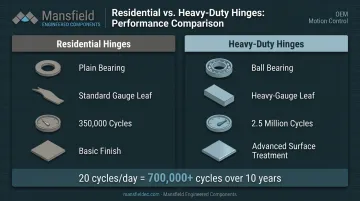
- ANSI/BHMA A156.1 specifies a heavy-weight 5-inch Grade 1 hinge at 0.190 ± 0.005 inches of leaf thickness — roughly double the gauge of a residential unit
- Anti-friction bearings: hardened steel ball bearing raceways, Oilite bearings, or self-lubricating nylon — each chosen for load, speed, and maintenance requirements
- Grade 1 commercial butt hinges must pass 2.5 million cycles under BHMA testing, compared to 350,000 for typical residential hardware
- Surface treatments matched to environment: zinc plating, powder coating, electropolishing, or passivation depending on corrosion exposure
- Tighter manufacturing tolerances — precision fit that prevents wear-induced play over time
A residential hinge runs plain bearings, light-gauge steel, and a 350,000-cycle rating. A heavy-duty equivalent uses ball bearings, heavier gauge, and 2.5M-cycle validation. For a door cycled 20 times a day in a commercial kitchen, that difference is the line between a 5-year service life and a warranty failure at month 14.
Types of Heavy-Duty Hinges
"Heavy-duty hinge" describes a performance category, not a single design. Several distinct hinge types fall within it, each optimized for different load types, motion requirements, and installation contexts.
Heavy-Duty Butt Hinges
The butt hinge is the most familiar form : two leaf plates joined by an interlocking knuckle and pin. In heavy-duty versions, the leaf plates are thicker gauge, the knuckle incorporates ball or roller bearings, and manufacturing tolerances are tighter than commercial-light or residential equivalents.
They distribute load across discrete mounting points and allow up to 180° rotation. Most are available in weld-on or screw-mount configurations, and in steel, stainless steel, or brass.
Best suited for:
- Heavy commercial doors and fire-rated openings
- Industrial enclosures and electrical panels
- Machinery covers and access doors
- Applications where visual exposure of the hinge is acceptable
One concrete sizing reference: a 6-inch heavy-weight ball bearing hinge can support a maximum door weight of 230 lb in high-frequency service (per Hager's BB1168 specification).
Strengths: Simple, versatile, widely available, proven in architectural and industrial use.
Limitation: Load concentrates at discrete mounting points. For very tall or wide panels under constant high-frequency use, a continuous hinge typically outperforms a set of butt hinges over the long term.
Continuous (Piano) Hinges
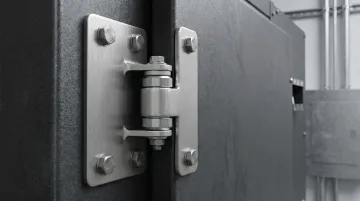
A continuous hinge (sometimes called a piano hinge) runs the full height or width of the door or panel. That single design choice changes the load math entirely: instead of concentrating stress at two or three hinge locations, load distributes along the entire mounting length.
ANSI/BHMA A156.26 covers architectural continuous hinges, with Grade 1 requiring 2.5 million cycles and load-code examples including a Grade 1 barrel hinge rated for a 300 lb door. Industrial-grade versions use gauges from 0.187 to 0.375 inches with pin diameters up to 0.625 inches and lengths up to 72 inches.
Best suited for:
- High-cycle commercial kitchen equipment
- Long access panels on industrial enclosures
- Cases, transport containers, and instrument enclosures
- Applications where sagging or racking over time is a concern
Strengths: Exceptional durability under high-cycle, high-weight conditions. Resistance to panel sag or racking is significantly better than discrete-point butt hinges.
Limitation: Alignment during installation must be exact. Also not suitable for applications requiring the door to open beyond approximately 270° or where full-panel disassembly access is needed.
Counterbalance Hinges
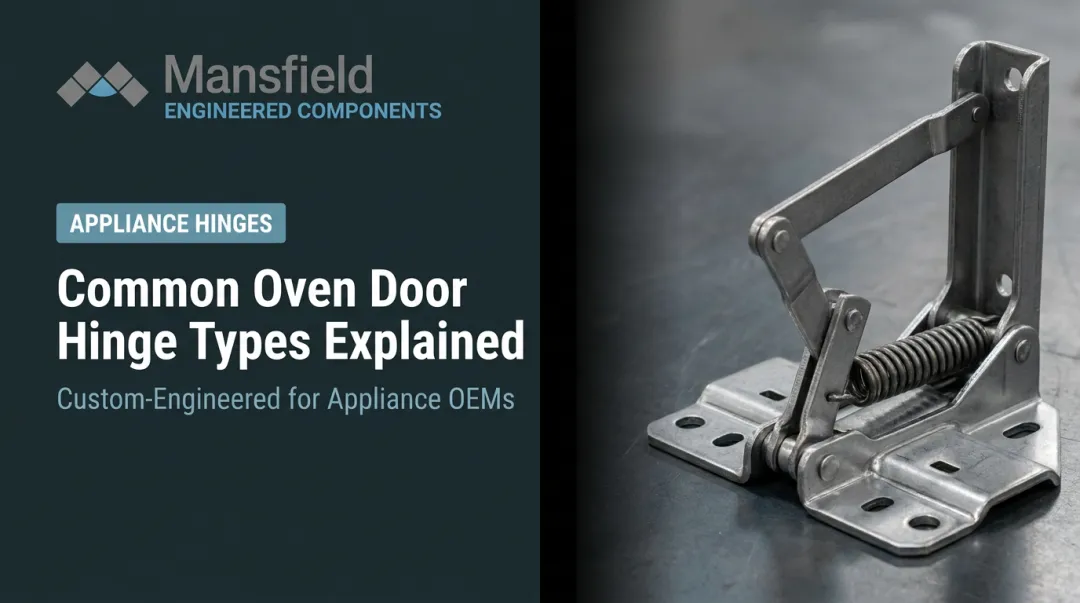
Counterbalance hinges are motion control assemblies, not simple pivots. Internal spring or cam mechanisms offset the weight of a lid or door, allowing it to open with minimal effort and hold position without a prop or support arm.
The mechanism stores energy in a torsion spring when the lid is closed, then releases that energy progressively during opening to neutralize the gravitational load. An 80 lb commercial kitchen exhaust cover that would otherwise require significant force to lift can be opened with one hand.
Southco documented a specific example where a counterbalance system reduced opening effort from 2.3 kg to 0.9 kg in a commercial kitchen application — a meaningful ergonomic improvement for operators performing that motion dozens of times per day.
Common applications include:
- Commercial oven doors and convection equipment lids
- Chest freezer and commercial refrigeration lids
- Centrifuge lids and medical equipment covers
- Industrial machinery access hatches
- Restaurant flip-up countertops
Strengths: Improved operator safety and ergonomics. Eliminates the risk of a heavy lid falling on a hand or causing strain injury — consistent with OSHA's recommendation for engineering controls as the preferred approach to reducing ergonomic hazards.
Limitation: Counterbalances require custom engineering. The torque profile must match the specific lid weight, center of gravity, and motion arc, which means an off-the-shelf counterbalance rarely fits an OEM application correctly.
Mansfield Engineered Components designs custom counterbalances for exactly this scenario, covering spring counterbalances, hydraulic counterbalances, and custom torque-curve mechanisms for appliance and industrial OEM customers. Their process includes in-house prototyping and cycle-life testing before any production tooling is cut.
Spring-Assist Hinges
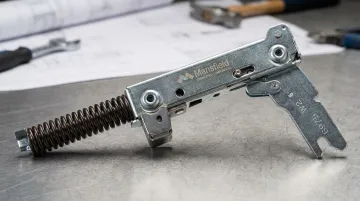
Spring-assist hinges incorporate a torsion or coiled spring mechanism to assist opening, closing, or both. The distinction from a full counterbalance is important: spring-assist hinges assist motion but don't fully offset weight. That makes them a more cost-effective option for moderate loads where some operator assist is needed but a full counterbalance would be over-engineering the problem.
ANSI/BHMA A156.17 covers self-closing hinges and pivots, with Grade 1 requiring 1 million cycles. Double-acting spring hinges can open in both directions and return automatically to closed — common in self-closing commercial doors and high-frequency pass-through applications.
Best suited for:
- Commercial appliance doors requiring assisted opening or closing
- Toolbox and equipment case lids
- Access panels and service doors
- Self-closing fire-rated doors (UL-listed spring hinges are available for openings up to 3-hour ratings)
Strengths: A practical balance between cost and function. Improves usability and reduces operator effort without the engineering complexity and cost of a full counterbalance system.
Limitation: Spring force is fixed at manufacture. The hinge is tuned for a defined weight range — if the lid weight changes after the design is locked, the hinge typically needs to be redesigned, with less flexibility than a custom counterbalance for iterating on load requirements.
Concealed (Hidden) Hinges
Concealed hinges are heavy-duty hinges where the mechanism disappears completely when the door or panel is closed. Mortised installation or internal mounting arms fold out of sight, leaving no visible hardware on the exterior face.
The security benefit is practical, not just aesthetic. According to JW Winco, concealed stainless hinges designed for tamper-resistant applications cannot be unhinged once assembled, and internal mounting prevents manipulation from outside the enclosure. There are no exposed pins to remove, and no leverage point for forced entry.
Mansfield engineers concealed hinges for appliance casework, medical casegoods, and industrial OEM applications where design requirements call for hardware that stays out of sight during normal use.
Best suited for:
- Premium commercial appliances and high-end refrigeration units
- Medical casegoods and hospital/clinical furniture
- Security enclosures and tamper-resistant panels
- Architectural doors where clean aesthetics are a design requirement
Strengths: Clean appearance, improved security (no exposed pins), and typically three-axis adjustability for precise door alignment during installation.
Limitation: Higher installation complexity, greater upfront cost, and maintenance requires the door to be open for access. Less suitable for very high-traffic abuse environments where exposed heavy-duty butt hinges or continuous hinges would hold up better to rough handling.
How to Choose the Right Heavy-Duty Hinge
The right hinge depends on reading the specific application requirements — not defaulting to familiarity or lowest unit cost.
Start With Load and Motion
- Calculate load per hinge based on door or lid weight and dimensions — heavier panels may need distributed support rather than discrete pivot points
- Define the required motion behavior: fixed hold-open angle (counterbalance), automatic return (spring-assist), full 180° swing (butt or continuous), or position-anywhere control (friction/torque hinge)
- Establish minimum cycle-life rating based on daily open/close frequency across the product's expected service life
Account for the Environment
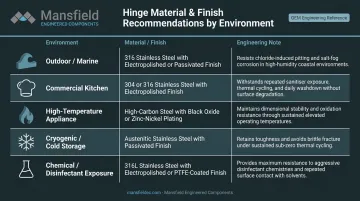
Environmental factors eliminate certain materials and finishes outright:
| Environment | Recommended Approach |
|---|---|
| Outdoor / marine | Stainless steel (304 or 316), anodized aluminum, or zinc-plated with powder coat |
| Commercial kitchen | NSF-certified stainless steel (NSF/ANSI 51 or NSF/ANSI 4 apply to food equipment) |
| High-temperature appliances | Review lubricant limits — standard lithium grease breaks down around 300°F; gas springs are often rated only to 176°F per Weber Knapp's design guidance |
| Cryogenic / cold storage | Avoid gas spring mechanisms; mechanical springs and counterbalances are more reliable at extreme cold |
| Chemical / disinfectant exposure | Stainless steel with electropolished or passivated finish for medical and lab applications |
Consider Aesthetics and Installation Constraints
Three practical constraints often narrow the field at this stage:
- Visibility: Concealed hinges require more precise panel geometry; exposed hinges simplify installation but affect finished appearance
- Attachment method: Welded mounting suits high-cycle industrial applications; fastened mounting allows field replacement
- Panel geometry: Mortised installation reduces protrusion but requires machined recesses; surface-mount works on flat panels without additional prep
For OEM applications where precise motion control is critical — appliance lids, medical equipment enclosures, or heavy industrial covers — working with a custom hinge engineering partner gets the design validated against real load and cycle requirements before production begins. Mansfield Engineered Components, for example, runs in-house prototyping, torque measurement across the full motion arc, cycle-life testing, and environmental validation before any tooling is approved.
Common Mistakes to Avoid When Selecting a Heavy-Duty Hinge
Price over performance. A lower-cost hinge that fails in the field creates warranty claims, replacement labor, and customer dissatisfaction that far exceeds the original savings. Specify to the application, not the budget line item.
Under-specifying cycle load. A commercial kitchen door opened 200 times per day accumulates 700,000 cycles over a 10-year product life. That eliminates plain-bearing or light-commercial hinges from consideration and requires Grade 1 ball-bearing hardware at minimum.
Over-specifying unnecessarily. Using a full custom counterbalance where a spring-assist would perform adequately adds cost and lead time without adding value. Match the mechanism to the actual requirement.
Ignoring corrosion exposure. Steel hinges without corrosion protection in commercial kitchen or outdoor enclosure applications are among the most common field failure triggers.
Overlooking thermal expansion. In high-temperature oven applications, thermal expansion can affect fit and function — an engineering check that's easy to skip and costly to discover after production.
Treating "heavy-duty" as a marketing label. Require measurable criteria: BHMA Grade, cycle-life rating, leaf gauge, bearing type, and documented door/panel weight capacity. If a manufacturer can't provide those specs, that's a signal.
Conclusion
Heavy-duty hinges are not interchangeable. Each type — butt, continuous, counterbalance, spring-assist, and concealed — is optimized for specific load conditions, motion requirements, and use environments. The right specification protects product performance and end-user safety. Field failures traced back to the wrong hinge type consistently cost far more to fix than getting the spec right from the start.
For engineers and product designers, the distinctions covered here translate directly into better first-pass specifications and fewer revision cycles downstream. For complex or high-volume OEM applications, custom-engineered solutions consistently outperform the closest standard catalog part — because the application requirements rarely fit neatly into a catalog. Mansfield Engineered Components designs and manufactures custom motion control components for exactly these situations, working from initial specification through prototype testing to production volume.
High volume is also where the commercial case turns. Heavy duty hinges bought in bulk amortize custom tooling quickly and attract volume price breaks, so compare the engineered option against the closest catalog part at your actual annual order quantity rather than at list price.
Frequently Asked Questions
What are the main types of heavy-duty hinges?
The five primary types are heavy-duty butt hinges, continuous (piano) hinges, counterbalance hinges, spring-assist hinges, and concealed hinges. Each serves a different application — from commercial doors and industrial enclosures to appliance lids, self-closing panels, and equipment where tamper resistance matters.
What is the strongest type of heavy-duty hinge?
"Strongest" depends on the load type. Continuous hinges distribute weight across a full panel edge; weld-on butt hinges deliver maximum strength at discrete points. For controlled motion under heavy loads, counterbalance hinges are purpose-built to manage torque across the full motion arc, not just bear static weight.
What is the difference between a heavy-duty hinge and a standard hinge?
Heavy-duty hinges use thicker leaf gauges, tighter tolerances, reinforced knuckles, and anti-friction bearings. The cycle life difference is significant: Grade 1 commercial hinges must pass 2.5 million cycles under ANSI/BHMA testing, compared to as few as 350,000 for plain-bearing commercial hinges.
What materials are heavy-duty hinges typically made from?
Steel, stainless steel, and aluminum are the most common choices. Steel suits dry indoor settings where maximum strength is the priority. Stainless steel (304 or 316) handles corrosion-prone environments — commercial kitchens, medical facilities, outdoor use — while aluminum serves lighter-load applications where corrosion resistance still matters.
Can heavy-duty hinges be used outdoors or in harsh environments?
Yes, with the right material and finish. Stainless steel, anodized aluminum, or powder-coated zinc-plated steel are standard choices for outdoor, marine, and high-humidity environments. For food equipment, verify NSF certification, and confirm that lubricants and any gas spring components are rated for your application's temperature range.