
Introduction: Why Soft-Close Hinges in Appliances Demand Engineering Precision
When a refrigerator door slams shut, the issue runs deeper than noise. That impact sends force directly into gaskets and seals, accelerating wear and creating warranty exposure for OEMs. In June 2022, Hisense recalled 55,278 French-door refrigerators after hinge failures caused doors to detach, resulting in 139 incidents and 5 injuries. Hinge specification is a safety-critical engineering task, not a commodity decision.
Yet when product engineers search for technical guidance on soft-close hinges, they encounter content written for homeowners and cabinet installers. Articles ranking high in search results address DIY retrofits, furniture applications, and consumer-grade hardware selection. Content addressing the unique demands of appliance OEM engineering—thermal cycling, cycle life validation, hydraulic damper fluid behavior—is absent from most search results.
This guide fills that gap. It's written for product engineers and design teams at appliance OEMs who need to understand how soft-close damping mechanisms work at a component level. It covers what performance parameters matter when writing a specification and how to avoid the costly mistakes that emerge when cabinet-grade hardware is applied to appliance use cases.
TLDR:
- Soft-close hinges use hydraulic dampers or spring mechanisms to decelerate doors in the final degrees of travel, preventing slamming
- Cabinet-grade cycle life standards (100,000 cycles) fall short of residential appliance demands (180,000+ cycles over 15 years)
- Hydraulic damper fluids are temperature-sensitive; silicone PDMS operates from -30°C to +250°C, making it suitable for extreme environments
- Specifications must cover cycle life, door weight/torque, temperature range, mounting geometry, and finish
- Custom-engineered hinges match damping curves to specific door weights and thermal environments — catalog parts don't
How Soft-Close Hinge Mechanisms Actually Work
Soft-close hinges control a door's motion by converting kinetic energy into manageable output (heat in hydraulic systems, stored energy in spring systems) rather than allowing that energy to transfer as impact force into the frame, latch, and gasket. The term "soft-close" describes behavior at end-of-travel, not across the entire arc. The door moves freely through most of its swing; damping engages only in the final degrees of closing.
Hydraulic (Fluid Damper) Mechanism
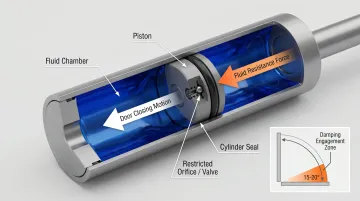
A hydraulic damper uses a piston moving through viscous fluid inside a sealed cylinder. As the door nears closure, fluid is forced through a restricted valve or orifice, creating resistance proportional to velocity. The faster the user pushes the door, the greater the resistance— a self-regulating quality that matters in appliances where closing force varies widely between users.
Key design variables:
- Orifice size and fluid viscosity determine the damping curve
- Designers tune these parameters to achieve soft-close engagement at a specific angular position and target closing force
- Fluid viscosity changes with temperature, a critical consideration for oven doors or appliances in extreme ambient conditions
Silicone PDMS fluids operate from -30°C to +250°C, with short-term tolerance to +300°C. This wide range makes silicone the only viable damping fluid class spanning oven-proximity and freezer environments. Viscosity grades range from 0.65 cSt to 1,000,000 cSt; medium and high viscosity grades (50–100,000 cSt) are typically specified for rotary damper applications.
Temperature effects on performance:
The damping force follows F = c × v (force equals damping coefficient times velocity). Real-world dampers are tuned via shaped orifices to produce F = c × v^α, where α typically falls between 0.3 and 1.0.
Temperature shifts that range directly with viscosity changes: higher heat reduces damping resistance; sub-zero conditions cause sluggish response. Industry testing protocols require validation at -20°C and +60°C, with pass criteria set at ≤30% damping torque variation from baseline.
Spring-Assisted and Torsion Spring Mechanisms
Spring-based soft-close systems store energy during the opening arc and release it in a controlled way to decelerate the door near closure. Torsion springs are common in integrated hinge assemblies; separate spring-damper combinations are also used. Spring mechanisms are generally less sensitive to temperature variation than hydraulic fluid, making them preferable in high-heat or sub-zero appliance environments.
Advantages:
- Consistent performance across wide temperature ranges
- No risk of fluid leakage
- Simpler sealing requirements
Tradeoffs:
- Less tunable damping curves compared to hydraulic systems
- May require more mounting space for larger springs
Integrated vs. Add-On Damping
Integrated damping means the soft-close mechanism is built into the hinge body as a single assembly. Add-on dampers attach to an existing hinge or door frame. For appliance OEM design, integrated soft-close hinges are almost always the correct choice:
- Consistent performance across production runs
- Smaller mounting footprint
- Single component for quality control
- Designed to handle appliance-specific thermal and cycle-life requirements
Add-on dampers are more common in aftermarket or retrofit contexts, where they're applied to existing furniture or cabinetry. They're typically not rated for appliance thermal environments or cycle life demands.
Soft-Close vs. Self-Close vs. Counterbalanced: Understanding the Differences
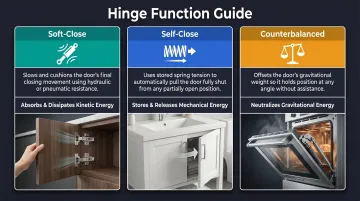
These three terms are frequently confused or used interchangeably, but they describe distinct engineering functions:
| Function | Definition | Energy Handling |
|---|---|---|
| Soft-Close | Controlled deceleration near end-of-travel to prevent slamming | Dissipates kinetic energy via damper |
| Self-Close | Spring actively pulls door to closed position once it passes a threshold angle | Direct spring force; energy transfers to frame on impact |
| Counterbalanced | Mechanism offsets door weight across the arc of travel, reducing effort required to hold or move the door | Stores and releases energy to reduce user effort |
When Each Function Is Specified
Self-close is appropriate where the door must positively latch and the user should not need to push it closed. Example: dishwasher doors that must engage a latch mechanism to start a cycle.
Soft-close is the right call when noise, user experience, and hardware longevity are the primary drivers. It prevents slamming regardless of how hard the user pushes, but does not actively pull the door closed.
Counterbalancing is appropriate for heavy or horizontal-opening doors where the door's weight would otherwise create unsafe or fatiguing operation. Examples: oven drawer doors, pull-down dishwasher fronts, and heavy oven doors. Counterbalance technology can reduce user effort from 2.3 kg to 0.9 kg, or from 60 lb to 3 lb for a 200 lb panel.
Combined Function Specifications
In appliance design, these functions often coexist in the same door system. A heavy oven door may use a counterbalance mechanism to manage door weight across the full open arc and a separate soft-close damper to control the final closing motion. They are complementary, not interchangeable — but that combination introduces a tuning dependency engineers need to account for:
- A counterbalance set too aggressively can oppose the soft-close damper, producing inconsistent closing behavior
- Mismatched tuning accelerates damper wear, shortening the mechanism's service life
- Both systems must be validated together, not independently
Where Soft-Close Hinges Are Specified in Home and Commercial Appliances
Residential Appliance Applications
Refrigerator doors: Consistent sealing is critical; slamming damages door gaskets and can stress the compressor. Americans open their refrigerators 33 times per day on average, accumulating approximately 180,000 cycles over a 15-year lifespan—already exceeding ANSI/BHMA A156.9 Grade 1 cabinet hinge ratings of 100,000 cycles.
Oven doors: Thermal cycling, door weight, and high user force are the main challenges. Hinges are exposed to elevated ambient temperatures during and after oven use, requiring materials and damping fluids that maintain performance at high heat.
Dishwasher doors: Horizontal-opening doors with heavy tub weight require coordinated soft-close and counterbalance systems to prevent slamming and reduce user effort.
Integrated appliance panels: Decorative panels add significant weight to appliance doors, changing the door's center of gravity and torque profile. Soft-close mechanisms must be spec'd to the actual installed weight, not the base appliance door.
Commercial Appliance Applications
Commercial ovens, combi-ovens, and pass-through dishwashers operate in environments with higher use frequencies, greater door weights, and more aggressive user interaction. These conditions push well beyond residential-grade cycle life standards, which drives fundamentally different specification requirements.
Cycle demands: High-traffic commercial applications cycle 50+ times per shift, accumulating over 36,500 cycles annually in a two-shift operation. Over a 10-year equipment life, this approaches 365,000 cycles—far exceeding cabinet-grade cycle life standards.
Material requirements: Commercial foodservice equipment must comply with NSF/ANSI 51 material standards, typically requiring Type 304 or 316 stainless steel for corrosion resistance and hygiene.
Emerging Applications
Beyond mainstream appliances, soft-close specification is expanding into specialty segments where closing behavior directly affects user experience or safety:
- Medical casegoods: Require surface treatments that withstand frequent disinfectant cleaning, plus quiet, controlled closing that doesn't disturb patient areas
- Warming drawers: Low-force, consistent closing prevents heat loss and protects door seals across thousands of daily cycles
- Wine coolers: Vibration-sensitive contents make slam prevention a product quality issue, not just a durability concern
Key Parameters to Include When Specifying a Soft-Close Appliance Hinge
Cycle Life Rating
Cycle life is the most critical spec variable for appliance hinges and is frequently under-specified. A hinge that meets ANSI/BHMA cycle life standards for cabinet hardware is not necessarily rated for appliance use.
Standards comparison:
- ANSI/BHMA A156.9 (cabinet hardware): 100,000 cycles
- ANSI/BHMA A156.1 (architectural doors): 2,500,000 cycles
The architectural door standard requires 25 times the cycle life of the cabinet standard. Residential appliances fall between these benchmarks, while commercial equipment may approach or exceed architectural door demands.
Calculating your requirement:
- Estimate daily door cycles based on usage data
- Multiply by 365 days
- Multiply by product service life (typically 10-15 years for residential, 10+ for commercial)
- Add a safety margin (20-30% minimum)
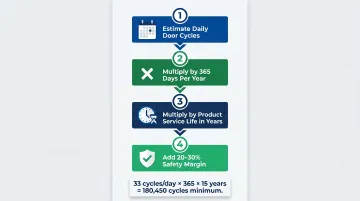
Residential refrigerators cycling 33 times daily over 15 years require hinges rated for at least 180,000 cycles. Commercial equipment cycling 50 times per shift across two shifts requires 365,000+ cycles over 10 years.
Door Weight and Torque Loading
The soft-close mechanism must be matched to the door's actual weight and the torque loads generated at the hinge mounting points. An under-damped hinge (spec'd for too light a door) will not slow a heavy appliance door. An over-damped hinge will cause the door to feel stiff or fail to fully latch.
Torque calculation:
Torque = Weight × Distance (pivot to center of gravity) × cos(Angle)
- If weight is evenly distributed, the center of gravity distance equals half the panel length
- At 0° (horizontal), cos(0) = 1, producing maximum torque
- As the panel moves toward vertical, torque decreases
Engineers should calculate door torque based on:
- Door weight (including any decorative panels or integrated components)
- Center of gravity location
- Hinge mounting geometry
- Number of hinges per door
Operating Temperature Range
Hydraulic dampers use fluid that changes viscosity with temperature — thicker at low temperatures (reducing damping effect) and thinner at high temperatures (potentially weakening damping or causing seal failure). Temperature range at the hinge location must be specified, not just ambient room temperature.
Specify:
- Operating temperature range at the hinge location, not just ambient room temperature
- For oven door hinges: ambient temperature during and after use (may exceed 80°C)
- For refrigerator hinges: cold environment performance (down to -5°C or lower for garage installations)
- For freezer applications: performance at -20°C or below
Industry damper testing protocols validate performance at -20°C (low) and +60°C (high), with pass criteria requiring torque variation ≤30%. Silicone PDMS fluids are the only class offering consistent performance from -30°C to +250°C.
Mounting Envelope and Integration Constraints
Appliance hinge designs frequently require custom geometry that off-the-shelf cabinet hinges cannot satisfy. Document the full mounting envelope early — geometry constraints that surface late in development typically force costly redesigns.
Key dimensions to document:
- Cup hole diameter (if applicable)
- Mounting hole pattern and fastener type
- Projection from door face
- Required opening angle (90°, 110°, 120°, etc.)
- Clearance constraints around hinge location
- Door panel thickness and material
Material and Finish Requirements
Appliance environments impose specific material requirements:
- Dishwasher and refrigerator applications: Corrosion resistance required; specifying zinc die-cast hinges in high-humidity dishwasher environments is a common field failure mode
- Oven applications: Heat tolerance; materials must maintain strength and dimensional stability at elevated temperatures
- Commercial foodservice: NSF/ANSI 51 compliance; Type 304 or 316 stainless steel is standard
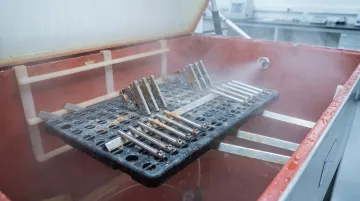
Salt spray testing: ASTM B117 is the standard method for assessing corrosion resistance. Test durations range from 24 to over 1,000 hours. Type 316 stainless steel passes 96-hour tests at 3% NaCl; Type 304 may be satisfactory for up to 120 hours at reduced 0.3% concentration.
Adjustability and Serviceability
Specify whether the hinge needs field adjustment of door position (height, depth, side-to-side) and/or damping force. Built-in installations are the most demanding case: alignment tolerances are tight, access is limited, and field adjustability can mean the difference between a 10-minute installer correction and a service call. Document serviceability requirements at the same time as dimensional constraints.
Common Soft-Close Spec Mistakes in Appliance Design
Applying Cabinet Hinge Specifications to Appliance Applications
The most frequent mistake engineers make is sourcing soft-close hinges from suppliers used for furniture or cabinet hardware, without verifying that the damping mechanism, cycle life rating, and material specifications are appropriate for appliance use cases.
The 25x cycle life gap: ANSI/BHMA A156.9 Grade 1 cabinet hinges are tested to 100,000 cycles. A residential refrigerator exceeds this in under 9 years. Cabinet-grade hardware is designed for lighter use that doesn't reflect what happens with heavier equipment or repeated use.
Under-spec'd hardware in heavy-duty applications leads to:
- Structural failure over time
- Loosening of hardware and fasteners
- Increased vibration and noise
- Accelerated wear at contact points, frames, and latch points
Ignoring the Thermal Effect on Hydraulic Dampers
A hinge tested at room temperature may perform very differently on an oven that has been in use for two hours or a refrigerator accessed in a cold garage. Hydraulic fluid viscosity is temperature-dependent.
Documented failure modes:
- Summer slam — oil thins in high heat, stripping damping resistance and letting the door fall shut
- Winter freeze — oil thickens in cold environments; the lid sticks open or closes too slowly to engage the latch
Engineers should require performance testing across the full operating temperature range, not just at ambient. Premium dampers use high-viscosity-index silicone oil to maintain performance across -20°C to +80°C, with typical torque tolerance of ±15%.
Failing to Specify the Full System
Component-level failures get most of the attention, but system-level mismatches cause just as many problems. Specifying a soft-close hinge without defining how it interacts with the door latch, counterbalance mechanism, and mounting structure results in integration problems late in development. Engineers must coordinate the soft-close engagement angle, closing force, and final latch engagement from the start.
Critical integration points:
- Latch engagement force and position
- Counterbalance torque profile
- Mounting structure stiffness
- Door seal compression force
Working with a Hinge Manufacturer to Specify the Right Solution
Why Off-the-Shelf Rarely Solves Appliance Engineering Problems
The unique combination of door weight, thermal environment, cycle life requirement, and integration geometry in most appliance applications means that a truly optimized soft-close hinge is custom-engineered for the application, not selected from a catalog.
Information to bring to an initial conversation with a hinge manufacturer:
- Door weight and dimensions (including decorative panels or integrated components)
- Hinge count per door
- Required opening angle
- Operating environment (temperature range, humidity, corrosive exposure)
- Cycle life target (calculated from usage data and service life)
- Adjustability requirements
- Material and finish constraints (NSF compliance, corrosion resistance, etc.)
Mansfield Engineered Components' Approach
With over 80 years of experience designing motion control components for appliance OEMs, Mansfield Engineered Components (MEC) custom-designs each hinge solution for the specific application and validates performance before production.
Engineers can engage MEC's team early in the design process to define specifications collaboratively — catching integration problems before validation, not during it. MEC ships over 250,000 motion control components per week to customers including Sub-Zero, GE/Haier, Bosch, Electrolux, Wolf, and Whirlpool.
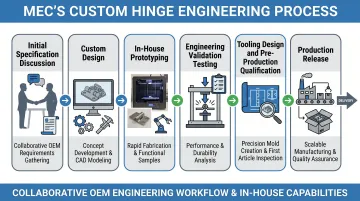
Collaborative engineering process:
- Initial specification discussion — door weight, thermal environment, cycle life, integration constraints
- Custom design — torque curve matching, material selection, damper tuning
- In-house prototyping — build and test prototypes before tooling commitment
- Engineering validation testing — cycle life, temperature, torque measurement, environmental exposure
- Tooling design and pre-production qualification
- Production release with documented performance data
The Value of Prototype and Testing Collaboration
A qualified hinge manufacturer should produce and test prototypes against the engineer's specification before committing to tooling. Documented performance data — cycle life test results, torque curves, temperature testing — should be delivered as part of the design package, not requested after the fact.
MEC's in-house prototyping and testing capability eliminates external lab handoffs and compressed development timelines, giving OEM engineers room to iterate on design changes without waiting on third parties.
Validated designs then move into volume. Soft-close hinges are supplied in bulk against a production plan, with programs running from about 5,000 pieces to 5,000,000 or more per program and unit pricing improving at each tier, so the documented test data and the bulk supply terms arrive together.
Frequently Asked Questions
How does a soft-close hinge work?
A soft-close hinge uses a hydraulic damper or spring mechanism to decelerate the door in the final degrees of closing travel, absorbing the kinetic energy that would otherwise cause slamming. The result is a controlled, quiet close regardless of how much force the user applies.
Why do soft-close hinges fail in appliance applications?
Common causes include:
- Worn or degraded hydraulic damper fluid from thermal cycling
- Damping mechanism mis-specified for the actual door weight
- Misalignment that prevents the damper from engaging at the correct point in the closing arc
- Damper exceeding its rated cycle life
Can soft-close hinges be retrofitted into an existing appliance design?
Retrofitting is rarely straightforward. The door geometry, weight, and thermal environment of an existing appliance often aren't compatible with aftermarket dampers. The preferred approach is working with an appliance hinge manufacturer to engineer a drop-in replacement built to the original application's requirements.
What is the difference between soft-close and self-close hinges in appliances?
Self-close hinges actively pull the door closed once it passes a certain angle, while soft-close hinges decelerate the door near the end of travel to prevent slamming. Many appliance hinges combine both functions, and the two terms are frequently used interchangeably, though they describe distinct behaviors.
What cycle life should I specify for a soft-close appliance hinge?
Start by defining your expected daily use rate and product service life, then calculate the minimum cycle rating from those numbers. Residential appliances typically require tens of thousands of cycles; commercial equipment often demands hundreds of thousands. Build in a 20–30% safety margin above your calculated minimum.
How do temperature extremes affect soft-close hinge performance?
Hydraulic dampers are temperature-sensitive—cold temperatures increase fluid viscosity and reduce damping effect, while high temperatures (near oven doors) can thin the fluid or stress seals. Engineers should specify and test hinges across the full operating temperature range, and may prefer spring-based damping mechanisms in extreme thermal environments.