
For product designers and OEM engineers in appliances, commercial equipment, transportation, and industrial sectors, counterbalance hinges solve a critical problem: how do you make heavy lids, doors, and covers effortless and safe to operate without compromising product reliability or user experience?
This article answers two key questions: what a counterbalance hinge is and when your product actually needs one.
Key Takeaways
- Counterbalance hinges offset panel weight using springs or mechanical geometry—keeping heavy doors and lids controlled without slamming
- Applications span appliances, commercial kitchens, medical devices, industrial machinery, and transportation equipment
- You need one when uncontrolled motion creates safety risks, user fatigue, or product damage
- Mechanical spring, gas spring, and hydraulic designs each suit different load levels and operating environments
- Custom engineering matches the hinge to specific weight, geometry, and cycle life requirements
What Is a Counterbalance Hinge?
A counterbalance hinge is a specialized mechanism that uses an internal spring system to fully or partially offset the weight of a pivoting load—such as a lid, door, or cover—so users experience controlled, effortless motion instead of fighting gravity.
Unlike a standard hinge, which simply allows rotation without weight compensation, a counterbalance hinge actively resists gravity. A standard hinge transfers 100% of the load to the user. A counterbalance hinge can reduce that perceived effort to 5%, or any level the designer specifies.
An 80-lb lid, for example, can be tuned to feel like only 5 lbs at the handle. The designer controls how much perceived weight remains: some products call for near-zero effort, while premium appliances deliberately retain a slight resistance to signal quality through touch.
Why concealment matters: That tuned feel also shapes how the product is perceived visually. Counterbalance mechanisms are typically hidden inside panels or enclosures, so end users experience the smooth motion without any visible hardware — which is why product designers treat concealment as a functional requirement, not just an aesthetic preference.
Horizontal vs. vertical loads:
- Horizontal pivoting loads (lids opening upward) are most impacted by gravity and require counterbalancing to prevent drop or slam
- Vertical pivoting loads (side-swinging doors) are less affected by gravity; spring assist helps with closing but counterbalancing is typically unnecessary
How Does a Counterbalance Hinge Work?
The fundamental principle: a spring applies force on a moment arm (lever) inside the mechanism. As the spring expands during opening, the lever geometry changes to match the gravitational torque on the lid, producing near-constant, controlled opening force throughout the arc of motion.
The variable pulley method offers an alternative: the pulley increases or decreases in effective size as the spring expands, matching the spring rate to the changing gravitational force. This delivers smooth, consistent feel across the entire motion range.
Both approaches give engineers precise control over how the lid feels in use. The system can be tuned to:
- Eliminate almost all perceived weight for effortless operation
- Retain some tactile feedback for a premium, controlled feel
- Adjust closing behavior—lids can stay open at set positions, coast gently to closed, or pop slightly when unlatched
These decisions are locked in during the design phase through geometry selection and spring specification—which is why getting the engineering right early matters.
Types of Counterbalance Hinge Systems
Mechanical Counterbalance Hinges
Mechanical systems use springs, levers, and cam geometry to counteract gravity. They do not rely on external fluids or gases, making them highly reliable and unaffected by temperature or pressure extremes.
Key advantages:
- Reliable in extreme temperatures (-30°C to +200°C environments)
- No pressure loss or seal degradation
- High cycle life (Grade 1 commercial hinges are tested to 2,500,000 cycles under ANSI/BHMA A156.1-2025)
- Ideal for commercial appliances, industrial equipment, and aerospace applications
Mansfield Engineered Components specializes in custom mechanical counterbalance hinges for exactly these demanding applications, offering spring counterbalances, constant-force counterbalances, and custom torque-curve systems tuned to specific requirements.
Understanding where mechanical systems excel becomes clearer when compared directly against gas spring and hydraulic alternatives.
Mechanical vs. Gas vs. Hydraulic: A Brief Comparison
| Type | Mechanism | Advantages | Limitations |
|---|---|---|---|
| Mechanical | Springs + levers/cams | Temperature-stable, high cycle life, no leaks | Larger packaging in some designs |
| Gas Spring | Compressed gas + piston | Smooth force, compact form factor | Force changes ~3.5% per 10°C; leaks disable function |
| Hydraulic | Hydraulic fluid + cylinder | Very high load capacity, precise damping | Complex, heavy, requires maintenance |
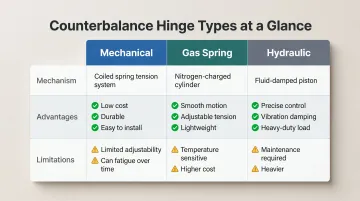
One detail worth noting on gas springs: temperature affects performance significantly. A spring calibrated at 20°C delivers roughly 20% more force at -30°C and 20% less at +80°C. Seal degradation and nitrogen permeation gradually reduce holding force over time.
When Do You Need a Counterbalance Hinge?
Safety Trigger: Preventing Injury and Impact Damage
Uncontrolled closing is a legitimate safety hazard. A heavy lid slamming shut can crush fingers, damage nearby equipment, or crack the component itself. Repeated impact also accelerates wear: cracking welds, tearing gaskets, and denting seals long before their design life ends.
For OEM designers, eliminating impact loading is both a liability argument and a direct ROI case — fewer warranty claims, longer service intervals, lower field failure rates.
Ergonomic Trigger: Reducing Operator Fatigue
In high-cycle environments — commercial kitchens, medical labs, industrial workstations — lid-opening effort accumulates into real musculoskeletal load across a shift.
The Revised NIOSH Lifting Equation establishes a 51-lb (23 kg) baseline as the maximum acceptable weight under ideal conditions. Lifting Index values above 1.0 indicate increased musculoskeletal risk. Equipment with lids approaching or exceeding this threshold should incorporate counterbalance mechanisms to stay within safe force limits.
ISO 11228-1:2021 provides ergonomic recommendations for manual handling tasks, reinforcing the importance of reducing repetitive lifting loads.
Product Longevity Trigger: Reducing Wear and Tear
A heavy door slamming shut dozens of times daily stresses welds, gaskets, and structural components. Research shows that cyclic loading accelerates fatigue crack propagation in steel joints, and mechanical joints subject to repeated impact degrade faster than those under controlled motion.
Controlled motion is, in effect, a maintenance reduction strategy built into the design itself.
Design Quality Trigger: Motion as a Product Feature
In premium appliances, hospitality furniture, and high-end commercial equipment, motion behavior is part of the product experience — and buyers notice it.
Brands like Sub-Zero, Thermador, and commercial kitchen OEMs use counterbalance hinges specifically because smooth, quiet operation is part of what they're selling. In categories where competitors offer similar specs, how a door opens and closes can be a genuine differentiator at the point of sale.
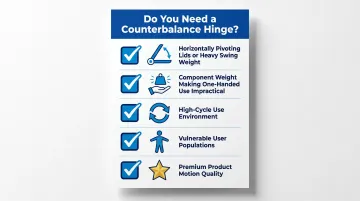
Decision Checklist for Product Designers
Consider a counterbalance hinge if your design involves:
- Horizontally pivoting lids or doors with significant swing weight
- Component weight that makes one-handed operation impractical
- High-cycle use environments (commercial kitchens, labs, industrial workstations)
- Users who include elderly, pediatric, or injury-prone populations
- Premium product lines where motion quality is part of the brand promise
Industries and Applications That Use Counterbalance Hinges
Home and Commercial Appliances
- Oven doors (drop-down mechanisms with controlled opening)
- Refrigerator lids (horizontal-opening chest freezers)
- Commercial warming drawers
- Washing machine lids (lift-assist mechanisms)
The major appliances market was valued at $395.1 billion in 2024, with refrigerators holding a 25% revenue share. At that scale, appliance brands require counterbalances that survive tens of thousands of open/close cycles, perform in extreme temperatures, and fit within tight dimensional envelopes.
Commercial Kitchen and Hospitality
- Flip-up bar tops and pass-through counters
- Smoker and grill lids
- Food prep tables with lift-up access panels
- Commercial refrigeration equipment
The commercial foodservice equipment market reached $37.08 billion in 2026, and commercial refrigeration hit $51.26 billion in 2025. In commercial kitchens, a hinge that fails after 50,000 cycles isn't a minor inconvenience — it's a service call during peak hours. That cycle count and exposure to grease, heat, and moisture is precisely what drives the counterbalance specification.
Medical and Laboratory Equipment
Medical equipment places some of the most demanding counterbalance requirements across any vertical. Access covers on centrifuges can exceed 80 lbs, and ULT freezer doors must open and close smoothly in environments that hover near -80°C.
- Centrifuge lids (often exceeding 80 lbs)
- Ultra-low-temperature (ULT) freezer doors
- Vacuum chamber access covers
- Medical casegood cabinet doors
Equipment used more than 25 times per day needs a counterbalance engineered for that specific cycle load — not a general-purpose solution. The medical furniture market is projected to reach $53.70 billion by 2026.
Industrial and Transportation
- Toolbox lids and cargo trailer decking panels
- Tonneau covers for pickup trucks
- Hood and deck lid assists
- RV cowlings and access covers
The U.S. truck bed accessories market was valued at $2.56 billion in 2024, with automotive tonneau covers reaching $1.02 billion globally in 2023.
Counterbalance hinges also appear in applications well beyond heavy industrial equipment — ergonomic office furniture, Murphy bed mechanisms, and tanning beds all use them where a lid or panel needs to open predictably and stay put without a user holding it open.
Key Design Considerations for Counterbalance Hinges
Primary Engineering Inputs
Counterbalance performance starts with accurate specifications. Engineers must define:
- Load weight and center of gravity relative to the pivot point (torque calculation)
- Desired opening force at the handle
- Arc of motion (total degrees of travel)
- Target cycle life (expected number of open-close cycles)
Of these, center of gravity is the most consequential. Inaccurate load geometry is the most common cause of poor counterbalance performance.

Secondary Considerations
Environmental and material requirements:
- Corrosion resistance for outdoor grills, marine environments, and food service (316L stainless steel recommended)
- Temperature range: mechanical systems handle -30°C to +200°C; gas springs require special seals above +80°C — relevant for oven-adjacent components or cold storage
- Space constraints for hidden hinge packaging within thin panels
- Finish requirements for aesthetics and durability (ASTM B117 salt spray testing establishes corrosion benchmarks; commercial-grade finishes require 96–200 hours without red rust)
Custom Design Is Often Necessary
Off-the-shelf hinges are built to general tolerances, not the specific load, geometry, and cycle life of a given product. Mansfield Engineered Components' engineering team works directly with OEM designers — from initial spec through prototype testing — to develop counterbalance solutions where motion behavior is validated against real product conditions before production begins.
Custom does not mean small quantity. Counterbalance hinges are normally supplied in bulk against a production schedule, with programs running from about 5,000 pieces to 5,000,000 or more per program and unit pricing improving at each volume tier — so the validated design and the bulk order terms can be settled together.
Frequently Asked Questions
What is a counterbalance hinge?
A counterbalance hinge is a specialized mechanism using springs and mechanical geometry to offset the weight of a pivoting load, making heavy lids or doors easier to open and preventing uncontrolled slamming.
Are anti-slam hinges worth the cost?
Yes, for most heavy-lid applications. The upfront cost is offset by reduced product liability exposure, longer component service life from eliminated impact damage, and measurably better user experience. For products with heavy or frequently cycled lids and doors, the ROI case is straightforward.
What are the 4 types of hinges?
Common hinge categories include butt/standard, continuous/piano, spring, and counterbalance/motion control hinges. Counterbalance hinges are purpose-built for applications where weight management and controlled motion are the primary design requirements.
How is a counterbalance hinge different from a standard hinge?
A standard hinge only enables rotation and offers no weight compensation, while a counterbalance hinge uses internal springs and geometry to actively offset gravity—so the user lifts a fraction of the actual load weight.
What weight threshold requires a counterbalance hinge?
There is no universal weight cutoff, but counterbalancing becomes important when a lid or door creates injury risk, operator fatigue in high-cycle settings, or component damage from slamming. In practice, lids exceeding 15–20 lbs on frequently accessed equipment are common trigger points—though torque requirements at the pivot, not raw weight alone, determine the final specification.
Need a custom counterbalance hinge solution? Mansfield Engineered Components designs and manufactures mechanical, gas spring, and hydraulic counterbalance systems tailored to your exact specifications. Contact the engineering team at jim.collene@mansfieldec.com or +1.419.524.1300 to discuss your application.