Introduction
An oven door hinge does far more than connect door to chassis. It carries the full weight of the door, controls how that weight shifts through every degree of opening, and maintains the compression needed for a proper thermal seal — reliably, across the appliance's entire service life.
For appliance OEMs, hinge selection carries real downstream consequences. The wrong choice means door sag, heat loss, slamming, and warranty exposure. The right one delivers consistent performance and the tactile quality users associate with a well-built product.
This article covers the most common oven door hinge types: how each works mechanically, where each fits best, and what tradeoffs matter most when specifying one for your application.
Key Takeaways
- Oven door hinges are engineered motion control systems that manage load, movement, sealing pressure, and safety
- Five primary types exist: spring-loaded, compression/counterbalanced, self-closing, continuous/piano, and concealed
- The right type depends on door weight, cycle frequency, installation space, motion requirements, and whether the application is residential or commercial
- Mismatched hinge selection causes poor sealing, premature wear, and costly redesign
- Standard off-the-shelf components frequently can't meet OEM spec — custom-engineered solutions are often necessary
What Is an Oven Door Hinge?
An oven door hinge is a mechanical system that connects the oven door to the appliance chassis and governs the full range of door motion — opening, holding position, and closing.
Modern oven door hinges are not simple leaf-and-pin designs. They are assembled systems combining several functional elements:
- Spring mechanisms (extension or compression) to counteract door weight
- Cam structures to manage motion through the opening arc
- Friction or damper elements to control closing speed and feel
- Arm geometry (short arm vs. long arm) that determines how force is applied and where the hinge mounts
The hinge defines how the door feels when you open it, how reliably it closes and seals, and how consistently it performs across tens of thousands of open/close cycles throughout the appliance's service life. Each of those performance characteristics traces back to a specific hinge type — and the differences between them matter well before a design goes to tooling.
Why Oven Door Hinges Are Critical in Appliance Design
A hinge system must do several things simultaneously: carry the door's weight, control its motion through the entire arc, and maintain the compression needed for a proper thermal seal. Failure in any one of these functions has consequences that go beyond the hinge itself.
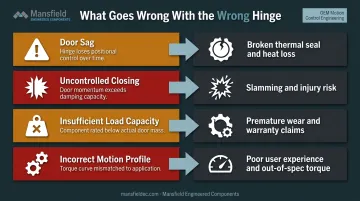
What Goes Wrong With the Wrong Hinge
| Failure Mode | Downstream Effect |
|---|---|
| Door sag | Broken thermal seal, heat loss, energy waste |
| Uncontrolled closing | Slamming, injury risk, door damage |
| Insufficient load capacity | Premature wear, hinge failure, warranty claims |
| Incorrect motion profile | Poor user experience, out-of-spec torque |
ASTM F1496-13 specifically identifies door seals as a design factor affecting idle energy rate in commercial convection ovens, drawing a direct line between hinge performance and energy efficiency.
UL 197 takes it further, codifying door-edge force stability tests and movable-member endurance requirements for commercial cooking appliances — requirements that treat door motion as a first-class safety and performance concern.
For OEM product development, hinge decisions made early in the program directly shape assembly complexity, variant count across a product line, and total system cost. Getting the specification wrong at the design stage rarely gets cheaper to fix later.
Common Types of Oven Door Hinges
Oven door hinges are not interchangeable. The right type depends on door weight and geometry, motion requirements, installation constraints, and whether the application is residential, built-in, or commercial grade.
Spring-Loaded (Extension Spring) Hinges
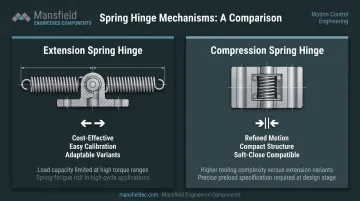
Extension spring hinges generate force through elongation. As the door opens, the springs stretch and create resistance; as it closes, they assist in returning the door toward the sealed position. The counterbalancing force is generated externally along the spring's length, which makes it straightforward to tune for different door weights.
Best suited for:
- Standard residential and mid-range ovens
- Platforms requiring calibration across multiple door weight variants
- Cost-sensitive programs where design flexibility matters
Strengths:
- Cost-effective and widely manufacturable
- Easier to calibrate across door weight ranges
- Adaptable across platform variants
Trade-offs:
- Requires more installation space than compression systems
- May not deliver the refined motion feel expected in premium appliances
Compression Spring / Counterbalanced Hinges
Compression spring hinges generate force within a compact internal structure. The spring compresses as the door opens, storing energy that controls the door's descent and assists closing. As described in US3712287A, this counterbalancing force can be adjusted by interchanging springs — making the system adaptable to heavy or light doors without changing the overall hinge architecture.
These systems are commonly paired with friction or damper elements to smooth motion further, and they form the mechanical basis for most counterbalanced hinge designs in premium oven applications.
That engineering complexity is also where custom manufacturing expertise matters most. Mansfield Engineered Components designs and manufactures custom-engineered spring and counterbalanced hinge systems specifically for appliance OEMs requiring precise motion control, including oven door counterbalances tuned to specific torque profiles.
Best suited for:
- Premium residential ovens with heavy glass doors
- Built-in ovens with tight chassis constraints
- Applications requiring refined, controlled door motion
Strengths:
- Controlled, stable movement through the full arc
- Compact force generation fits tight chassis designs
- Integrates well with soft-close or damped motion systems
Trade-offs:
- More complex manufacturing than extension spring alternatives
- Higher component cost
Self-Closing Hinges
Self-closing hinges incorporate an internal mechanism — typically spring-based — that automatically returns the door to the closed position once released past a defined angle. The mechanism activates at a specific point in the door's travel arc, pulling it fully closed without user effort.
This is distinct from a standard counterbalanced hinge, which manages door weight throughout the arc but doesn't actively drive closure. A true self-closing mechanism is calibrated to engage at a set angle and complete the closure stroke reliably.
Bosch's QuietClose hinge system — which softly guides the door shut and prevents slamming — is a commercial example of controlled-closing hinge behavior applied to a premium residential product.
Best suited for:
- High-traffic commercial kitchens where hands-free operation matters
- Residential ovens where consistent sealing and energy efficiency are priorities
Strengths:
- Ensures positive door closure, reducing heat loss from improperly latched doors
- Reduces user error in demanding operating environments
Trade-offs:
- Adds mechanical complexity
- Requires precise calibration to prevent slamming or excessive closing force
Continuous / Piano Hinges
A continuous hinge runs the full height of the oven door, distributing the door's weight evenly along the entire length of the hinge rather than concentrating load at two or three discrete mounting points. This load distribution is the defining functional advantage — stress concentration is eliminated by spreading it continuously.
UL 197 provides useful context here: commercial cooking appliance standards require heavy-duty hinge construction in applicable configurations and specify door-edge stability tests at 35 lbf (156 N) or 15 lbf (67 N) depending on appliance type. The movable-member endurance language in UL 197 references 30,000 cycles when movement occurs during cooking — the kind of demand that makes distributed load capacity genuinely important.
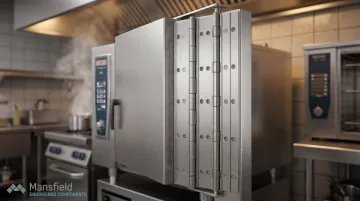
Mansfield manufactures continuous hinges for long edges requiring distributed support, including commercial appliance applications.
Best suited for:
- Heavy commercial and industrial ovens in bakeries, commissary kitchens, and foodservice operations
- Doors that are large, heavy, and cycled at high frequency
Strengths:
- Exceptional load distribution along the full door height
- Long service life under high-cycle, high-weight conditions
Trade-offs:
- Heavier and more expensive to manufacture and install
- Less practical for compact residential designs
Concealed Hinges
Concealed hinges are engineered so the hinge mechanism is fully hidden when the door is closed. Meeting that requirement simultaneously with load-bearing and motion performance demands close-tolerance manufacturing — the internal geometry must be precise enough to keep the mechanism functional without being visible.
According to a 2022 Grand View Research report, the global built-in kitchen appliances market reached USD 13.8 billion and is projected to grow at 7.6% CAGR through 2030. That growth is putting real specification pressure on OEMs to deliver premium aesthetics — and concealed hinges are increasingly how wall oven and designer range programs answer it.
Best suited for:
- High-end residential ovens and built-in appliances where exterior appearance is a key differentiator
- Wall ovens, designer ranges, and integrated appliance panels
Strengths:
- Clean visual design that supports brand premium positioning
- Increasingly specified in the growing built-in appliance segment
Trade-offs:
- Requires higher manufacturing precision and tighter tolerances
- More complex installation
- Careful material selection required to meet thermal and mechanical demands
- Typically the highest-cost hinge option
How to Choose the Right Oven Door Hinge Type
The right hinge type comes from matching design requirements to the application. Familiarity or ease of sourcing are not valid selection criteria on their own.
Start With Door Characteristics
These parameters define the baseline specification before any hinge type is evaluated:
- Total door weight — the primary load the hinge must carry
- Center of gravity — determines the actual torque profile through the opening arc
- Glass structure — full glass vs. framed affects weight distribution
- Door geometry — height, width, and pivot point location
Get these wrong and no hinge type will perform correctly.
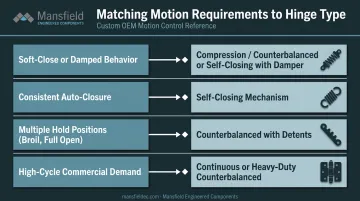
Let Motion Requirements Determine System Type
- Soft-close or damped behavior → compression/counterbalanced or self-closing with damper
- Consistent auto-closure → self-closing mechanism
- Multiple hold positions (broil, full open) → counterbalanced system with detents
- High-cycle commercial demand → continuous hinge or heavy-duty counterbalanced
Use Installation Constraints to Narrow Options
Available space within the appliance chassis is a hard constraint. Short-arm configurations fit tighter envelopes; long-arm designs offer cleaner aesthetics but require more room. Whether the design can accommodate a glass cutout also affects which hinge types are physically compatible.
Account for Production and Compliance Requirements
Once physical constraints are resolved, production and compliance requirements shape the final specification. Hinge decisions affect assembly time, part variant count across a product line, and regulatory compliance. UL 197 for commercial appliances, IEC 60335-2-6 for household electric cooking appliances, and ANSI Z21.1/CSA 1.1 for gas appliances all include door-related requirements that must be confirmed before final specification.
Mansfield Engineered Components works with OEM engineering teams to prototype and validate designs against real operating conditions — before production commitment — reducing the risk of late-stage specification changes.
What to Check Before Finalizing Your Hinge Selection
Three areas where OEM programs most often run into trouble late in development:
1. Test under real conditions, not spec sheets alone. Thermal cycling, door weight, cycle count durability, and sealing force all need confirmation through physical testing — not just published specs. Mansfield's in-house prototyping process covers:
- Cycle-life testing and force/torque measurement across the full motion arc
- Environmental testing for heat and long-term wear
- Hold-at-angle testing for counterbalance components
All of this happens before tooling is cut.
2. Match complexity to the actual requirement. A high-complexity hinge where a simpler proven design meets requirements adds cost and assembly time with no performance gain. Equally, defaulting to a familiar hinge type that doesn't match the door weight, cycle frequency, or motion profile creates warranty risk after launch.
3. Plan for the full service life, not just launch. How does the hinge perform after tens of thousands of cycles? Can it be serviced or replaced in the field? Total cost of ownership over the product's service life should drive the decision, not the unit component cost alone.
Conclusion
Oven door hinges are engineered motion control systems. The type you specify directly determines how the door performs, how reliably it seals, how safe it is under load, and how long it holds up in service.
Each hinge type serves a distinct role:
- Extension spring systems — cost-efficient choice for standard residential platforms
- Compression and counterbalanced designs — suited for premium or heavy-door applications
- Self-closing mechanisms — specified for compliance-driven and commercial environments
- Continuous hinges — built for high-cycle commercial equipment
- Concealed hinges — used where aesthetics drive the specification
Working through these tradeoffs systematically — door weight, cycle targets, seal requirements, cost constraints — is what separates a hinge spec that holds up in production from one that generates warranty calls at scale. If your application involves variables that off-the-shelf components can't address, that's the point at which custom-engineered hinge design becomes the practical path forward.
Once the type is chosen, quantity drives the commercial terms. Oven door hinges are ordered in bulk against production schedules, with unit pricing improving at each volume tier — so quote the type you selected at your actual annual volume before comparing it against a catalog alternative.
Frequently Asked Questions
What are the different types of oven door hinges?
The five main categories are spring-loaded (extension spring), compression/counterbalanced, self-closing, continuous/piano, and concealed hinges. Each suits different applications — from standard residential ovens to heavy commercial equipment and premium built-in appliances.
Can you replace oven door hinges?
Oven door hinges can be replaced, but the process varies by design — some hinges come off with the door, others remain on the chassis. For OEM applications, replacement compatibility depends on whether the hinge is a standard or custom-engineered component.
What is the most common oven door hinge type in residential ovens?
Spring-loaded extension spring hinges are widely used in residential ovens due to their versatility and cost efficiency, and because they calibrate well across a range of door weights and platform variants.
What is the difference between extension spring and compression spring oven door hinges?
Extension springs generate counterbalancing force through elongation, offering flexibility and cost efficiency across door weight ranges. Compression springs generate force within a compact internal structure, delivering more controlled, refined door motion, making them better suited for premium or space-constrained designs.
What materials are oven door hinges typically made from?
Oven door hinges are typically manufactured from steel, stainless steel, or high-strength alloys chosen for their thermal resistance, load capacity, and corrosion performance. Material choice depends on the operating environment and whether the application is residential or commercial.
How do oven door hinges affect energy efficiency?
Hinges directly affect thermal sealing. A worn or improperly specified hinge causes the door to sag or fail to close fully, breaking the seal and allowing heat to escape, which increases energy consumption and reduces cooking performance. ASTM F1496-13 identifies door seals as a named design factor in oven idle energy rate measurement.