Introduction
Washing machine door hinges appear on hundreds of millions of units globally, yet remain one of the most overlooked components in appliance design. These small mechanisms support doors that open and close thousands of times over a machine's life—often exceeding 2,750 cycles, according to EU usage data (220 cycles per year over 12.5 years).
Front-load washing machine doors present distinct engineering challenges that standard cabinet hinges simply aren't built for:
- Static load: Heavy glass portholes alone weigh 1.7–2.8 kg, plus outer trim and door bowl
- Dynamic stress: High-speed spin cycles generate drum displacement of 1.5–4.5 mm without auto-balancing mechanisms
- Angular hold: Doors must remain stable at any position from 90° to 180° throughout their service life
Those demands raise a fundamental question for appliance engineers and OEM designers: how are these hinges actually engineered to handle those loads, and what separates a well-engineered hinge from one that fails prematurely?
This guide breaks down the engineering principles, structural demands, material choices, and validation methods behind washing machine door hinges.
Key Takeaways
- Washing machine hinges handle static door weight, dynamic spin-cycle vibration, and 10,000–20,000+ open/close cycles across a product's lifespan
- Load distribution, counterbalance systems, pivot geometry, and vibration dampening are the core engineering mechanisms
- Material selection — steel gauge, surface treatment, bearing type — is driven by load rating, corrosion resistance, and target cycle life
- Cycle testing, torque measurement, and load deflection analysis validate performance before any production run begins
- Meeting appliance-specific performance specs requires custom-engineered solutions, not off-the-shelf components
What Is a Washing Machine Door Hinge?
A washing machine door hinge is a motion control component that connects the door assembly to the machine's front cabinet, allows controlled rotation along a defined axis, and distributes the door's static weight across a mounting interface. Many designs integrate a counterbalance spring or friction mechanism to hold the door at a set open angle.
Appliance hinges carry a different set of demands than architectural or furniture hinges. Beyond static load and rotation, they must handle:
- Axial vibration transmitted from drum spin cycles
- Prolonged exposure to moisture and detergent residue
- Repeated cycling within a tight spatial envelope inside the cabinet
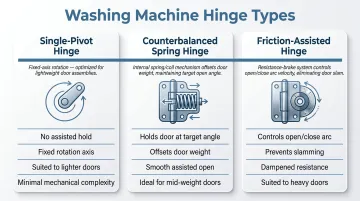
Main types relevant to washing machines:
- Single-pivot hinges — rotate on a fixed axis; suited to lighter doors where no assisted hold is needed
- Counterbalanced spring hinges — use a calibrated spring to hold the door open at a target angle, offsetting door weight
- Friction-assisted hinges — apply controlled resistance through the open/close arc to prevent slamming or free-fall
The engineering approach differs between these types: counterbalanced designs require precise spring rate tuning, while friction hinges depend on careful bearing surface selection.
The Engineering Demands Specific to Washing Machine Doors
Static Load Requirements
Front-load washing machine door assemblies typically weigh 1.6-2.8 kg total, with glass portholes alone contributing 1.7-1.8 kg for 325mm diameter units and up to 2.8 kg for 450mm units. The full weight transfers through two hinge mounting points, making each hinge responsible for a defined share of the static load. The lower hinge typically bears a higher proportion due to door geometry.
Some OEMs actively manage this constraint—Bosch/Siemens uses lightweight plastic viewing windows in certain models to reduce total door weight to approximately 1.6 kg specifically "to relieve the door hinge."
Moment Load Amplification
Door width creates a moment arm—the further the center of mass from the hinge pivot axis, the higher the rotational force on the hinge body and mounting screws. Wider, heavier doors in large-capacity front-loaders sharply amplify this torque load. A door extending 300mm from the pivot creates far greater torque than the raw weight suggests.
Dynamic Vibration Loading
Front-load machines generate significant vibration during spin cycles. At 744 rpm effective spin speed with 20% load imbalance, drum displacement reaches 3.02mm without auto-balancing. This vibration transmits through the cabinet to hinge mounting points, creating cyclic fatigue stress in the hinge body and fasteners. A hinge rated for static load alone is insufficient for this environment.
Open-Position Holding Demand
Unlike doors with fixed stops, washing machine doors must remain stable at intermediate angles (90-150°) without sagging or drifting closed. This requires the hinge to provide controlled resistance or active counterbalancing across the full arc, not just at the fully open position.
Cycle Life Requirement
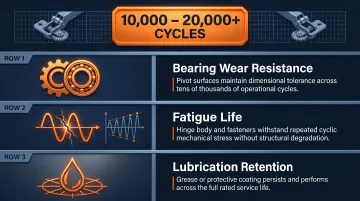
Based on EU usage data showing 220 cycles annually and a 12.5-year lifespan, appliance hinges must survive approximately 2,750 wash cycles minimum. In practice, door open/close cycles exceed wash cycles — loading, unloading, and mid-cycle checks push real-world requirements closer to 10,000-20,000 cycles.
That range drives engineering specifications well beyond structural strength to include:
- Bearing wear resistance — pivot surfaces must maintain tolerance across tens of thousands of cycles
- Fatigue life — hinge body and fasteners must withstand repeated cyclic stress without crack initiation
- Lubrication retention — grease or coating must persist across the full service life without reapplication
How Washing Machine Door Hinges Are Engineered for Heavy Loads
Washing machine door hinges achieve heavy-load performance through engineered geometry, load-path design, counterbalance integration, and controlled motion. Each element is addressed as a defined engineering challenge—not an aesthetic decision.
Load Distribution and Pivot Mechanics
Hinge body geometry distributes the door's weight load across the full mounting interface rather than concentrating stress at a single point. Engineers tune leaf plate dimensions, knuckle barrel diameter, and pin-to-barrel clearance to the specific load rating.
Pivot design considerations:
- Hinge pin and knuckle must handle both vertical shear load (door weight) and lateral moment load (torque from door width)
- Bearing surfaces—plain or rolling element—are selected based on load and cycle life requirements
- Inadequate bearing design leads to pin wear, hinge slop, and eventual sagging
Material strength requirements:
Cold-rolled steel grades (SPCC/SPCD/SPCE) provide minimum 270 MPa tensile strength with elongation of 32-43% depending on grade. This balances formability during stamping with fatigue strength under cyclic loading.
Counterbalance and Position Control
Most washing machine hinges integrate a spring (torsion, compression, or tension) that applies counteracting torque as the door opens past a threshold angle. The spring rate and pre-load are engineered to match the specific door weight and target open-angle behavior—for example, a door that stays open at 90° without assistance.
Position control elements:
- Friction elements or damping features regulate the closing arc
- Spring tuning prevents the door from slamming shut under its own weight
- Engineers calibrate spring behavior through iterative prototyping
Vibration Resistance and Sealing Integrity
Engineers address spin-cycle vibration through:
- Fastener selection: thread type, torque value, and locking features matched to vibration exposure
- Material gauge and geometric reinforcement to maintain hinge body rigidity under cyclic loads
- Mounting interface geometry that distributes load and resists loosening or fatigue failure
A hinge that passes static load testing alone may still fail in field use if vibration loading isn't accounted for in the design. Doors (including seals, handles, hinges, and locks) account for 11.5% of all washing machine failures—the third most common failure category after electronics and shock absorbers.
Mansfield Engineered Components designs and tests custom hinge prototypes for each application rather than offering standard catalogue components—allowing spring rates, bearing selection, and geometry to be matched precisely to the appliance manufacturer's door weight, open angle, and cycle life specification.
Materials and Testing Standards That Validate Heavy-Load Performance
Material Selection Decisions
Common materials in appliance-grade washing machine hinges include:
- Stamped steel — cost-effective for hinge leaves and brackets
- Stainless steel — superior corrosion resistance for moisture exposure
- Zinc alloy die castings — complex geometries when needed
Key tradeoffs:
| Material | Strength | Corrosion Resistance | Weight | Cost |
|---|---|---|---|---|
| Cold-rolled steel (SPCC) | High (≥270 MPa) | Low (requires coating) | Medium | Low |
| Stainless steel | High | Excellent | Medium | High |
| Zinc alloy | Medium | Good | Low | Medium |
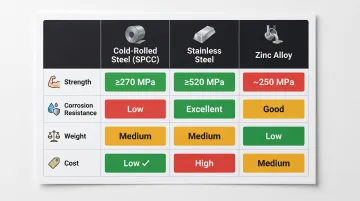
Moisture and detergent exposure make surface treatment a functional requirement, not just aesthetic. Standard zinc plating provides only 48-96 hours salt spray resistance to red rust, while zinc-nickel alloy plating achieves 1,000+ hours—10x the protection.
Key Material Properties That Govern Load Performance
Critical specifications:
- Yield strength and tensile strength — determine how much load a hinge can carry before permanent deformation
- Fatigue strength — determines how many cycles it can survive
- Hardness of bearing surfaces — determines pin and barrel wear rate over product life
Engineers specify all three properties during the design phase, before any prototype enters fabrication.
Cycle Life and Load Testing
Washing machine hinges undergo validation testing before production approval:
Typical validation checks:
- Mechanical cycling rigs — open and close the door through full arc for the required number of cycles while monitoring dimensional change, torque shift, and structural failure
- Static load testing — verifies hinge can support specified door weight without deformation
- Torque measurement — validates counterbalance performance across motion arc
ANSI/BHMA A156.1 Grade 1 architectural hinges require 2.5 million cycles, exceeding appliance duty cycles—but the test methodology (cycle speed, door weight, failure criteria) provides a validated framework OEMs can adapt.
By contrast, IEC 60335-2-7 requires only 4 cycles with an imbalanced load—a minimal safety compliance test that doesn't validate real-world durability. OEMs must supplement this with proprietary extended-cycle testing.
How Test Results Tie Back to Design Decisions
When a prototype fails cycle testing prematurely, engineers trace the failure mode back to a specific design variable:
- Bearing wear → increase pin hardness or switch to rolling element bearing
- Spring fatigue → adjust spring material grade or pre-load
- Fastener loosening → add thread-locking compound or change fastener specification
Each corrected variable feeds back into the design model, tightening the specification before production tooling is ever cut.
Conclusion
Washing machine door hinges are engineered systems that must satisfy a defined set of load, motion control, vibration resistance, and durability requirements simultaneously. For OEM engineers specifying these components, that means the hinge design can't be an afterthought — it needs to be validated against real load cycles, installation constraints, and service life targets before production begins.
Mansfield Engineered Components has designed and manufactured motion control components for appliance brands including Whirlpool, GE/Haier, Bosch, and Electrolux for over 80 years. Every hinge project follows a defined path from initial load analysis through prototype validation to production release — no off-the-shelf substitutes, and no skipped steps.
Validated hinges then ship in volume. Washing machine door hinges are supplied in bulk against build schedules, with programs running from about 5,000 pieces to 5,000,000 or more per program and unit pricing improving as annual volumes rise.
Frequently Asked Questions
What are the mechanical components of a hinge?
Core components include two leaves (or plates) that attach to fixed and moving surfaces, a knuckle barrel that joins the leaves, and a pin that runs through the barrel as the pivot axis. Load-bearing appliance hinges also incorporate bearing elements (plain or rolling) and often include spring or damping mechanisms that govern motion control behaviour.
What are the 4 types of hinges?
The four commonly referenced types are butt/plain hinges, pivot hinges, continuous/piano hinges, and specialty hinges (concealed or spring-integrated). Washing machine applications primarily use pivot-style hinges with integrated counterbalance mechanisms tailored to appliance-specific load and motion requirements.
What is the 7 11 hinge rule?
The 7-11 rule is an architectural door installation guideline: top hinge placed 7 inches from the top of the door frame, bottom hinge 11 inches from the floor. This rule applies to standard residential door hinges and does not apply to appliance hinges, which are positioned based on cabinet structure and engineered load distribution requirements.
How much weight can a washing machine door hinge support?
Load capacity varies by design. Front-load door assemblies typically weigh 1.6-2.8 kg, with glass portholes adding another 1.7-2.8 kg depending on diameter. Each hinge is rated to handle both static door weight and dynamic moment load, with safety margins built in.
Why do washing machine door hinges fail over time?
Common failure modes are bearing wear from repeated cycling, spring fatigue, fastener loosening from spin-cycle vibration, and corrosion from moisture and detergent exposure. Well-engineered designs address each through material selection, surface treatment, and validated cycle life testing.
What materials are used in washing machine door hinges?
Appliance-grade hinges use stamped or cold-formed steel for leaves and knuckle, hardened or stainless steel for pivot pins and bearing surfaces, and zinc plating or equivalent corrosion-resistant coatings. Spring-integrated designs add heat-treated steel springs, with all materials matched to the load rating and target service life.