Introduction
A standard butt hinge works well enough on a bedroom door — but put that same hardware on a hospital corridor door, a commercial oven, or an industrial access panel that cycles hundreds of times daily, and it will fail. The engineering demands are different.
Continuous hinges exist to solve that problem. By spanning the full length of a door, lid, or panel, they distribute load across the entire edge rather than concentrating stress at two or three isolated points. The result is a hinge that resists sagging, maintains alignment, and holds up through years of heavy use.
This article covers:
- What continuous hinges are and how they work
- The key types: geared, pin-and-barrel, and friction
- Where each type is used — and how to choose the right one
Key Takeaways
- A continuous hinge spans the full door or panel edge, distributing weight evenly instead of at isolated stress points
- Also called piano hinges, they outperform standard butt hinges in high-cycle, heavy-duty, or high-security environments
- Geared, pin-and-barrel, and friction types each serve different load, cycle, and performance requirements
- Selection depends on door weight, cycle frequency, environmental conditions, and specific performance requirements like position-holding or fire ratings
What Is a Continuous Hinge?
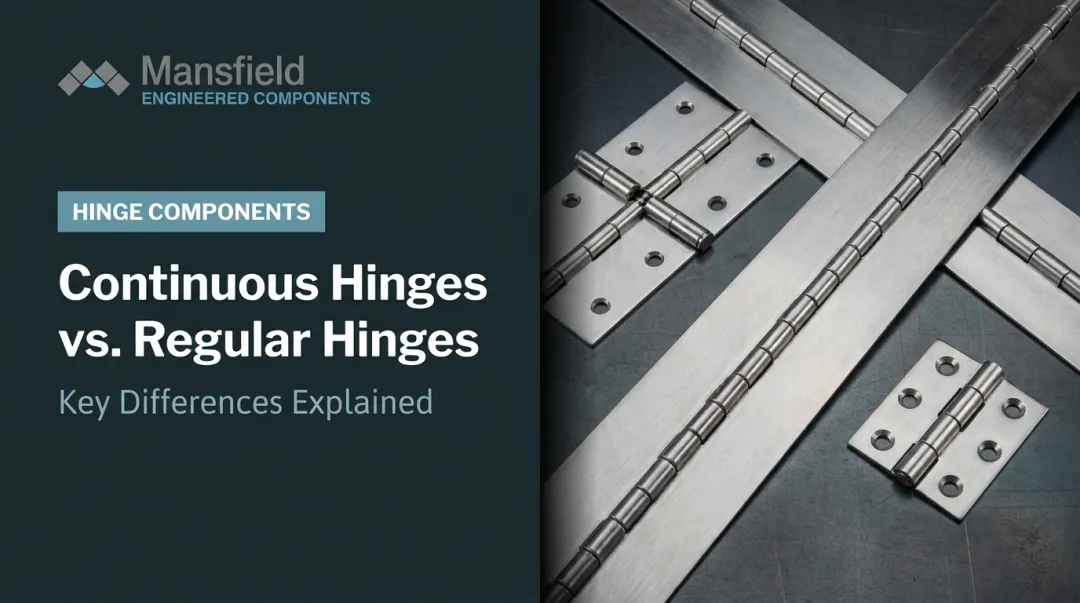
A continuous hinge is a single-piece hinge designed to run the full length of whatever it supports — a door, lid, panel, or enclosure — rather than two or three individual hinges spaced along the edge. The design is also widely known as a piano hinge, a name that traces back to its original application: supporting the full-length lids of grand pianos, where consistent, distributed support was critical.
How the Design Works
Two long metal leaves are joined by interlocking knuckles along a central pin or rod running the entire hinge length. One leaf mounts to the door or lid; the other attaches to the frame or body. The result is a single, uninterrupted pivot axis.
Standard manufactured lengths run 6, 7, or 8 feet or longer, according to Guden's continuous hinge specifications, and can be cut to a precise length for the application. Common materials include:
- Steel and stainless steel (grades 302/304/316)
- Aluminum
- Brass
- Plastic
Why Continuous Hinges Outperform Standard Hinges
The core engineering advantage is load distribution. As Hager's stainless continuous hinge catalog explains, a continuous hinge distributes door weight along the full door length, eliminating localized stresses on the frame and reducing hinge failure.
A standard butt hinge concentrates all stress at two or three points. Over thousands of cycles, those points wear, flex, and eventually allow the door to sag or fall out of alignment. For high-cycle applications — commercial appliances, industrial enclosures, transportation access panels — that difference in service life is significant.
Types of Continuous Hinges
Continuous hinges aren't a single product. They exist in several distinct mechanical types, each engineered for different load requirements, operating environments, and performance needs. Getting the type right matters as much as getting the size right.
Geared Continuous Hinges
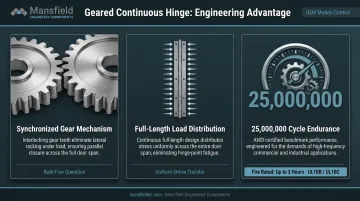
Geared continuous hinges feature two leaves with intermeshing gear teeth running the full hinge length, housed beneath a protective cap or channel. The design was patented by MIT-trained engineer Austin R. Baer in 1963 (US Patent 3,092,870), with thrust bearings added in a 1968 follow-on patent (US Patent 3,402,422). Most geared continuous hinges are extruded aluminum with an anodized finish.
The interlocking gears synchronize both leaves simultaneously as the door moves. Unlike pin-and-barrel designs where the two leaves rotate independently, synchronized gears eliminate lateral racking or twisting under heavy use, providing superior alignment control and reducing stress on the door frame.
Durability benchmark: SELECT's SL11 HD600 concealed geared continuous hinge surpassed 25,000,000 open/close cycles in ANSI-approved physical endurance testing at Architectural Testing Inc., per SELECT's endurance testing documentation.
Best suited for:
- High-traffic commercial and institutional environments: schools, hospitals, airports, hotels, office buildings
- Fire-rated doors (available rated up to 3 hours under UL10B/UL10C)
- Security doors requiring maximum cycle durability
Trade-offs: Higher cost than pin-and-barrel types. The heavier, bulkier profile isn't ideal for lightweight applications or low-profile aesthetics. Installation requires more precise alignment.
Pin-and-Barrel Continuous Hinges
Pin-and-barrel continuous hinges follow the classic hinge structure — a long barrel runs the full hinge length with a single pin inserted through it. The two leaves interlock via knuckles curled around the barrel. This is the most direct evolution of the original piano hinge design.
Available variants (per Ives documentation):
- Full surface — both leaves mount to the surface face of the door and frame
- Full mortise — both leaves inset into the door and frame
- Swing clear — allows the door to swing fully clear of the opening
- Half wrap / full wrap — reinforced edge variants that increase load capacity for heavier doors
Ives' 700/715/705/711 continuous hinge family is rated to 300 lb without reinforcing and up to 600 lb with reinforcing, per their installation documentation.
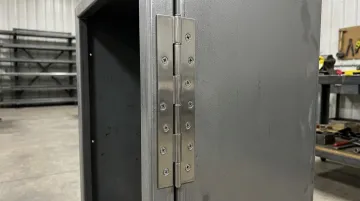
The two leaves rotate independently around the shared pin rather than through synchronized gears. This simpler structure makes them easier to produce across a wider range of materials — steel, stainless steel, aluminum, and brass. They don't match geared hinges for maximum cycle durability, but they're highly versatile and available in more finish options.
Best suited for:
- Commercial and industrial cabinets, enclosures, and toolboxes
- Appliance doors and commercial cooking equipment (a common OEM application)
- Any situation where cost-effectiveness and dimensional flexibility matter more than extreme cycle life
Trade-offs: Under very heavy use or with heavier doors, pin wear on the barrel knuckle can cause minor door sag over time. Not the right choice for maximum-cycle institutional environments without periodic maintenance.
Friction Continuous Hinges
Friction continuous hinges — sometimes called torque hinges — incorporate internal resistance directly into the mechanism. This lets the door or lid open to any position and stay there without an external stay, arm, or prop. The friction torque is calibrated to the door's weight and the required hold force, which means it must be accurately specified for each application.
How they differ mechanically: Standard geared and pin-and-barrel hinges allow free rotation; gravity and door closers do the work of positioning. Friction hinges add controlled resistance that holds the door stationary at any angle within its range. This is an engineered property, not a byproduct of wear.
Best suited for:
- Appliance doors that must stay open at a fixed angle (oven lids, commercial equipment access panels)
- Medical casegood lids requiring hands-free access
- Industrial equipment hatches and instrument enclosures
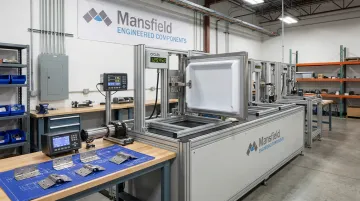
Mansfield Engineered Components, for example, engineers custom friction hinges for appliance and industrial OEMs across applications including oven drop-down doors, washing machine lids, and dishwasher mechanisms. Each program is engineered against specific torque profiles, motion arcs, and cycle life requirements, then validated in-house through cycle-life testing, force and torque measurement, and hold-at-angle testing before production.
Trade-offs: Friction torque must be accurately specified — too little and the lid won't hold; too much and the door becomes difficult to operate. Not suited for applications that need a free, unrestricted swing.
Other Notable Variants
A few specialized types are worth knowing:
- Interleaf continuous hinges — reduce the clearance gap between door and frame from the typical 12mm down to approximately 3mm. Useful where a tight seal or reduced pinch risk is required.
- Slip-joint lift-off hinges — a pin on one leaf slides into a barrel on the other, allowing the door to be completely removed by lifting it off. Practical for access doors that must be frequently detached for maintenance.
- Plastic continuous hinges — made from polyolefin, PVC/RPVC, or PETG, these are completely corrosion-immune, lightweight, and quiet. Guden notes their plastic hinges resist acids, oils, and grease; Essentra confirms salt water resistance. The right choice for marine environments, chemical exposure applications, or any installation where metal is unsuitable.
Where Continuous Hinges Are Used
Commercial and Institutional Buildings
Geared and heavy-duty pin-and-barrel continuous hinges are standard hardware on fire-rated doors, school corridor doors, hospital ward doors, and high-traffic office building entries. Hager specifically notes their stainless continuous hinges are suited for high-traffic institutional settings including hospitals, where doors and frames receive severe daily use.
The governing standard is ANSI/BHMA A156.26, which covers cycle, abuse, overload, vertical wear, strength, security, corrosion, and fire-resistance requirements for architectural continuous hinges — making it the specification benchmark for architects and facility managers.
Industrial Enclosures and Equipment Panels
Continuous hinges are widely used on electrical enclosures, control panels, switchgear cabinets, and machine access hatches. The full-length design keeps panels properly aligned for sealing and safety, and prevents the warping or binding that single-point hinges can develop over time. Guden's predrilled continuous hinge line is specifically designed for metal box and enclosure producers.
Appliance and Commercial Equipment Manufacturing
Ovens, refrigerators, dishwashers, washing machines, and commercial cooking equipment all demand controlled, smooth door operation across tens of thousands of cycles. Friction and pin-and-barrel types are common in these applications.
Mansfield Engineered Components designs and manufactures custom hinge and motion control solutions for appliance OEMs across residential and commercial segments. Their customers include:
- Whirlpool, GE/Haier, and Electrolux (white goods)
- Bosch, Sub-Zero, and Thermador (premium residential)
- Commercial food service equipment manufacturers
Mansfield ships over 250,000 motion control components every week to appliance manufacturers worldwide.
Transportation and Specialty Vehicles
Buses, coaches, trucks, and specialty vehicles use continuous hinges on access panels, equipment hatches, and storage compartments. The full-length design resists vibration-induced loosening and maintains alignment despite road vibration and repeated loading. Mansfield supplies motion control components for tonneau covers, hood and deck lid assists, trailer access mechanisms, and specialty vehicle cowlings — serving automotive aftermarket OEMs that require consistent performance across high-cycle applications.
Marine and Outdoor Applications
Grade 316 stainless steel is the standard choice for marine environments. World Stainless confirms that AISI 316 (1.4401) is appropriate for coastal service, splash zones, and intermittent immersion — though more demanding permanent seawater immersion may require higher-alloy grades. For corrosive chemical or wet environments where metal is problematic altogether, plastic continuous hinges offer a fully rust-immune alternative.
How to Choose the Right Continuous Hinge
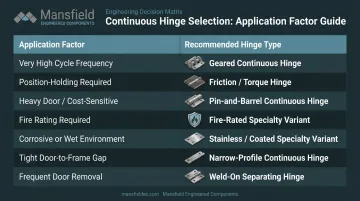
The right type depends on the specific demands of the application. Here are the primary selection factors:
| Factor | Points Toward |
|---|---|
| Very high cycle frequency | Geared continuous hinge |
| Position-holding required | Friction (torque) continuous hinge |
| Heavy door, cost-sensitive | Pin-and-barrel with full wrap |
| Fire rating required | Geared, UL-listed (up to 3 hours for metal doors) |
| Corrosive or wet environment | 316 stainless steel or plastic |
| Tight door-to-frame gap needed | Interleaf variant |
| Frequent door removal | Slip-joint lift-off variant |
Common Specification Mistakes
- Choosing standard-duty for high-cycle use to cut cost: the maintenance burden typically exceeds the original savings within the first year
- Specifying a geared hinge when friction hold is required: geared hinges allow free rotation, so the door won't stay open at any position
- Using plain steel in a marine or food-service environment: corrosion and contamination follow quickly
- Specifying a stock hinge when custom dimensions are required: a poor geometric fit compromises both performance and service life
When Standard Catalog Hinges Aren't Enough
When the application has specific torque-curve requirements, unusual geometry, high-volume unit-cost targets, or demanding environmental requirements, a custom-engineered solution is usually the right call. What to look for in a manufacturing partner:
- In-house design engineering and prototyping capability
- Physical validation testing (cycle life, torque measurement, hold-at-angle)
- Material and finish flexibility across steel, stainless, aluminum, and specialty alloys
- Production volume scalability from development quantities to full OEM volumes
Mansfield Engineered Components covers each of those criteria under one roof. Their process runs from specification and concept through in-house prototyping, engineering validation, tooling qualification, and full production. Programs from 5,000 to 5,000,000+ components are handled without separate design, tooling, and manufacturing handoffs.
Conclusion
Continuous hinges solve a fundamental engineering problem: providing full-length, evenly distributed support to doors, lids, and panels that standard hinges can't handle reliably over time. Each type fills a distinct role:
- Geared — highest-cycle institutional environments where failure isn't an option
- Pin-and-barrel — versatile, cost-efficient across commercial and industrial applications
- Friction — controlled position-holding for appliances and equipment
- Specialty variants — sealing, removal, and corrosion-specific requirements
The difference between a hinge that fails in 18 months and one that runs for decades often comes down to specification — whether the type, material, and torque profile were matched to the actual demands of the application. For applications where those parameters are complex or non-standard, engaging a manufacturer like Mansfield Engineered Components early in the design process means the specification gets built around your actual load, cycle, and environmental requirements — not adapted from a catalog that wasn't designed for them.
Volume shapes the commercial side of that decision. Continuous hinges bought in bulk against an annual build plan price very differently from small catalog quantities, so it is worth confirming volume pricing tiers, minimum order quantities per part number, and lead times alongside the technical specification.
Frequently Asked Questions
What does a continuous hinge do?
A continuous hinge supports the full length of a door, lid, or panel as it opens and closes, distributing weight evenly across the entire edge. This prevents sagging, maintains alignment, and delivers reliable operation across a high number of cycles — which is why standard butt hinges can't substitute for them in demanding applications.
What is the difference between a continuous hinge and a regular hinge?
A standard butt hinge supports a door at two or three isolated points, concentrating all stress at those locations. A continuous hinge spans the entire door height and spreads that load across the full edge, resulting in better durability and alignment stability — particularly on heavy or frequently used doors.
Why are continuous hinges also called piano hinges?
The design was originally developed to support the full-length lids of grand pianos, where consistent, distributed support was needed. The name stuck. As the design was adapted for commercial and industrial use, "continuous hinge" became the standard industry term, though both names are still used interchangeably.
Can continuous hinges be cut to size?
Yes — most continuous hinges can be cut to a required length in the field. Ordering them pre-cut to specification from the manufacturer is more precise, however, and avoids burrs or uneven cuts that can affect fit and long-term performance.
What materials are continuous hinges available in?
The main options are steel, stainless steel (grades 304 and 316 are most common), aluminum, brass, and plastic (polyolefin, PVC/RPVC, PETG). Material selection should reflect the application's load requirements, corrosion exposure, and any applicable regulatory or certification requirements.
Are continuous hinges suitable for fire doors?
Yes. Geared continuous hinges made from appropriate materials, such as stainless steel series listed by Underwriters Laboratories to UL10B/UL10C, can be rated for up to three hours of fire resistance. This makes them a code-compliant choice for hollow metal or steel-covered composite doors in commercial and institutional fire door assemblies.