Introduction
Picture a commercial oven door held open at 45 degrees while a chef loads sheet pans with both hands — no prop rod, no gas strut, nothing holding that door in place except the hinge itself. Or a medical monitor arm that stays exactly where the clinician positioned it, even under the weight of the display. That's a torque hinge doing its job.
For product designers and engineers, hinge selection rarely gets the attention it deserves until something goes wrong. A panel that slams shut injures an operator. A lid that won't hold position requires a secondary support mechanism — adding cost, weight, and another failure point.
This guide covers what torque hinges are, how their internal friction mechanisms work, the main types available, where they're used across industries, and how to select the right one for your application.
Key Takeaways
- A torque hinge holds a panel, lid, or door at any angle within its range without additional support hardware.
- Internal friction generated by disc, curl, or pipe mechanisms creates the resistance that makes free-stop positioning possible.
- Six main types cover most applications: constant torque, adjustable torque, one-way, bi-directional, detent, and concealed.
- Sizing torque correctly requires dividing panel weight × distance from pivot to center of gravity by the number of hinges.
- Material selection (stainless, aluminum, zinc, glass-filled nylon) is driven by load, environment, and weight constraints.
What Is a Torque Hinge?
A torque hinge is a mechanical device that provides controlled rotational resistance, allowing a panel, lid, door, or screen to hold at any position within its range of motion — without gas struts, lid stays, or locking mechanisms.
Standard hinges (butt hinges, piano hinges, strap hinges) provide unrestricted rotation. The panel moves freely under gravity. A torque hinge introduces an internal opposing force that counteracts gravity, giving the panel what engineers call "positioning torque" — the ability to stay where it's placed.
Torque Hinge vs. Friction Hinge
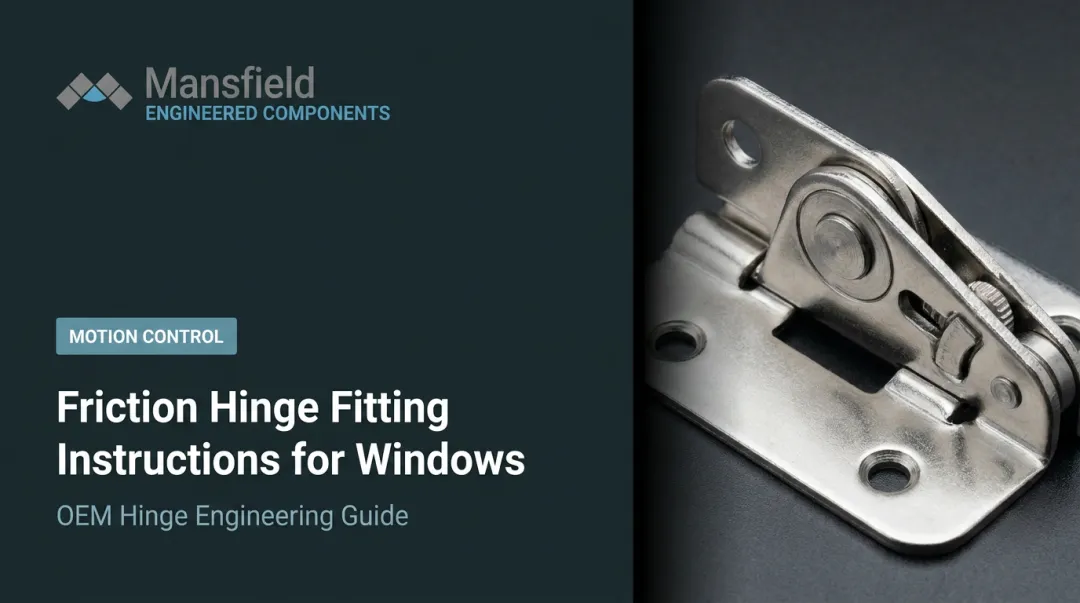
The two terms are used interchangeably across the industry. "Friction hinge" describes the mechanism — frictional surfaces resisting rotation. "Torque hinge" is the broader functional term covering any hinge that delivers controlled rotational resistance. Southco and Sugatsune both treat these as equivalent terms in their technical documentation.
The clearest everyday example: laptop screens. They stay open at whatever angle the user sets — no latch, no spring-back, no drift. That free-stop behavior is exactly what OEM designers specify a torque hinge to achieve.
How Does a Torque Hinge Work?
When a panel rotates, the rotational force acting on the hinge shaft activates an internal friction mechanism. That mechanism generates a resistive force opposing the motion. Once the user lets go, if the panel's gravitational torque doesn't exceed the hinge's resistive torque, the panel stays in place — the "free-stop" function.
Friction Mechanism Types
Sugatsune's technical documentation identifies three primary internal designs:
- Disc (plate) structure — Rotating discs sandwich a fixed disc around the hinge shaft. Friction between disc surfaces generates resistance as the shaft turns. High torque output makes this design common in heavier industrial and appliance applications.
- Curl (spring sheet) structure — A rolled spring sheet wraps around the hinge shaft. As the shaft rotates, the sheet grips it, generating friction proportional to spring tension. Well-suited to compact applications with moderate loads.
- Pipe structure — A shaft press-fitted into a plastic or polymer pipe. Rotation creates consistent frictional resistance. Typically used in lighter-duty applications where cost-effective positional control is the primary requirement.
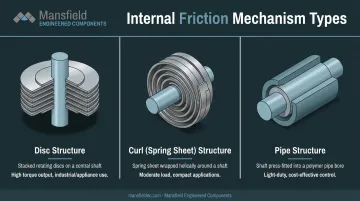
Some designs supplement solid friction elements with high-viscosity oil damping. Fluid-based mechanisms reduce wear over long service life and are preferred in high-cycle applications where drift-free motion is critical.
Beyond mechanism type, torque hinges divide into two operating philosophies based on whether the friction level can change after installation.
Constant vs. Adjustable Torque
| Constant Torque | Adjustable Torque | |
|---|---|---|
| Friction setting | Fixed at manufacture | Modified post-installation via hex key or set screw |
| Field adjustment | None | Yes — by a technician |
| Best for | Stable, well-defined panel loads where predictability matters | Panels whose weight may change, or applications requiring user-tunable resistance |
Types of Torque Hinges
Beyond the constant/adjustable distinction, torque hinges come in several designs, each addressing a specific motion control challenge.
| Type | Key Characteristic | Typical Applications |
|---|---|---|
| Constant Torque | Fixed resistance, set at manufacture | Medical devices, lab equipment, precision instruments |
| Adjustable Torque | Field-adjustable friction level | Equipment with variable panel loads, user-preference applications |
| One-Way | Resistance in one direction only | Overhead lids — easy to lift, won't fall shut |
| Bi-Directional | Resistance direction reverses at vertical | Panels requiring full 180° positional control |
| Detent | Positive snap-closed at specific positions | Cabinet doors, enclosures needing secure-close feel |
| Concealed | Hardware hidden when panel is closed | Premium appliances, medical casegoods, aesthetics-driven designs |
A few practical notes on selection:
- Commercial equipment enclosures often specify detent hinges so operators get audible and tactile confirmation that a door is fully closed — critical in food service and industrial settings.
- Concealed hinges are a frequent requirement in hospital casegood and premium appliance programs; Mansfield Engineered Components engineers these for OEMs where exposed hardware is unacceptable in the finished product.
- One-way resistance fills a gap that bi-directional designs can't cover: allowing easy user lift while preventing the panel from dropping under its own weight when released.
Key Benefits of Torque Hinges
Safety
A panel that can't slam shut is a panel that won't injure an operator. Torque hinges keep access covers, oven doors, and equipment lids from swinging closed under gravity — a passive safety feature that requires no user action and no secondary hardware.
OSHA's machine guarding requirements (1910.212) apply broadly to moving parts, and uncontrolled panel motion is a recognized hazard in commercial kitchen and industrial equipment environments. Designing positional control into the hinge eliminates that failure mode at the component level.
Ergonomics and Workflow
When a hinge holds a panel open, both of the operator's hands are free. In commercial kitchens, this means loading sheet pans without awkward one-handed contortions. In clinical settings, it means adjusting a monitor arm while maintaining patient contact.
The CDC/NIOSH ergonomics framework identifies sustained force and awkward posture as primary musculoskeletal risk factors. A hinge that holds position addresses both without adding a separate support mechanism.
Design Simplification
A torque hinge can replace several discrete components in a single assembly. As Sugatsune notes, torque hinges can eliminate the need for separate stoppers and lid supports — the hinge bears the load.
That consolidation has downstream benefits for OEM product teams:
- Eliminates gas struts, lid stays, and prop rods from the BOM
- Reduces assembly steps and associated labor time
- Lowers warranty exposure by cutting the number of parts that can fail in the field
Torque Hinge Applications Across Industries
Appliances
Oven doors, refrigerator access panels, commercial cooking equipment hoods, dishwasher doors, and washing machine lids are all torque hinge territory. The requirements are demanding: repeated thermal cycling, high daily cycle counts, and user expectations for smooth, controlled feel.
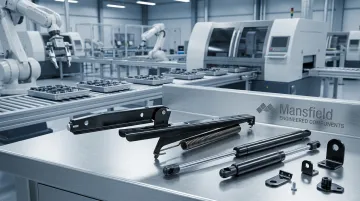
Mansfield Engineered Components has served residential and commercial appliance OEMs for over 80 years, shipping more than 250,000 motion control components per week to manufacturers including Whirlpool, GE/Haier, Sub-Zero, Wolf Appliance, Middleby, and Welbilt. Every torque profile is matched to the panel's weight, geometry, and motion arc — no two applications get the same solution.
Medical Equipment and Casegoods
Examination tables, imaging equipment arms, diagnostic monitor mounts, and surgical lighting rigs all require positional holding under load. In clinical settings, positional drift directly affects clinical reliability.
Material requirements in healthcare are specific:
- Corrosion resistance — stainless steel construction withstands repeated disinfectant cleaning
- Quiet operation — smooth, low-noise movement avoids disturbing patient environments
- High cycle durability — components must hold up against the daily use volume typical of hospitals
Mansfield designs concealed and counterbalance hinges for hospital and clinic casegoods, mobile medical carts, and specialty equipment cabinets with these constraints addressed at the design stage.
Automotive, Transportation, and Industrial
Torque hinges appear throughout vehicle interiors — center console lids, glove box doors, infotainment screen mounts. In the transportation sector, Reell identifies aircraft, bus, and rail applications including tray tables, adjustable headrests, and overhead storage bins. In industrial machinery, they manage access panels and equipment guards in high-cycle, demanding environments.
That demand has scale behind it: the broader motion control market (which includes positioning components like torque hinges) was valued at $16.57 billion in 2024 and is projected to reach $21.63 billion by 2029 at a 5.5% CAGR, according to MarketsandMarkets. Mansfield's transportation work spans four-bar hinges for pickup truck tonneau covers, lift-assists for hoods and deck lids, and cowling hinges for recreational vehicles.
How to Select the Right Torque Hinge
Calculating the Required Torque
The fundamental formula:
Required Torque = Panel Weight × Distance from Pivot to Panel's Center of Gravity
When using two hinges, divide the total by two to get the per-hinge requirement. Specify against the lower end of the hinge's torque tolerance — not the nominal value — to ensure the panel is held even when manufacturing variation works against you. A practical rule: the application torque should fall below the minimum of the hinge's rated tolerance band.
Key Selection Factors
Four variables drive hinge selection:
- Panel weight — Heavier panels require higher torque ratings. This is the starting point for any specification.
- Center of gravity — A panel with its CoG far from the pivot exerts more torque than a heavier panel with CoG close in. Measure distance carefully; it dominates the torque calculation.
- Direction of movement — Horizontally-hinged panels (opening upward or downward) carry gravitational loading that vertically-hinged panels don't. This changes both the torque requirement and the appropriate hinge type.
- Environmental conditions — Heat, moisture, chemical exposure, and cycle count expectations all drive material and finish selection.
Material Comparison
| Material | Density | Tensile Strength | Corrosion Resistance | Typical Use |
|---|---|---|---|---|
| 304 Stainless Steel | 8.00 g/cc | 505 MPa | Excellent | Medical, appliance, harsh environments |
| 6061-T6 Aluminum | 2.70 g/cc | 310 MPa | Good | Aerospace, weight-sensitive applications |
| Zinc (Zamak 3) | ~6.6 g/cc | ~280 MPa | Moderate | General industrial, cost-sensitive |
| Nylon 6, 30% GF | ~1.37 g/cc | ~140 MPa | Good (chemical) | Lightweight, lower-load applications |
Material property data sourced from MatWeb.
Stainless steel is the preferred choice for appliance and medical applications: corrosion resistance, durability under cleaning chemicals, and compatibility with food-contact environments justify the weight premium. Aluminum earns its place where weight matters, particularly in transportation. Zinc is cost-effective for general industrial enclosures. Glass-filled nylon works where loads are light and weight reduction is critical.
When to Bring in Engineering Support
Standard torque calculations handle most cases. Some applications push beyond what standard formulas can reliably resolve:
- Non-standard panel geometry or asymmetric load distribution
- Unusual mounting constraints that affect pivot placement
- Multi-axis movement requirements
- Demanding duty cycles in harsh or high-temperature environments
Mansfield Engineered Components designs and prototypes custom torque hinge and motion control solutions in-house, testing force and torque across the full motion arc before tooling is cut. Serving programs from 5,000 to 5,000,000+ units, their engineering team takes on applications where a fully custom-engineered solution is the only path to the required performance, geometry, or unit economics.
That 5,000 to 5,000,000+ range is the bulk-buying range. Torque hinges ordered in volume against a build plan are priced by tier, so it is worth confirming the minimum order quantity per part number and the release schedule alongside the torque specification itself.
Frequently Asked Questions
How does a torque hinge work?
A torque hinge uses an internal friction mechanism (disc, curl, or pipe type) to generate resistance against rotation. When the user releases the panel, the hinge's resistive torque counteracts gravity, holding the panel at whatever angle it was left without additional support hardware.
What are the different types of torque hinges?
The main types are constant torque, adjustable torque, one-way, bi-directional, detent, and concealed. Each targets a different combination of load direction, positional control range, and mounting or aesthetic requirement. Selecting the right type starts with defining whether the application needs free-stop positioning, indexed positions, or load-direction specificity.
What is the difference between a torque hinge and a friction hinge?
The terms are largely interchangeable. "Friction hinge" describes the mechanism (frictional surfaces resisting rotation), while "torque hinge" is the broader functional label covering any hinge that provides controlled rotational resistance and positional holding. Both refer to the same product category.
How do I calculate the torque needed for my application?
Multiply the panel weight by the distance from the hinge pivot to the panel's center of gravity, then divide by the number of hinges. Specify against the lower end of the hinge's torque tolerance band rather than the nominal value to account for manufacturing variation.
What materials are torque hinges typically made from?
The most common materials are stainless steel, aluminum, zinc alloy, and glass-filled nylon. Material choice is driven by load requirements, environmental exposure (corrosion, heat, chemicals), weight constraints, and target unit cost.
Can torque hinges be customized for specific applications?
Yes. Custom torque hinges are available for non-standard geometry, unique load profiles, or specialized environmental conditions. Mansfield Engineered Components designs each hinge to the specific application — no catalog parts adapted to fit — which means the component is optimized from the start rather than compromised.