
Introduction
A refrigerator door that detaches mid-use, a commercial oven door that drops unexpectedly, a dishwasher panel that won't seal—these aren't hypothetical failures. CPSC recalls since 2011 have documented over 68,000 appliance units with hinge-related failures, including 139 reports of refrigerator doors detaching from Hisense units and 95 reports of oven door springs breaking through trim on ZLINE wall ovens. Each recall traces back to the same root cause: incorrect hinge specification at the design stage.
Hinge selection is a safety-critical design decision with direct consequences for warranty costs, brand reputation, and consumer safety. Whirlpool alone paid $303 million in warranty claims in 2023, with mechanical component failures accounting for a measurable share of that exposure.
This checklist walks through six engineering factors that must be evaluated sequentially to select the right appliance door hinge — before a single prototype is built.
Key Takeaways
- Hinge selection follows a fixed sequence: load capacity, cycle life, temperature range, motion control, mounting geometry, and material grade
- Wrong hinge choices trigger warranty returns, recalls, and redesigns that cost 10x more than catching the error at specification stage
- Custom-engineered hinges consistently outperform off-the-shelf options for commercial and premium appliances demanding long-term reliability
What Is an Appliance Door Hinge?
An appliance door hinge is a motion control component that supports door weight, guides rotational arc, manages opening/closing torque, and maintains seal integrity over a defined service life.
Unlike architectural or furniture hinges, appliance hinges face three compounding demands: higher duty cycles (20–50+ daily operations for residential refrigerators, 100+ for commercial units), thermal exposure from cryogenic freezer environments to 700°F oven chambers, and strict regulatory compliance under IEC 60335 and NSF/ANSI standards.
Appliance hinges span a broad spectrum—from simple pivot hinges on light compartment doors to spring-loaded counterbalance assemblies managing 160-pound French door refrigerators or heavy commercial oven drop-downs. Engineers must identify the right category before specification work begins.
Core Functions of an Appliance Door Hinge
Appliance hinges perform four primary mechanical functions:
- Structural support — bearing static door weight without deflection or sag
- Motion guidance — controlling swing arc, preventing binding, and maintaining alignment with seal surfaces
- Load management — absorbing dynamic forces from repeated open/close cycling, including door bin loading in refrigerators and thermal mass in insulated oven doors
- Motion control integration — soft-close damping to prevent gasket wear, stay-open positioning for loading ergonomics, and counterbalance springs that reduce operating force to 5 lbs or less per ADA Section 404.2.9
Why Appliance Hinge Selection Matters for Engineers
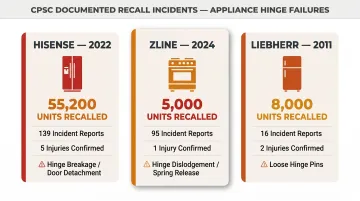
Hinge failure in a consumer appliance triggers warranty claims, brand reputation damage, and potential safety liabilities. Three documented CPSC recalls demonstrate the real-world consequences:
- Hisense (2022): 55,200 French door refrigerators recalled for hinge breakage causing door detachment—139 reports, 5 injuries
- ZLINE (2024): 5,000 wall ovens recalled for hinge dislodgement releasing spring through door trim—95 reports, 1 injury
- Liebherr (2011): 8,000 refrigerators recalled for loose hinge pins—16 reports, 2 injuries
The cost of getting the specification right follows the Rule of Ten: a defect caught in design costs 1x to fix, 3x if caught during manufacturing, and 10x if caught in the field.
For appliance manufacturers, that math is unforgiving. A hinge specification error that costs $500 at the drawing stage will cost $5,000 to retrofit in production, and $50,000 or more per incident once units reach consumers.
Key Hinge Types for Appliance Doors
Engineers encounter four main appliance hinge categories, each with different load, geometry, and motion control implications:
- Concealed/flush hinges — fully hidden when closed; common in built-in refrigerators and integrated dishwashers where seamless cabinet integration is required. Shields the mechanism from dust and grease.
- Lift-off/detachable hinges — enable tool-free door removal for service, cleaning, or shipping. Standard in commercial refrigeration and range ovens where maintenance access takes priority.
- Offset hinges — shift the pivot point outward to create clearance in tight installations. Widely used in walk-in cooler/freezer doors; high-temperature variants (rated to 450°F / 232°C) handle reach-in applications with adjustment for gasket compression.
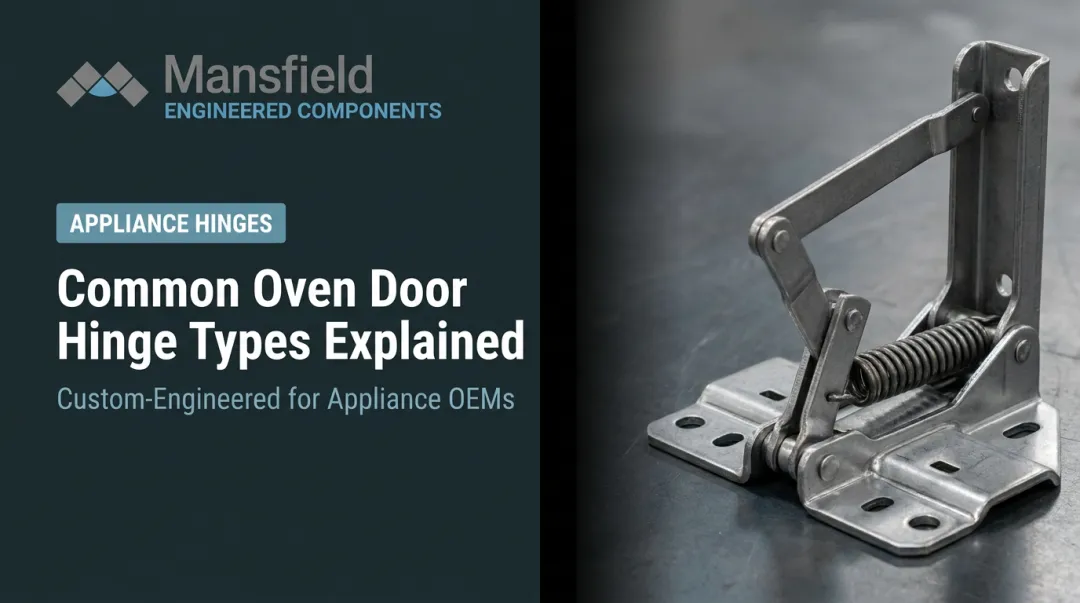
- Counterbalance/spring hinges — integrate extension or compression springs to offset door weight on heavy horizontal drop-down doors (oven doors, grill lids), preventing uncontrolled drop and reducing operator effort.
For built-in refrigerators and dishwashers, a fifth distinction applies: fixed vs. sliding (vario) hinges, determined by baseboard (toe kick) height.
| Hinge Type | When to Use | How It Works |
|---|---|---|
| Fixed | Toe kick below 9 cm (3½ in.) | Cabinet door attaches directly to appliance door; bears combined weight |
| Sliding (vario) | Toe kick 9 cm (3½ in.) or higher | Cabinet door travels independently along the appliance; prevents fouling on the baseboard during opening |
Note: Hinge type selection must follow the engineering criteria evaluation below, not precede it. Choosing a hinge category first and reverse-engineering the specification around it is a common — and costly — mistake.
The Engineer's Checklist: 6 Factors for Selecting the Right Appliance Door Hinge
Each factor below operates as a hard filter: a hinge that fails any single criterion is eliminated regardless of how well it scores elsewhere. Work through them in order.
Factor 1: Door Weight and Dynamic Load Capacity
The hinge must support the full static weight of the door plus dynamic load imposed during opening and closing. For refrigerators, this includes door bin contents (up to 44 kgf/97 lbs documented in Marquette University accelerated life testing). For oven doors, it includes thermal mass of insulated panels.
Calculate required load per hinge and apply appropriate safety factor. For example, Weber Knapp's SI.1 concealed hinge supports doors up to 30 inches wide and 160 lbs; the SI.2 supports 24 inches wide and 40 lbs. Walk-in cooler doors use 14-gauge galvanized steel backing for structural hinge support, with a third hinge added when engineering calculations require it based on door size.
Primary failure mode: Progressive surface wear of hinge cam components leading to door sag. The Marquette study defined failure as 1 mm of vertical deflection, which occurred at 204,604 cycles under 44 kgf load. Undersized hinges accelerate this wear, compromising door seal thermal efficiency and increasing warranty return rates.
Factor 2: Required Cycle Life
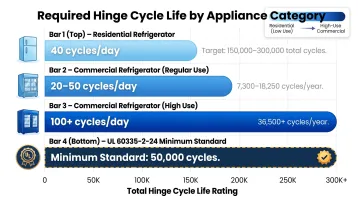
Cycle life specification must match appliance category usage patterns:
- Residential refrigerators: ~40 open/close cycles per day → 14,600 cycles/year
- Commercial refrigerators (regular use): 20-50 cycles/day → 7,300-18,250 cycles/year
- Commercial refrigerators (high use): 100+ cycles/day → 36,500+ cycles/year
The hinge's rated cycle life must exceed the appliance's expected service life at its design cycle rate with margin. For residential refrigerators, this typically means 150,000-300,000 cycle ratings to achieve 10-20 year service life. Commercial applications require proportionally higher ratings.
UL 60335-2-24 requires door switch endurance testing at 50,000 cycles minimum for refrigerators. For commercial food service ovens and walk-in coolers experiencing far higher duty cycles, engineers should calculate required cycle life based on application-specific daily usage rate multiplied by design life in years, not assume residential benchmarks apply.
Factor 3: Operating Temperature Range and Environmental Exposure
Thermal environment is a critical differentiator and directly constrains material selection:
| Material/Component | Max Service Temperature | Application |
|---|---|---|
| Standard spring material | 275°F | General appliance use |
| Standard gas springs | 176°F | NOT suitable for ovens or freezers |
| Kason 0225 hi-temp hinge | 450°F (232°C) | Commercial reach-in ovens/proofers |
| Chrome silicon springs | 475°F | High-heat oven applications |
| 17-7PH stainless steel springs | 600°F | High-performance ovens |
| Inconel 600 spring wire | 700°F | Extreme-heat industrial ovens |
Material and lubricant specification must align to operating temperature. Standard lithium grease breaks down at ~300°F, mandating silicone-based, Teflon-based, or graphite lubricants for cooking appliances. Zinc and galvanized finishes burn off at oven-level temperatures and are unsuitable despite lower cost.
Gas springs are not recommended for extreme heat (explosion risk) or extreme cold (gas contraction and seal leakage)—mechanical springs are required for both ends of the temperature spectrum.
Dishwasher environment: Main wash cycles heat water to 130-140°F; sanitize cycles go higher. Hinges face steam, detergent chemicals, and repeated thermal cycling. Stainless steel components can experience accelerated corrosion from continuous immersion in water above 140°F combined with dishwasher detergent chemistry.
Refrigeration environment: Cold, humid conditions accelerate corrosion on unprotected metals. 300-series stainless steels are standard; specific nickel steel alloys are required for cryogenic applications.
Factor 4: Motion Control Requirements (Soft-Close, Stay-Open, Counterbalance)
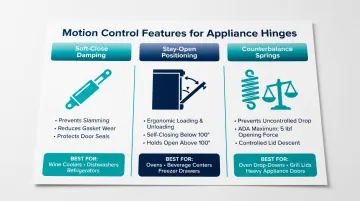
Each motion control feature addresses a specific functional requirement. Specify only what the application demands, then validate under realistic use conditions:
- Soft-close damping: Prevents door slamming, reducing noise, gasket wear, and vibration damage to internal components. Critical for wine coolers (contents disturbance) and dishwashers (glassware rattling).
- Stay-open positions: Improve ergonomics during loading and unloading. Walk-in cooler doors typically set the self-closing dwell point at 100 degrees—past this the door stays open; below it, the door self-closes.
- Counterbalance springs: Required for heavy horizontal drop-down doors (oven doors, grill lids) to prevent uncontrolled drop and operator fatigue. The ADA standard caps interior door operating force at 5 lbf (22.2 N); Whirlpool's ADA-compliant appliance line mirrors this threshold.
Design parameters for counterbalance hinges: OEMs must provide door/lid dimensions, center of gravity, total weight, and desired torque. The interplay of these values determines the counterbalance force profile. Tooling investment ranges from $25,000 (short-term/lower volume) to $250,000 (high-volume/lifetime-grade).
CRITICAL: The choice of motion control feature affects hinge geometry, spring rate selection, and damper specification. These must be prototyped and validated under realistic use conditions, not assumed from catalog specifications alone.
Factor 5: Mounting Geometry and Installation Constraints
The hinge must fit within the appliance's physical envelope:
Available mounting surface area: Dictates hinge footprint and fastener pattern. Walk-in cooler doors use 14-gauge galvanized steel backing to provide sufficient structural support for hinge hardware anchoring.
Door thickness and reveal requirements: For concealed hinges, Weber Knapp's SI.1 and SI.2 feature a 1/8" reveal for flush door panel mounting, enabling seamless integration with surrounding cabinetry.
Clearance for adjacent cabinetry or walls: GE Appliances specifies minimum air clearance of 1/8" to 1" on each side of refrigerators, 1" on top, and 1-2" in the back. These clearances constrain hinge protrusion and swing arc geometry. Offset hinges may be required where standard pivot points create interference.
Swing arc and door-open angle requirements: Arctic walk-in cooler doors use a cam-rise hinge system that lifts the door approximately 1/2 inch upon opening. Confirm swing arc and door-open angle requirements early in the design phase.
Baseboard (toe kick) height for integrated appliances: For integrated dishwashers, a toe kick below 9 cm permits either fixed or sliding hinges; at or above 9 cm, only sliding (vario) hinges are viable because the appliance door would catch on the baseboard during opening with a fixed hinge. This is a hard constraint that determines whether a hinge configuration is even viable before any performance consideration.
Factor 6: Material, Finish, and Corrosion Resistance
Material selection must account for the specific exposure profile of the appliance:
- Stainless steel (minimum 10.5% chromium): Superior corrosion resistance through its chromium oxide layer. It's the standard choice for food-service and commercial environments where corrosion resistance and cleanability are non-negotiable. Austenitic grades perform well across hot and cold environments; ferritic grades favor high-temperature applications.
- Zinc die-cast: Strong strength-to-weight ratio and lower manufacturing cost, but more susceptible to rust under prolonged moisture exposure. Not recommended for water-contact applications. Zinc coatings burn off at oven-level temperatures, making them unsuitable for cooking appliance hinges regardless of cost advantage.
- Plated or coated carbon steels: May be acceptable for sealed residential applications, but require environmental exposure validation. For high-heat applications, specify high-temperature paint, powder coating, or plated finishes (chrome or nickel).
NSF/ANSI 51 compliance: For commercial food equipment, NSF/ANSI 51 (Food Equipment Materials) establishes cleanability, corrosion resistance, impact resistance, abrasion resistance, heat resistance, and coating adhesion requirements. Materials must not adulterate food. Compliance is anchored to 21 CFR Parts 170-199 (FDA food contact regulations). Any hinge in a commercial food-service appliance must meet NSF/ANSI 51 material criteria.
Visible hinges (strap, offset) must also match the appliance's aesthetic finish specification. For premium residential appliances where visual differentiation is a design objective, custom color or surface treatment options should be evaluated for brand consistency.
How Mansfield Engineered Components Can Help
Mansfield Engineered Components has spent over 80 years custom-designing appliance hinges, counterbalances, and motion control components for OEMs including Whirlpool, GE/Haier, Sub-Zero, Bosch, Electrolux, and Wolf Appliance. Every component is engineered to the specific load, cycle life, and motion control requirements of the application — no catalog substitutions, no off-the-shelf compromises.
MEC's 200+ design and manufacturing professionals handle the full development cycle in-house, from concept through validated production. With 250,000+ components shipping weekly, engineering validation is built into the process — not bolted on at the end. In-house testing includes:
- Cycle-life testing to confirm durability targets
- Force and torque measurement across the full motion arc
- Environmental testing covering temperature, humidity, and corrosion exposure
- Hold-at-angle testing for counterbalance components
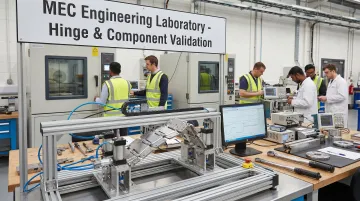
All validation is completed before tooling is cut.
Key differentiators for appliance engineers:
- Custom design solutions for complex hinging needs—no off-the-shelf compromise
- Same-day response to all engineering questions and concerns
- On-time delivery supported by strategic inventory levels aligned to OEM production schedules
- Global sourcing partnerships for cost-effective production at volumes from 5,000 to 5,000,000+ units
- Collaborative design process that treats MEC as an extension of the customer's engineering team
Since joining the Sabaf Group in 2023, MEC combines the manufacturing depth of a global components leader with US-based engineering support and North American time-zone availability. For appliance engineers working under tight development schedules, that means faster design iterations and fewer handoff delays.
Conclusion
Choosing the right appliance door hinge is a systematic engineering decision, not a catalog lookup. The six-factor checklist—load capacity, cycle life, operating temperature, motion control, mounting geometry, and material specification—provides a repeatable framework connecting hinge selection directly to product performance, warranty cost, and end-user satisfaction.
Hinge performance deserves review at each product generation. Evolving designs—heavier insulated doors, higher duty cycle commercial units—may require re-evaluation of existing specifications rather than a direct carry-forward from prior models.
Apply the checklist early, validate prototypes under realistic conditions, and specify with margin. Engineering changes caught during development typically cost 10–100x less than field retrofits; by the recall stage, that ratio climbs further still.
Once the specification is settled, the sourcing question follows. Appliance door hinges are normally bought in bulk against a production schedule rather than piece by piece, and the unit cost falls as annual volumes rise — Mansfield runs bulk hinge programs from about 5,000 pieces to 5,000,000 or more per program, with price breaks at each volume tier and blanket orders released against your build plan.
Frequently Asked Questions
What are the 4 types of hinges?
The four main appliance hinge types are: concealed/flush (hidden when closed, used in built-in refrigerators), lift-off/detachable (tool-free serviceability, common in commercial refrigeration), offset (pivot-point relocated for door clearance), and counterbalance/spring (torque management for heavy horizontal doors). Each serves a distinct combination of aesthetic, accessibility, and load-management needs.
What is the 7 11 hinge rule?
The 7/11 rule is an architectural standard placing building door hinges at 7 inches from the top and 11 inches from the bottom to distribute load and prevent sag. It does not apply to appliance doors, where hinge placement is governed by the appliance design envelope, door weight distribution, and mounting constraints.
What load capacity should an appliance door hinge support?
Residential refrigerator hinges typically support 40–160 lbs; commercial appliance doors often exceed that range considerably. Engineers should calculate static door weight plus dynamic loading factors—door bin contents for refrigerators, thermal mass for oven doors—then apply a safety margin appropriate to the duty cycle.
How many cycles should a commercial appliance door hinge be rated for?
Commercial appliance hinges typically target 300,000 cycles or more, versus far lower thresholds for residential units. Food service environments can see 100+ door openings per day compared to roughly 40 for home appliances, so target cycle life should be calculated from expected daily usage multiplied by design life in years.
What is a counterbalance hinge and when is it needed for appliance doors?
A counterbalance hinge integrates a spring mechanism to offset door weight, preventing uncontrolled drop on heavy horizontal doors such as oven drop-downs or grill lids. It is essential for user safety, ergonomics (reducing operating force to 5 lbs or less per ADA standards), and reducing structural stress on the appliance frame.
What materials are best for oven door hinges versus refrigerator door hinges?
Oven door hinges require heat-stable materials rated for sustained high-temperature exposure: chrome silicon or 17-7PH stainless steel springs (475–600°F), high-temperature lubricants (silicone, Teflon, graphite), and non-zinc finishes. Refrigerator hinges call for corrosion-resistant materials suited to cold, humid environments, with 300-series stainless steel preferred for high-performance applications.