Introduction
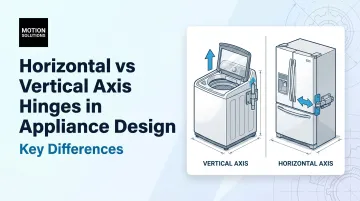
Every time an appliance door opens, the axis around which it pivots — horizontal or vertical — determines more than swing direction. It shapes counterbalancing requirements, door seal performance, user ergonomics, and available clearance, making axis orientation one of the first structural decisions engineers need to get right.
Selecting the wrong orientation can cascade into costly redesigns, sealing failures, or poor user experience — especially in high-cycle applications like ovens, refrigerators, and commercial cooking equipment.
According to industry field data, 60% of appliance door-related failures originate in the hinge, which means early-stage hinge decisions carry real weight for product reliability and warranty costs.
This article breaks down both hinge types, examines their mechanical trade-offs, and offers a practical framework for choosing the right orientation for your application.
Key Takeaways
- Horizontal axis hinges pivot doors up or down (ovens, dishwashers); vertical axis hinges swing doors side to side (refrigerators, freezers)
- Each axis type suits distinct appliance categories — the pivot direction is determined by how the door opens, not preference
- Horizontal axis hinges require engineered counterbalancing because gravity creates variable torque throughout the swing arc
- Vertical axis hinges face door sag over time, side clearance demands, and alignment drift — particularly in heavier doors
- The right choice depends on appliance type, door weight, spatial constraints, seal geometry, and how users interact with the door
- Neither axis is universally superior; the best hinge matches the specific engineering demands of the application
Horizontal vs Vertical Axis Hinges at a Glance
| Attribute | Horizontal Axis | Vertical Axis |
|---|---|---|
| Axis of rotation | Horizontal pivot line | Vertical pivot line |
| Door movement | Swings up or down | Swings left or right |
| Primary counterbalancing need | Spring-assist or counterbalance mechanisms to offset gravity | Minimal counterbalancing; magnetic gasket provides closure force |
| Typical sealing approach | Gravity or spring tension compresses seal | Lateral pull-shut force via magnetic gasket |
| Common appliance applications | Ovens, dishwashers, chest freezers | Refrigerators, upright freezers, wine coolers |
| Space/clearance requirements | Vertical clearance above or below appliance | Lateral clearance for side swing |
The table above captures the mechanical basics. Door weight, cycle count, heat exposure, and user interaction patterns are where these two hinge types diverge most in practice.
What Is a Horizontal Axis Hinge?
A horizontal axis hinge pivots along a horizontal line, causing the door or panel to rotate upward or downward. In appliance design, this orientation is standard when the door must drop down to provide full access to the appliance cavity (ovens, dishwashers) or lift up to open (chest freezers, some drop-down microwave doors).
Mechanical Reality: Variable Torque Curves
As the door swings away from the closed position, the lever arm — the distance between the door's center of gravity and the pivot — changes continuously, creating a variable torque curve that engineers must account for. According to Weber Knapp's engineering analysis, the engineering objective is to match the spring rate with the change in gravitational force, producing "near-constant opening force" throughout the range of motion. Two primary methods achieve this:
- Variable-geometry internal lever arm that changes configuration as the spring expands
- Variable pulley that increases or decreases in size during spring expansion
Without engineered counterbalancing, horizontal axis doors either feel heavy to open or slam shut — creating safety hazards and poor user experience.
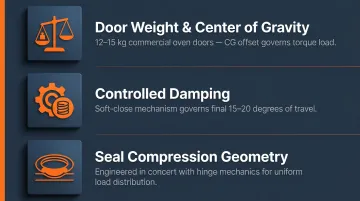
Three design variables drive the engineering brief for any horizontal axis hinge system:
- Door weight and center of gravity — commercial oven doors typically weigh 12–15 kg, and the center of gravity position determines the full torque profile the counterbalance must offset
- Controlled damping — drop-down doors require damping to prevent slamming; soft-close systems govern the final 15–20 degrees of closure, protecting internal components while delivering a quality feel
- Seal compression geometry — bottom-hinged doors that rely on gravity to hold shut require the sealing system to be designed in concert with the hinge mechanics, or thermal efficiency suffers
Variations in Horizontal Axis Hinges
- Top-mounted (door drops down): Standard on residential and commercial ovens — the hinge is in tension during opening and requires spring-assist to control descent
- Bottom-mounted (door lifts up): Less common; chest freezers with back-hinged lids use this configuration
- Integrated counterbalance hinges: Used on heavier commercial doors where unassisted lifting creates ergonomic or safety issues — pivot mechanism and counterbalance spring are combined in a single assembly
Use Cases of Horizontal Axis Hinges in Appliance Design
Horizontal axis hinges dominate these appliance categories:
- Residential and commercial ovens: Bottom-hinged drop-down doors provide ergonomic access for loading heavy cookware
- Dishwashers: Door hinges at the bottom and pivots forward, creating a stable platform for loading racks
- Chest freezers: Lid lifts from the back hinge, typically with spring-assist to reduce lifting effort
- Commercial cooking equipment: Drop-down access panels on convection ovens, combi ovens, and deck ovens
High-heat applications add another layer of engineering complexity. Commercial oven hinges must survive 500+ self-clean cycles at 425°C while holding torque stability within ±10% from room temperature to 200°C.
That thermal requirement drives material selection toward hardened 420 stainless steel at 52 HRC for pins and knuckles, with INOX 304 or 430 stainless steel for body components.
What Is a Vertical Axis Hinge?
A vertical axis hinge pivots along a vertical line, causing the door to sweep horizontally — either left or right. This orientation is the default for appliance doors that need to open into the room without requiring clearance above or below, and it mirrors how most cabinet and furniture doors work.
Mechanical Behavior: Gravity Acts Parallel
Because the pivot is vertical, gravity acts parallel to the hinge axis rather than perpendicular to it. The door's weight doesn't directly resist the opening motion, eliminating the need for complex counterbalancing. However, this same gravity load acts as a downward force on the hinge pins and door structure, making door sag and long-term alignment drift the primary engineering concern.
Research on residential refrigerator hinges found that polyacetal hinge cams reach the 1mm sag failure threshold at approximately 204,604 cycles, predicting 14-15 year service life at 40 cycles per day. For tall, heavy refrigerator or freezer doors, sag tolerance is the primary wear metric.
Key Design Considerations
Four variables most directly affect vertical axis hinge performance and longevity:
- Hinge placement along door height — top-heavy doors need upper hinge reinforcement; bottom-loaded doors (deep storage drawers, heavy crisper compartments) need lower bearing support
- Swing direction — fixed left- or right-hand hinges reduce part complexity; field-reversible designs allow consumers to reconfigure during installation but require symmetrical mounting geometry
- Bearing surfaces — heavy doors require hardened steel hinge pins and reinforced brackets; worn bearing surfaces are the primary driver of sag in 10-15 year service life targets
- Gasket integration — unlike drop-down doors that gravity-seal, horizontal swing doors rely on magnetic gasket strips embedded in flexible rubber to provide consistent lateral pull-shut force
Variations in Vertical Axis Hinges
Beyond the standard single-pivot design, two variations appear in premium and high-load applications:
- Field-reversible hinges — symmetrical geometry lets installers flip swing direction on-site, useful for kitchen reconfigurations or flexible appliance placement
- Multi-link vertical hinges — four-bar linkage designs guide the door through a controlled arc, preventing lateral twisting under load; Weber Knapp's concealed four-bar linkage hinge for Sub-Zero's 700 Series supports a 143-lb (65 kg) wood-paneled door with a self-closing bias that engages at 30 degrees
Use Cases of Vertical Axis Hinges in Appliance Design
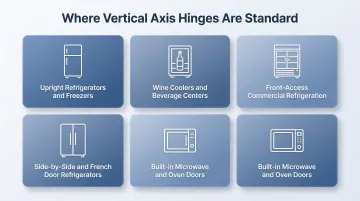
Vertical axis hinges are standard in:
- Upright refrigerators and freezers: Tall door height makes drop-down access impractical
- Wine coolers and beverage centers: Side-swing access matches user interaction patterns
- Side-by-side and French door refrigerators: Multiple vertical axis doors per unit
- Front-access commercial refrigeration units: Walk-in coolers, reach-in refrigerators
- Some microwave and built-in oven doors: Where vertical swing clearance is constrained
In refrigeration applications, hinge performance has a direct energy cost. Approximately 35% of total refrigerator heat leakage comes from ambient air seeping through door gaskets.
A door that doesn't seal properly — due to hinge sag or alignment drift — forces the compressor to run longer, driving up energy consumption and creating food safety risks.
Horizontal vs Vertical Axis Hinges: Which Is Better for Your Appliance Design?
The comparison isn't about which axis is mechanically superior — it's about which orientation aligns with the appliance's spatial envelope, access pattern, door weight, and sealing geometry.
Clearance and Spatial Constraints
Horizontal axis hinges require vertical clearance above or below the appliance cavity for the door arc. In built-in or under-counter applications with limited overhead space, this can be a hard constraint — oven doors dropping 60–90 degrees require floor clearance and room for the user to step back.
Vertical axis hinges require lateral clearance and enough room to fully open in the installed environment. In galley kitchens or side-by-side configurations, a 36-inch refrigerator door swinging 90 degrees into the room can block adjacent walkways — a common constraint that gets underestimated in early design.
Counterbalancing and Engineering Complexity
Horizontal axis hinges — especially on heavy oven or commercial cooking doors — almost always require engineered counterbalance or spring-assist solutions to make the door controllable and safe throughout its swing. The variable torque curve demands cam-link mechanisms, variable pulleys, or precisely calibrated torsion springs.
Vertical axis hinges generally require less counterbalancing but demand more attention to bearing load distribution and door-weight management over the product's service life. The primary engineering effort goes into preventing sag rather than offsetting gravity.
Seal Geometry and Performance
Sealing behavior differs meaningfully between the two orientations:
- Horizontal axis doors rely on gravity or spring force for seal compression. Door weight naturally seats the gasket along the top edge, but side and bottom seals depend on spring tension or magnetic attraction to maintain contact.
- Vertical axis doors create seal contact through horizontal pulling force, which tends to produce more uniform compression across the full perimeter. The gasket strip must still overcome air cell resistance and the weight of door-mounted contents to seat properly.
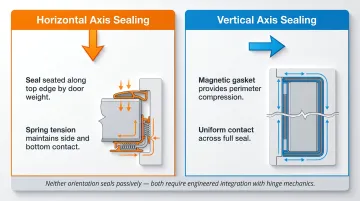
The key takeaway: neither orientation seals itself passively. Both require the sealing system to be engineered in concert with the hinge mechanics from the start.
Situational Recommendations
Choose horizontal axis when:
- The appliance requires drop-down access for ergonomic loading (ovens, dishwashers)
- Vertical clearance is available and the door swing won't obstruct users
- The design team can engineer appropriate counterbalancing within budget
- The door weight is heavy enough that a side-swing would create ergonomic issues
Choose vertical axis when:
- Lateral swing access is practical in the installation environment
- The installation environment constrains vertical space (under-counter, built-in)
- The appliance requires reversible door swing capability
- The door height makes drop-down access impractical (tall refrigerators)
Real-World Applications and Design Considerations
The choice of hinge axis becomes visible across the appliance landscape. Oven manufacturers standardize on bottom-hinged horizontal doors because drop-down access is the most ergonomic for loading heavy cookware. Refrigerator manufacturers use vertical axis hinges because the door height makes drop-down access impractical and side swing matches how users interact with the appliance throughout the day.
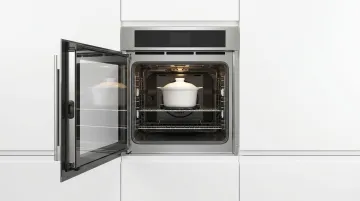
Those conventions aren't always fixed. Whirlpool's side-swing oven door for Latin America showed how axis orientation can become a deliberate design variable. The door shared the same 30-inch product platform and most existing parts from drop-down models, but the axis change delivered measurable ergonomic gains:
- Swings more than 100 degrees from the cavity opening
- Holds position via a mechanical detent — no hands needed
- Eliminates the drop-down door barrier, letting users stand directly in front of the oven cavity and reducing reaching distance
When Off-the-Shelf Solutions Fall Short
For complex or premium appliances — particularly commercial cooking equipment and built-in refrigeration — off-the-shelf hinge solutions often fall short. The specific combination of door weight, swing arc, counterbalance requirement, and sealing geometry requires custom-engineered hinge assemblies.
Mansfield Engineered Components' approach reflects this reality. Their engineers design and test hinge assemblies specific to each axis orientation and application, with customers including Bosch, GE/Haier, Sub-Zero, and Whirlpool.
Engineers working through a horizontal vs vertical axis hinge decision should engage Mansfield's engineering team early in the design process to ensure hinge geometry, counterbalance system, and sealing interaction are resolved before tooling is committed.
Contact Mansfield's engineering team at jim.collene@mansfieldec.com or +1.419.524.1300 to discuss your specific appliance hinge requirements.
Conclusion
Horizontal axis hinges suit appliances where drop-down or lift-up access is the ergonomic standard and where the design team can engineer around the counterbalancing demands. Vertical axis hinges suit appliances where lateral swing access is natural and the primary challenge is managing door weight and alignment over product lifetime. Neither is a default — the right choice follows directly from the appliance type, installation context, and how users interact with it across thousands of cycles.
In both cases, the hinge axis is not an isolated component decision: it sets the parameters for the entire door system. The downstream effects include:
- Spring selection and counterbalance force curves
- Seal geometry and compression consistency
- Bearing load distribution across the pivot
- Expected cycle life under real-use conditions
Engineers who treat hinge axis selection as a first-principles decision rather than a default convention will build more reliable, more ergonomic, and more energy-efficient appliances.
Axis choice also sets what gets bought in bulk. Because the hinge axis determines spring, seal, and bearing selection, standardizing it across a product family consolidates order quantities onto fewer part numbers, which improves bulk pricing and leaves fewer separate programs to schedule and stock.
Frequently Asked Questions
What appliances most commonly use horizontal axis hinges?
Horizontal axis hinges dominate in residential and commercial ovens, dishwashers, chest freezers, and commercial drop-down cooking equipment. In each case, the door drops forward or lifts from the back — a motion that provides ergonomic access for loading and unloading heavy items.
What appliances most commonly use vertical axis hinges?
Upright refrigerators, freezers, wine coolers, side-by-side and French door appliances use vertical axis hinges. The tall door height and user interaction pattern (frequent daily access) make horizontal axis impractical, and the side-swing movement mirrors intuitive cabinet door operation.
How does hinge axis orientation affect door sealing performance?
Horizontal axis doors typically rely on gravity or spring tension to compress the door seal, creating natural compression along the top edge. Vertical axis doors compress the seal through lateral pull-shut force via magnetic gaskets. Misalignment or inadequate counterbalancing in either case directly degrades seal performance and increases energy loss.
Why do horizontal axis hinges often require counterbalancing systems?
A door's weight creates variable torque against the pivot throughout its swing arc. Without counterbalancing, horizontal axis doors feel heavy to open or slam shut. Springs, torsion elements, or counterbalance mechanisms resolve this by matching spring force to the changing gravitational moment arm.
Can a hinge be designed to function on both horizontal and vertical axes?
Most appliance hinges are purpose-built for one axis orientation. Some articulating or multi-axis designs exist for specialized applications, but load paths, seal requirements, and spring geometries differ so fundamentally between axes that dedicated designs are more reliable and cost-effective.
What engineering factors should teams evaluate first when selecting a hinge axis?
Assess available clearance (vertical vs. lateral), door weight and center of gravity, required seal geometry, user access pattern, and whether the appliance installation requires reversibility. These factors should drive the decision before defaulting to a conventional axis choice based solely on appliance category.