Introduction
In appliance engineering, a hinge is never "just hardware." Choosing between a custom-engineered solution and an off-the-shelf component has direct consequences for door performance, warranty exposure, and how long your product holds up in consumers' hands.
The stakes are measurable. Door-related issues drive up to 40% of oven warranty claims, and the appliance industry's 22-year average warranty claims rate sits at 1.95% of revenue. For Whirlpool alone, that translated to $245M in warranty claims in 2024.
Sourcing an off-the-shelf hinge can save weeks and reduce tooling costs—but it can also force design compromises on fit, motion feel, and cycle life that undermine quality targets and brand positioning.
This guide gives appliance engineers and procurement teams a clear framework for weighing performance requirements, volume, timeline, and differentiation—so the hinge decision supports your program goals, not just your budget.
Key Takeaways
- Off-the-shelf hinges offer speed and lower upfront cost; custom hinges deliver precision fit and application-specific performance
- The right choice depends on load and motion requirements, cycle life standards, geometric fit constraints, production volume, time-to-market pressure, and brand positioning
- Many programs benefit from a hybrid approach: catalog solutions for standard SKUs and custom hinges for flagship or high-cycle products
- Custom development requires early supplier engagement (18–24 weeks typical); catalog parts need vetting for appliance-grade cycle and temperature ratings
- Choosing a partner with expertise in both options simplifies evaluation and reduces risk
Off-the-Shelf vs. Custom Appliance Hinges: What's the Difference?
Off-the-shelf (catalog) hinges are pre-engineered, stocked components available in standard sizes, materials, and torque ratings. They're designed to meet the needs of a broad range of applications without modification, with published specifications for load capacity, cycle life, and dimensional envelopes.
Custom appliance hinges are engineered from the ground up to meet a specific appliance's dimensional envelope, load profile, motion curve, cycle life target, finish requirement, or regulatory specification. No catalog. No compromises.
Both paths apply across the same core hinge types used in appliance programs:
- Butt/pivot hinges — pin-and-leaf designs that hold 34.7% of global market share; simple but often the first compromised by standard sizing
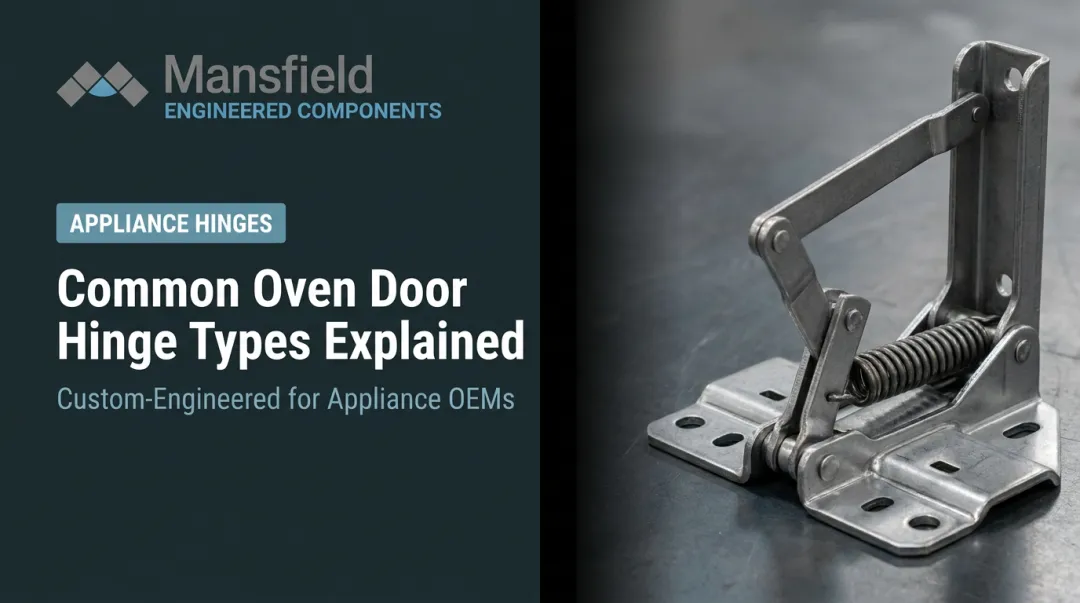
- Four-bar linkage hinges — multi-link mechanisms that control door trajectory and enable soft-close behavior; geometry-sensitive enough that off-the-shelf rarely fits
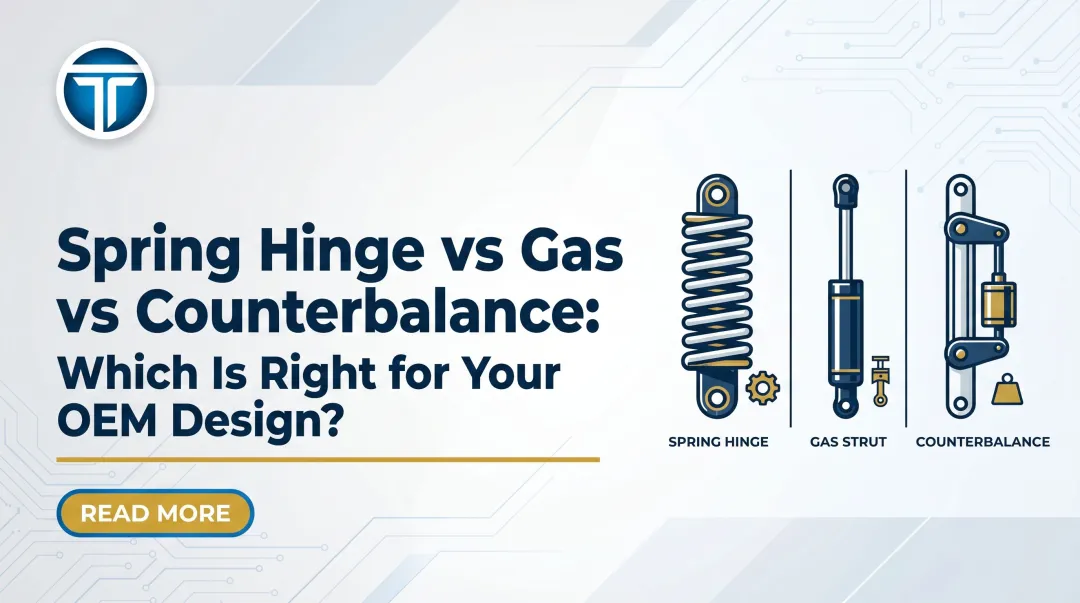
- Lid-stay/counterbalance hinges — spring or gas strut mechanisms that offset door weight; load and travel requirements almost always require custom calibration
- Concealed hinges — hidden when the door is closed, growing at a 6.4% CAGR in premium appliances where aesthetics drive the spec
Key Factors to Consider When Your Appliance Program
Key Factors to Consider When Evaluating Your Appliance Program
Selecting between custom and off-the-shelf is an engineering and business decision shaped by six factors, each connecting directly to downstream KPIs such as warranty cost, assembly time, cost-per-unit, and consumer satisfaction scores.
Load Profile and Motion Requirements
Start here. Appliance hinges carry highly variable loads—an oven door tested at 50 lb to meet UL standards requires a counterbalance spring, while a dishwasher panel-ready door handles 4.5-12 kg panels. Catalog hinges are rated for load ranges; if the appliance's door weight, center of gravity, or required motion curve falls outside that envelope, a custom solution becomes necessary.
Torque calculation is straightforward but application-specific: Torque = Weight (kg) × Distance from center of gravity to hinge axis (m) × 9.8. A lightweight door with the center of gravity positioned further from the hinge axis may require more torque than a heavier door with closer mounting.
KPIs affected:
- Door sag over product life
- Consumer-perceived quality of door motion
- Field return rates tied to hinge failure
Cycle Life and Durability Standards
Appliance OEMs must meet internal or industry-standard cycle life requirements. IEC 60335 series standards define the regulatory floor, but requirements vary dramatically by appliance type:
| Appliance Type | Standard | Cycle Requirement |
|---|---|---|
| Pyrolytic ovens | IEC 60335-2-6 | 5,000 door cycles at 90N force |
| Microwave ovens | IEC 60335-2-25 | Up to 100,000 cycles |
| Refrigerator doors | UL 60335-2-24 | 300,000 cycles (wiring flex test) |
| Tumble dryers | IEC 60335-2-11 | 6,000 cycles |
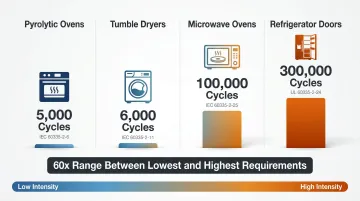
That 60x range in cycle requirements reflects entirely different use profiles. Off-the-shelf hinges rarely come with documented appliance-grade cycle life data, so the buyer must conduct their own validation testing. Custom suppliers like Mansfield Engineered Components design and validate to the stated cycle target from the start, eliminating that burden.
Geometric Fit and Integration Complexity
Appliance chassis are tightly packaged. Standard hinges are built around generalized hole patterns and flange geometry — not your specific chassis. Common constraints that force a custom solution include:
- Mounting boss patterns that don't align with catalog footprints
- Door panel thickness or reveal requirements outside standard ranges
- Clearance limits to internal components (wiring, insulation, control boards)
- Motion arc requirements that conflict with a standard pivot geometry
The more constrained the design envelope, the stronger the case for custom engineering.
Using an off-the-shelf hinge in a non-standard application often requires workaround brackets or assembly modifications that add cost, increase assembly variation, and introduce new failure modes.
Production Volume and Tooling Economics
Custom hinges require upfront tooling investment that must be spread across a production run. Stamping dies average $10,000-$50,000 (typically $15,000+) with annual maintenance of $2,000-$5,000. Stamping becomes cost-advantaged only above approximately 10,000 units annually.
| Cost Factor | Stamping | Laser Cutting |
|---|---|---|
| Tooling investment | $10,000-$50,000 | $0 |
| Per-unit cost (small batch) | $14.20 | $8.50 |
| Breakeven volume | Above 10,000 units | Below 3,000 units |
| Tooling lead time | 4-8 weeks | N/A |
For low-volume programs, specialty runs, or service parts, catalog hinges often provide lower total cost. Stress-test volume projections against your program's expected life before committing to custom tooling.
Time-to-Market and Supply Chain Readiness
Custom hinge development adds significant time to a program timeline. Based on published validation frameworks, expect:
| Phase | Duration |
|---|---|
| Tooling fabrication | 4-8 weeks |
| EVT (Engineering Validation) | 5 weeks |
| DVT (Design Validation) | 6-8 weeks |
| PVT (Production Validation) | 3 weeks |
| Total | 18-24 weeks |
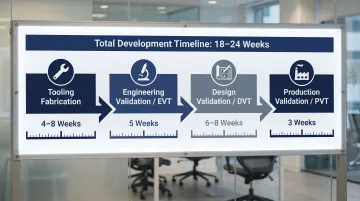
Off-the-shelf hinges can be sourced and qualified much faster—typically 1-4 weeks—making them the practical choice when a launch window is fixed.
Supply chain risk: Catalog components sourced from multiple distributors offer redundancy. Custom components tie the program to a single supplier relationship, making supplier qualification and capacity planning more critical.
Brand Differentiation, Aesthetics, and Regulatory Compliance
Premium appliance brands use hinge motion, feel, and appearance as tangible quality signals. A door that closes with a precise, damped arc communicates craftsmanship in a way a standard hinge cannot.
The data supports this: OEMs adopting soft-close hinge technology report customer ratings increasing by more than 0.5 stars and NPS door-slamming complaints dropping from 18% to below 2%. These improvements enabled average price premiums of $30-$45 per unit.
Custom hinges let the OEM engineer a proprietary motion profile and match exposed finishes to the appliance's design language.
Regulatory requirements add another layer: specific certifications (UL, CE, NSF for commercial food equipment) may require a custom supplier who designs to the spec from the outset. In those cases, catalog components may not meet the standard at all.
Decision Framework: Off-the-Shelf, Custom, or Hybrid?
Most mature appliance programs map each door or hinge point to the six factors above and make the selection at the SKU level — not across the program as a whole.
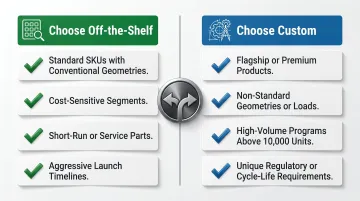
When Off-the-Shelf is the Right Call
Catalog hinges are the logical choice for:
- Standard product-line SKUs with conventional door weights and geometries
- Cost-sensitive segments where tight margins make tooling investment hard to justify
- Short-run or service-replacement needs
- Programs with aggressive launch timelines that cannot accommodate custom development cycles
When Custom is the Right Call
Custom engineering is justified for:
- Flagship or premium-tier products where door motion is a brand differentiator
- Appliances with non-standard geometries or load profiles that fall outside catalog ratings
- High-volume programs where per-unit cost savings from optimized design quickly offset tooling investment (typically above 10,000 annual units)
- Programs with unique regulatory, thermal, or cycle-life requirements
The Hybrid Approach: Matching Solution Type to Product Tier
Many appliance OEMs run a mixed strategy: catalog hinges for entry and mid-tier lines to protect margins and speed time-to-market, while investing in custom-engineered hinges for premium or flagship products where design differentiation and performance justify the cost.
In practice, this often means splitting sourcing across two supplier relationships — a catalog supplier for the volume tiers and a dedicated custom-engineering partner, like Mansfield Engineered Components, for the premium end where performance tolerances are tighter and brand expectations are higher.
The financial stakes make this worth structuring carefully. Warranty claims average 1.22% of revenue across the appliance industry. One European OEM saved the equivalent of roughly $200,000 USD annually in service costs after switching to soft-close hinges, with defect rates dropping from 3.2% to 0.8%.
How Mansfield Engineered Components Can Help
With over 80 years of appliance hinge engineering experience, Mansfield Engineered Components (MEC) partners with OEMs that need custom-engineered solutions—not catalog parts adapted to fit. The company's 200+ design and manufacturing professionals build every motion control component to customer specifications from the ground up.
MEC serves global appliance brands including Whirlpool, GE/Haier, Bosch, Sub-Zero, Electrolux, and Viking, shipping over 250,000 motion control components per week. The company's custom design process includes:
- Designs each component around your appliance's specific load profile, motion curve, cycle life target, and geometric constraints
- Builds and tests prototypes in-house—covering cycle-life testing, force and torque measurement, environmental testing, and hold-at-angle validation—before committing to production
- Responds to all customer questions and concerns the same day
- Supports production volumes from 5,000 to 5,000,000+ units through strategic inventory management
As part of the Sabaf Group since 2023—one of the world's leading manufacturers of mechanical and electronic components for household appliances—MEC combines North American manufacturing with global sourcing partnerships to give programs access to offshore manufacturing when volume economics or lead times call for it.
Conclusion
The goal is not to find the most sophisticated hinge, nor the cheapest one, but the one that aligns with the appliance program's specific performance requirements, volume profile, timeline, and brand positioning. That answer often differs by product tier within the same program — a mid-range model and a flagship unit rarely share the same hinge criteria.
Treat hinge selection as a recurring engineering review, not a one-time sourcing decision. Reassess the catalog-versus-custom balance whenever any of these conditions apply:
- Volume crosses a threshold where custom tooling becomes cost-neutral or advantageous
- Performance specs tighten due to regulatory, safety, or consumer expectation changes
- Program differentiation becomes a competitive priority in a given product tier
When programs consistently push against what catalog solutions can offer, that's the signal to engage a custom engineering partner early — before a product launch forces a reactive redesign.
Volume is usually the deciding variable. Once a program buys hinges in bulk, the tooling investment behind a custom part amortizes quickly and the volume price break can put the engineered hinge below the catalog part on unit cost — so run the comparison at your actual annual order quantity, not at catalog list price.
Frequently Asked Questions
What are the 4 types of hinges?
The four primary hinge categories are butt/pivot (simple pin-and-leaf), continuous/piano (long hinge spanning the full edge), concealed/European (hidden when door is closed), and specialty/counterbalance hinges (incorporating springs or gas struts). In appliance applications, butt/pivot and concealed hinges are most common, with four-bar linkage designs used where controlled motion paths are required.
What is the strongest hinge design?
Load capacity depends on material, geometry, and fastening method. Heavy-duty butt hinges and four-bar linkage designs engineered for specific load profiles typically offer the highest strength in appliance contexts. "Strongest" is relative: a hinge rated for 100 lb static load may fail quickly if the design doesn't match your application's motion profile and cycle count.
When should an appliance manufacturer choose a custom hinge over a catalog option?
Choose custom when the door load or geometry falls outside catalog ratings, when cycle life or regulatory requirements exceed what off-the-shelf data sheets support, or when door motion quality is a brand differentiator in a premium product segment. Custom also makes economic sense above approximately 10,000 annual units, where tooling amortization beats catalog component pricing.
How long does custom appliance hinge development typically take?
Custom development typically spans 18-24 weeks from design freeze to production readiness, covering tooling fabrication (4-8 weeks), engineering validation (5 weeks), design validation (6-8 weeks), and production validation (3 weeks). Initiate hinge development in parallel with appliance platform design, not after chassis freeze, or the timeline will compress your launch window.
Can off-the-shelf hinges meet appliance-grade cycle life and temperature requirements?
Some catalog hinges are engineered to appliance-grade standards with documented cycle life data, but many general-purpose options are not. Before qualifying a catalog component, require test data specific to appliance operating conditions. IEC requirements range from 5,000 cycles (ovens) to 300,000 cycles (refrigerators), and generic catalog specs rarely align with those targets.
What is the typical minimum order quantity for custom appliance hinges?
MOQs vary by manufacturer and design complexity, tied to tooling cost amortization. Custom stamping typically becomes cost-effective above 10,000 annual units, though some suppliers (like MEC) operate with no minimum-order constraints, serving programs from 5,000 to 5,000,000+ units.