Introduction
Oven door counterbalances rarely appear at the top of appliance design spec sheets, yet they govern user safety, door alignment, heat retention, and long-term reliability. A misspecified counterbalance creates doors that slam shut unexpectedly, sag over time, or fail prematurely—driving warranty costs and potential safety liability.
The real engineering challenge is translating door geometry, weight distribution, and thermal exposure into a mechanism that delivers neutral feel across thousands of cycles. This article covers:
- How counterbalances work mechanically
- The key engineering inputs you must define before specifying
- Main mechanism types and their trade-offs
- Oven-specific thermal challenges
- Failure modes to design against
Key Takeaways
- A counterbalance stores mechanical energy in a spring or gas cylinder and releases it to offset gravitational torque throughout the door's motion arc
- Critical design inputs: door weight, CG location, pivot geometry, torque curve, handle force limits, and cycle life
- Torsion springs, extension springs, and gas cylinders each carry different trade-offs across cost, packaging, temperature resistance, and damping
- Thermal cycling, especially during self-clean operation, degrades spring rate; this demands careful alloy selection and heat stabilization processes
- Residential designs target ~50,000 cycles; commercial applications require 100,000+, which drives material and geometry decisions
How Oven Door Counterbalances Work
The Torque Balance Principle
A counterbalance must provide spring torque (force × moment arm) that equals and opposes the gravitational torque of the door at every angle across its full opening arc. When properly designed, the door feels neutral to the user at all positions—neither pulling open nor falling shut.
When the torque curve is not properly matched, the door behaves unpredictably. At angles where spring torque exceeds door torque, the door coasts open or slams. Where door torque exceeds spring torque, it coasts closed or falls. Engineers should target a torque mismatch within the 5 lbf (22.2 N) ergonomic benchmark described below throughout the full travel arc.
Handle force standards:
- ADA Standards Section 309.4 caps force for operable parts—including appliance handles—at 5 lbf (22.2 N) maximum
- Neither UL 858 nor IEC 60335-2-6 specifies a maximum oven door opening force; OEMs should adopt the ADA 5 lbf limit or an internal ergonomic benchmark
True counterbalance vs. spring assist:
- A true counterbalance keeps the door stationary at any angle when released
- A spring assist only offsets part of the weight; the door will still drift
- Clarify which is required for your use case before specifying the mechanism
Pivot Geometry and Center of Gravity
Torque balance doesn't exist in isolation—it's directly shaped by where the pivot sits relative to the door's center of gravity (CG).
Pivot placement defines the torque demand at each degree of opening. Shifting the pivot up, down, or outward changes the moment arm and reshapes the entire torque profile across the travel arc. That's why engineers must map the door's CG before selecting or specifying a counterbalance mechanism.
Two geometry concepts drive the design:
- Moment arm: The perpendicular distance from the pivot to the door's CG; even small positional changes here alter the torque curve significantly
- Balance angle: The specific opening angle at which door torque equals spring torque; counterbalance design targets this angle within the usable travel range so the door holds position in typical use
Key Engineering Parameters for Counterbalance Design
Door Weight and Center of Gravity Position
- Establish total door mass, including glass, inner panel, insulation, gaskets, and handle
- Measure the horizontal distance from the pivot axis to the CG at the fully open (horizontal) position — this gives peak torque demand
- Glass-heavy doors and solid steel doors have significantly different CG locations and different torque profiles
That CG position feeds directly into the torque profile — the core input for every spring specification.
Required Torque Range Across the Opening Arc
- Calculate torque at each 10–15 degree interval from closed (0°) to fully open
- This torque profile becomes your spring specification
- Define the full opening angle; some oven models exceed 90° for broil or storage drawer access, extending required spring travel
Handle Force Targets
- Specify the maximum allowable opening force a user must apply throughout the door's travel arc
- Driven by ergonomic standards, product category requirements, and ADA or regulatory compliance
- The counterbalance spring must be tuned to keep residual handle force within this limit at all angles
Cycle Life Requirement
Cycle life isn't just a warranty figure — it determines spring alloy, wire diameter, and stress ratio.
- Define the minimum number of open/close cycles based on product category and warranty commitment
- Residential: Approximately 50,000 cycles
- Commercial: 100,000+ cycles (per ASTM F2057-21 cited by HRB Industries)
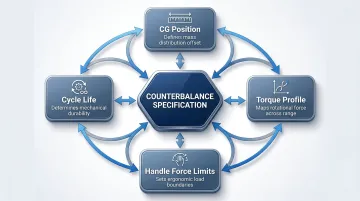
These four parameters — CG position, torque profile, handle force limits, and cycle life — are interdependent. Changing one affects all the others, which is why getting the specification right early matters.
Working with an engineering partner like Mansfield Engineered Components, who custom-designs counterbalances around your specific door geometry rather than adapting catalog springs, compresses that iteration into a defined modeling process. Engineers get a validated torque profile before the first prototype is cut.
Counterbalance Mechanism Types for Oven Doors
Torsion Spring Counterbalances
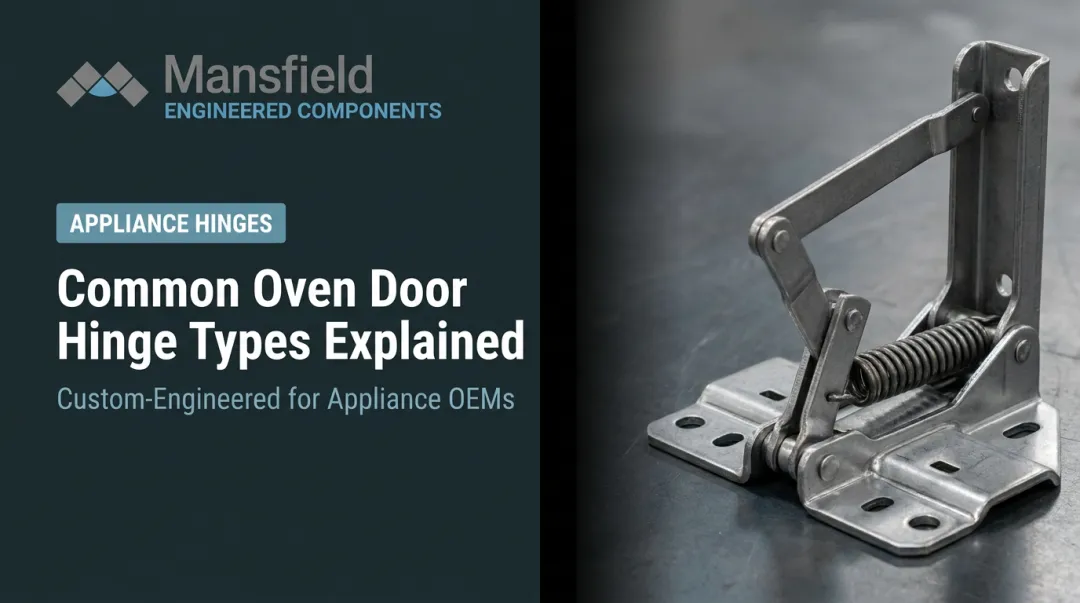
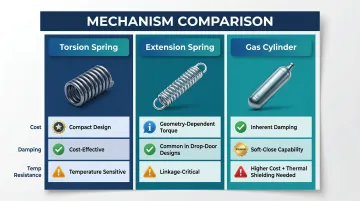
Torsion springs are the most widely used mechanism in residential oven doors. They integrate compactly into the hinge assembly, are cost-effective at volume, and deliver predictable torque output determined by wire diameter, coil diameter, active coils, and material. These variables are tuned to hit the target torque curve; a tighter torque tolerance (e.g., ±5%) requires tighter coiling process control.
Key limitation: Torsion spring steel is sensitive to elevated temperature. At temperatures near oven hinge mounting points—and particularly during self-clean cycles—spring steel experiences stress relaxation (set), causing permanent loss of torque.
Mitigation:
- Alloy selection: High-temperature chrome-silicon or chrome-vanadium alloys
- Pre-setting during manufacturing to minimize set
- Chrome-silicon (ASTM A401): Rated to 475°F (246°C) with a "Fair" fatigue rating
- Chrome-vanadium (ASTM A231): Rated to 425°F (218°C) with an "Excellent" fatigue rating
- Chrome-silicon outperforms chrome-vanadium by 50°F but carries a fatigue trade-off
Extension Spring Counterbalances
Extension spring configurations are common in pull-down or drop-door oven designs. As the door opens, the spring stretches and the linkage geometry converts that linear force into rotational torque — making geometry the primary lever for shaping the torque curve.
Engineers must model this carefully. Key design variables to control:
- Pivot location: Small shifts can create torque spikes at the start or end of the opening arc
- Spring attachment point: Altering attachment geometry redistributes torque across the swing range
- Dead spots: Insufficient torque mid-arc leaves the door feeling heavy or unstable at certain angles
- Linkage ratio: Determines mechanical advantage at each position; model across the full arc, not just at open/closed positions
Gas Spring / Gas Cylinder Counterbalances
Gas springs offer consistent force delivery across a wider temperature range, inherent damping capability (enabling soft-open and soft-close behavior), and adjustment potential. They carry higher component cost but can measurably improve perceived quality and reduce slam-related glass breakage.
Temperature limitations:
- Standard gas springs (Stabilus, SUSPA, Gemini) are rated at -30°C to +80°C
- No manufacturer publishes a high-temperature oven variant
- Gas springs in oven applications require thermal shielding or remote mounting away from oven heat zones
Seal and fluid selection:
- Standard NBR seals fail at approximately 120°C
- Viton/FKM seals tolerate up to 205-230°C depending on grade
- Gas springs require careful seal and fluid selection to prevent pressure loss or fluid degradation in high-temperature environments
Thermal and Environmental Challenges Unique to Ovens
Oven counterbalance components operate in one of the harshest thermal environments of any appliance application — and self-clean cycles push conditions well beyond normal operating limits.
Operating temperature ranges:
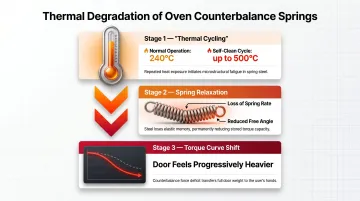
- IEC 60335-2-6 normal operation: Conventional ovens at 240°C ± 4°C (464°F ± 7°F)
- Self-clean surges: Up to 500°C (932°F) at cavity; hinge-point temperatures are lower but still exceed standard component ratings
- Commercial oven hinges specified for 200°C ambient operating temperature
Thermal cycling degrades spring performance over time in three compounding ways:
- Repeated heating and cooling causes spring relaxation — loss of rate and free angle — that shifts the torque curve
- A shifting torque curve makes the door feel progressively heavier across the product's service life
- Spring alloy, wire diameter, and heat-stabilization process (pre-setting at elevated temperature) must all be specified for the operational temperature range, not just room-temperature performance
Lubrication requirements at counterbalance pivot points:
- Standard petroleum-based greases degrade at approximately 285°F (140°C)
- High-temperature synthetic greases rated for the expected temperature range are required
- PFPE synthetics (for example, Krytox XHT) tolerate up to 300°C (572°F)
- Verify that lubricant selection is compatible with spring and bracket materials to avoid galvanic or chemical degradation
Common Failure Modes and How to Avoid Them
Spring Fatigue Fracture
Fatigue fractures initiate at stress concentrations — typically at the spring ends or coil contact points — when a spring is operated above its design stress ratio. Left unaddressed, this failure mode is sudden and catastrophic.
Mitigation strategies:
- Specify an appropriate safety factor on working stress
- Use shot-peened wire to improve fatigue life (up to 5x improvement documented in peer-reviewed literature)
- Ensure correct end geometry to minimize stress concentration
- Research published Wöhler curve data for the selected spring alloy at operating temperature
Spring Set and Torque Loss
A door that gradually feels heavier — or won't hold at horizontal — is the signature symptom of spring set. It's the most common functional failure in oven counterbalance applications, caused by permanent deformation of the spring under sustained high-temperature load.
Mitigation requirements:
- High-temperature alloy selection (chrome-silicon or chrome-vanadium)
- Heat stabilization (pre-setting) of the spring after coiling
- Verification testing at maximum expected operating temperature before production release
- Design torsion springs at maximum working stress not exceeding 75% of minimum yield strength
Door Misalignment and Binding
When bracket geometry shifts — from installation error, worn pivot pins, bent brackets, or improper door reinstallation — the door can sag, bind, or produce audible friction under load.
Mitigation in design:
- Robust bracket tolerancing
- Hardened pivot pins
- Clear installation documentation
- Serviceability features that support accurate reinstallation
These components are supplied in volume rather than one at a time. Oven door counterbalance hinges bought in bulk against a build schedule are priced by volume tier, so confirm the minimum order quantity per part number and the lead time on repeat releases alongside the thermal and torque specification.
Frequently Asked Questions
What is the difference between a counterbalance and a spring assist on an oven door?
A true counterbalance holds the door stationary at any position when released by matching spring torque to door torque across the full arc. A spring assist only partially offsets door weight; the door will still drift open or closed if released.
How do I calculate the spring torque required for an oven door counterbalance?
The required torque at any angle equals the door's weight multiplied by the horizontal distance from the pivot axis to the door's center of gravity at that angle. Calculate this at multiple angles (10–15° intervals) across the full opening arc to define the torque profile the spring must match.
How many cycles should a residential vs. commercial oven door counterbalance be designed for?
Residential applications commonly target approximately 50,000 cycles, while commercial appliances typically require 100,000 cycles or more. The cycle life target directly determines the required spring wire stress ratio, alloy selection, and surface treatment.
What spring materials are recommended for high-temperature oven counterbalance applications?
Standard carbon spring steel is generally insufficient for oven environments. Chrome-silicon (ASTM A401) or chrome-vanadium (ASTM A231) alloys are the standard choices, offering superior resistance to stress relaxation at the elevated temperatures typical of oven applications.
Can removing an oven door cause misalignment?
Yes, improper door removal or reinstallation can disturb the hinge and counterbalance bracket geometry, leading to misalignment, binding, or uneven door gaps. Clear installation documentation and tight pivot pin and bracket tolerancing in the design directly mitigate this risk.
When does an oven door counterbalance design require a custom solution rather than a standard component?
Custom solutions are needed when door weight, geometry, pivot location, or operating temperature fall outside what standard catalog components can address — or when handle force and cycle life targets demand a torque curve that off-the-shelf springs cannot match. In those cases, a custom-engineered counterbalance designed around your exact specifications is the reliable path forward.