Introduction
Picture a commercial oven door that a chef swings open and leaves at 45 degrees while plating food — no prop rod, no stay, nothing holding it there except the hinge itself. Or a heavy equipment access panel that stays exactly where a technician positions it during maintenance. That controlled, stable behavior comes from a friction hinge doing exactly what it was designed to do.
Most beginners run into trouble here: they spec a standard free-swinging hinge, the panel either slams shut or flops open, and they're back to the drawing board adding lid supports, gas springs, or other hardware to compensate. What follows explains why that happens — and how to avoid it from the start.
You'll learn what friction hinges are, how their internal mechanisms generate torque, the four main types you'll encounter, the key design factors that determine performance, and a practical method for sizing the right hinge for your application.
Key Takeaways
- A friction hinge uses internal resistance (torque) to hold a panel at any angle without extra hardware.
- The key spec is torque, measured in N·m or in-lb — it must exceed gravity's pull on the panel.
- Four main types — constant, adjustable, one-way, and detent — each suited to a different application.
- Size by calculating torque = panel weight × distance to center of gravity, then add a ~30% safety margin.
- OEM applications rarely fit a standard mold — custom-engineered hinges deliver the precise torque, form factor, and environmental fit your design requires.
What Is a Friction Hinge?
Southco defines a torque hinge as a component that "uses friction to control the movement of a door, lid, or other type of panel" and holds it at any position without additional support hardware. It's the most practical starting point for anyone specifying these components.
That definition only makes sense against the alternative. A free-swinging hinge rotates with zero resistance — useful for doors that need to open and close freely, but useless when you need a panel to stay put. A friction hinge generates calibrated internal resistance that opposes rotation in both directions. Release the panel, and it stays exactly where you left it.
Terminology You'll Encounter
The naming in this product category trips up most beginners. These terms all refer to the same class of component:
- Friction hinge — most common in industrial and appliance contexts
- Torque hinge — preferred by many component manufacturers
- Position control hinge — emphasizes the functional outcome
- Constant torque hinge — refers specifically to the fixed-resistance subtype
Sugatsune's torque hinge guide uses these terms interchangeably while distinguishing subtypes by mechanism and behavior. For specification purposes, start with the functional outcome you need — controlled positioning — then narrow to the right subtype based on torque range, travel angle, and load requirements.
How Friction Hinges Work: Torque and Internal Mechanisms
Torque is the core concept. When a panel rotates around the hinge axis, the internal mechanism generates a frictional resistance force — measured in N·m or in-lb — that opposes that rotation. Once you stop applying force, that internal friction exceeds gravity's pull on the panel. The panel holds its position. No latch, no stay, no prop rod needed.
It behaves like a bolt tightened partway — enough resistance to hold position, but still movable with deliberate force.
The Three Primary Internal Mechanisms
Three primary internal mechanism structures are used in torque hinges:
- Disc (plate) type: rotating discs press against fixed discs. Common in higher-torque applications where consistent holding force is critical.
- Curl (wrap spring) type: a shaft rotates inside a coiled spring sheet; the spring's grip generates friction. Known for smooth, consistent feel across the full motion arc.
- Pipe type: a shaft press-fitted into a plastic or metal pipe creates friction through interference fit. Simpler construction, lower cost, suited for lighter-duty applications.
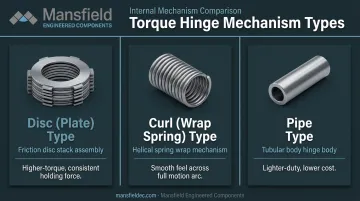
Each mechanism produces torque differently, which affects feel, consistency over time, and suitability for demanding environments. Torque requirements and expected cycle life are usually the first two filters that narrow the field.
Constant vs. Adjustable Torque
The distinction beginners miss most often:
| Type | Constant Torque | Adjustable Torque |
|---|---|---|
| Set at | Manufacturing | Field adjustment (hex key or screw) |
| Best for | Fixed-weight panels, repeatable feel | Variable loads, field fine-tuning |
| Risk | Can't compensate for design changes | Over-adjustment below holding torque |
Constant torque is simpler and more predictable. Adjustable torque adds flexibility but introduces a common beginner mistake: adjusting torque down below the holding threshold needed to support the panel. The panel then drifts under gravity — and the hinge appears to be failing when it's just been mis-adjusted.
Types of Friction Hinges
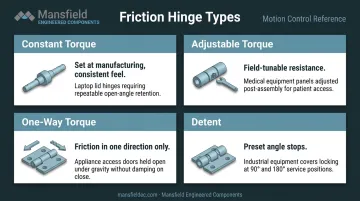
The Four Main Types
Constant torque hinges deliver fixed resistance set during manufacturing. Reell notes that these hold position throughout the full range of motion with load capacities available up to 11.30 N·m. Best fit: medical equipment, appliance doors, and industrial panels where consistent feel is required and panel weight won't change.
Adjustable torque hinges let users tune resistance after installation, typically with a hex key. These suit applications where panel weight may change, or where tactile feel needs refinement during product development or field installation.
One-way torque hinges apply friction in only one direction — typically resisting closing/gravity — while allowing freer movement in the other direction. Reell describes this as eliminating "nearly all torque in one direction without compromising holding force in the other." Oven hoods and appliance access panels are the classic use case: easy to open, controlled on the way down.
Detent hinges provide resistance at specific preset angles rather than continuously across the full range. The panel clicks into a defined stop position — fully open, fully closed, or a specific intermediate angle. Best fit: applications needing a firm, indexable stop rather than free-stop anywhere.
Beyond the Basics
Those four types cover the majority of friction hinge applications. A handful of specialized configurations go further:
- Concealed hinges — hidden when the panel is closed, used in premium appliances and medical casegoods where exposed hardware interrupts the visual finish
- Dual-axis/swivel hinges — support multi-directional movement
- Custom-engineered friction hinges — designed to specific load, torque, space, and environment requirements when standard configurations fall short
Mansfield Engineered Components specializes in that last category, designing application-specific friction hinges for appliance, commercial, and industrial OEMs when exact torque ranges, form factors, material requirements, or cycle life demands require a purpose-built solution.
Key Design Considerations for Friction Hinges
Torque Specification
You need two torque values, not one:
- Holding torque — resistance needed to keep the panel stationary against gravity
- Operating torque — force a user must apply to open or close the panel
These are not always identical. Some designs require asymmetric torque — different resistance opening versus closing — for example, a heavy oven hood that should resist closing under its own weight but open easily with minimal user effort.
Material and Surface Finish
The friction interface material determines how torque behaves over time:
- Metal-on-metal interfaces offer durability but may shift torque as surfaces wear
- Metal-on-polymer interfaces provide consistent friction early in life but can degrade faster under heat or chemical exposure
- Coated surfaces add corrosion resistance but must be compatible with the friction mechanism
For harsh environments — commercial ovens, foodservice equipment, medical settings requiring disinfectant cleaning — material selection is not a secondary concern. It directly affects torque stability over the product's service life. In these applications, matching material and finish to the specific environment — food-grade, high-temperature, or chemically aggressive — is part of the engineering process, not an afterthought.
Cycle Life and Durability
Commercial appliances and industrial equipment open and close thousands of times. Manufacturer-rated cycle life benchmarks give you a starting point:
- Southco ST constant torque embedded hinges: 20,000 to 50,000 cycles within ±20% of static torque specification
- Reell commercial friction hinges: up to 50,000 cycles with zero-adjustment performance
These are product-specific values, not universal requirements. Define your minimum cycle life requirement upfront, then validate through testing under actual application conditions — not just manufacturer data sheets.
Environmental Factors
Temperature matters more than most beginners expect. Standard catalog hinges often operate in a range of -20°C to 65°C (-4°F to 150°F). Near commercial ovens or heat-generating equipment, that ceiling is frequently exceeded. Specialized heat-resistant designs, such as Sugatsune's HG-ITHP15, are rated to 212°F and designed for dryers, lighting equipment, and temperature chambers.
Beyond temperature, several other conditions can shift friction behavior over time:
- Humidity — accelerates corrosion at the friction interface, especially in metal-on-metal designs
- Chemical exposure — disinfectants and cleaning agents common in medical and foodservice settings can degrade polymer components
- Contamination — grease, dust, and particulates alter surface friction unpredictably
Account for all of these during material selection — not after the product is in the field.
How to Size and Select the Right Friction Hinge
The Basic Torque Calculation
Reell's torque calculator states the fundamental formula:
Torque = Weight × Distance to Center of Gravity × Cosine(Angle)
For beginners working with a panel that swings on a horizontal axis (like an oven door), the worst-case angle is typically 90 degrees open (where cosine approaches 0 and gravity's rotational load is near maximum). If the panel weight is evenly distributed, the distance to the center of gravity is simply half the panel length.
Example: A 4 kg oven door, 400 mm tall, with the hinge at the bottom edge.
- Distance to CG = 200 mm = 0.2 m
- Torque = 4 kg × 9.81 m/s² × 0.2 m ≈ 7.85 N·m (total for all hinges)
Southco recommends adding approximately 30% to account for real-world variables like accidental force, torque tolerance bands, and desired "feel."
Step-by-Step Selection Process
- Calculate required torque using weight × CG distance (worst-case angle)
- Divide by number of hinges to get per-hinge torque requirement
- Add 30% safety margin to the per-hinge value
- Match to a rated hinge at or above this value
- Verify fit — leaf dimensions, barrel diameter, mounting hole pattern, installation clearance
- Confirm environmental compatibility — temperature, chemical exposure, cycle life rating
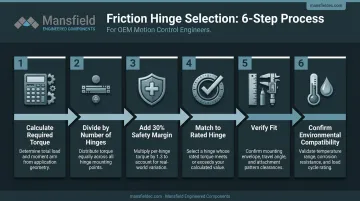
Those six steps assume a catalog hinge exists that fits your requirements. Often one does. But standard ranges have limits, and that's where custom engineering enters.
When to Go Custom
If your application involves any of the following, a catalog hinge is unlikely to be the right fit:
- Torque requirements outside standard catalog ranges
- Tight space envelopes that standard leaf geometry won't fit
- Material requirements for high-temperature or food-contact environments
- Cycle life demands exceeding catalog-rated benchmarks
- Asymmetric torque profiles (different opening vs. closing resistance)
In these cases, a custom-engineered hinge is the practical path. Mansfield Engineered Components designs application-specific friction hinges from initial requirements through prototyping, torque and cycle-life validation, and production release — for OEM programs ranging from 5,000 to over 5,000,000 units annually.
Where Friction Hinges Are Used
Friction hinges appear across more product categories than most beginners realize. The underlying need is the same in every case: a panel, door, or lid that must hold at multiple angles without additional hardware.
Appliance and commercial equipment — the highest-demand category for torque precision and cycle life:
- Residential oven doors and refrigerator compartment lids
- Commercial oven hoods and heavy access panels
- Microwave doors and dishwasher lid mechanisms
- Washing machine lids
Medical casegoods — requires durability, quiet operation, and resistance to clinical cleaning chemicals:
- Equipment arms and instrument panel covers
- Hospital and clinical casegood cabinet doors
Industrial and transportation covers a wider torque range and more demanding environments:
- HMI panels and maintenance hatches on industrial machinery
- Center console lids, fold-out displays, and armrests in vehicles
- Automotive aftermarket storage panels and tonneau covers
Consumer electronics — lower torque values but high cycle counts:
- Laptop screens and tablet covers
- Point-of-sale terminal displays
A friction hinge is the right choice any time a free-swinging hinge creates a safety risk (panel slamming), a usability problem (panel won't stay open), or requires additional hardware to achieve position control. If you're adding a lid support or gas spring to compensate for a hinge that doesn't hold position, a friction hinge solves the root problem directly.
With the sizing settled, the next question is quantity. Friction hinges are usually bought in bulk once a design is fixed, and unit pricing improves at each volume tier, so it is worth quoting your annual usage rather than a sample quantity when you take the specification to a manufacturer.
Frequently Asked Questions
What is a friction hinge?
A friction hinge uses calibrated internal resistance (torque) to hold a panel, door, or lid at any desired angle along its range of motion, with no latches, stays, or additional support hardware required. It differs from a standard hinge in that it actively resists rotation rather than swinging freely.
How does a friction hinge work?
Internal components — such as disc stacks, curl springs, or a press-fitted shaft and pipe — generate frictional resistance when the hinge rotates. Once the user releases the panel, that friction exceeds gravity's pull and the panel holds its position.
What are friction hinges used for?
Common applications span a wide range of industries and products:
- Appliance doors (ovens, refrigerators, dishwashers)
- Commercial oven hoods and food equipment access panels
- Medical equipment arms and casegood lids
- Automotive console lids and tonneau covers
- Industrial access covers and drop-down doors
How long do friction hinges last?
Cycle life is product- and application-specific. Manufacturer benchmarks range from 20,000 to 50,000 cycles within specified torque tolerance, depending on design and material selection. Define your minimum cycle life requirement upfront and validate through testing under actual operating conditions.
How are friction hinges made?
Structural leaves and internal components are precision-stamped or machined, then assembled with controlled preload to hit the target torque value. Torque and cycle-life testing validate performance.