Introduction
Global electric vehicle sales exceeded 17 million units in 2024—more than 20% of all new cars sold worldwide—and automotive OEMs are investing heavily in frunk and deck lid design. Many are discovering a fundamental challenge: hinge and motion control requirements for exterior closures bear little resemblance to the appliance hinges that component suppliers know well.
Both applications involve a lid opening and closing on a pivot. That surface similarity masks deep engineering differences that can derail development timelines and quality expectations.
This article is written for engineers, procurement teams, and product designers evaluating hinge solutions for EV body closures. With at least 59 distinct EV models now offering frunks ranging from 7 liters to 400 liters, understanding why appliance hinge expertise doesn't transfer to automotive applications has real consequences for development timelines and supplier selection.
Key Takeaways
- EV closure panels (8–13+ kg) require non-linear torque counterbalance systems that exceed what appliance springs are designed to handle.
- SAE J2334 cyclic corrosion testing exposes automotive hinges to salt, heat, and humidity cycles that appliance hinges never face indoors.
- Multi-link hinge architectures are required in most automotive applications to clear body panels and preserve crumple zones; appliance doors typically use simple single-axis pivots.
- Aluminum and high-strength steel are standard EV hinge materials for mass reduction—a material selection challenge absent from appliance engineering.
- FMVSS 113, EC pedestrian safety regulations, and AIAG PPAP/FMEA requirements impose certification demands that have no direct appliance counterpart.
What Makes EV Frunk and Deck Lid Hinges Fundamentally Different
The engineering problem looks identical at first glance: both appliance doors and EV frunks/deck lids rotate on a hinge mechanism to access a cavity. Both need to stay open reliably and close with a consistent feel. That resemblance is exactly what causes teams to underestimate the re-engineering required — particularly when it comes to counterbalance force calculations, cycle life targets, and crash compliance that simply don't apply in appliance contexts.
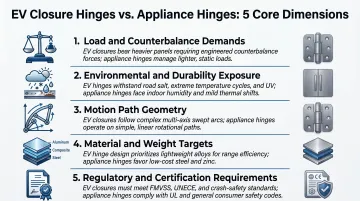
The applications diverge across five core dimensions:
- Load and counterbalance demands — Panel mass, opening arc, and torque curve complexity
- Environmental and durability exposure — Corrosion, thermal cycling, and cycle life targets
- Motion path geometry — Multi-link architectures versus simple pivots
- Material and weight targets — Lightweighting mandates and bimetallic interface challenges
- Regulatory and OEM certification requirements — Crash safety, pedestrian protection, and quality system documentation
Unlike traditional ICE hood hinges that cover engine compartments, EV frunk lids sit over storage space rather than a powertrain. This changes the geometry, the expected access frequency, and the consumer-facing quality feel requirements — all of which feed directly into hinge specification decisions.
Global EV sales rose more than 25% year-over-year in 2024, adding 3.5 million vehicles to the road. That growth is expanding frunk and deck lid hinge applications across platforms from compact sedans to full-size pickups like the Ford F-150 Lightning with its 14.1 cubic foot Mega Power Frunk.
Load Requirements and Counterbalance Engineering
Appliance doors—oven doors, dishwasher doors, refrigerator doors—typically operate within a well-defined weight range. Dishwasher custom door panels are rated at 7 kg to 11 kg maximum, and they're engineered with gravity-assist or simple torsion springs because the panel is relatively light and the range of motion is predictable. Adjustment is straightforward: manufacturers specify linear spring tension adjustments to accommodate panel weights within a narrow band.
EV frunk lids and deck lids are categorically different. These are large, multi-layer exterior body panels with significant mass. Automotive hood assemblies range from approximately 8.1 kg (aluminum) to 12.6 kg (steel), with carbon fiber reinforced polymer (CFRP) hoods reaching as low as 3.2 kg in specialty applications. EV frunk lids, which incorporate weathersealing, latch hardware, insulation, and structural reinforcement for cargo use, typically equal or exceed these weights.
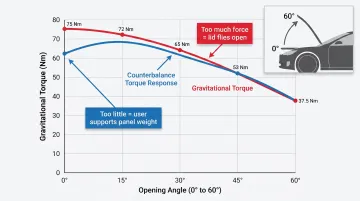
That mass creates a non-linear counterbalance problem. A heavy frunk lid must hold open at various angles without slamming, without requiring the user to support the full panel weight, and without demanding excessive actuation force. The gravitational moment acting on a rotating panel varies as a cosine function of the opening angle, producing a non-linear torque curve that passive spring-based appliance systems — which deliver linear force profiles — cannot match. Automotive applications require torsion bars, gas struts, or multi-spring systems specifically tuned to that curve.
Take a 12 kg frunk lid opening through a 60-degree arc: gravitational torque peaks at the closed position and drops to its minimum at full open. The counterbalance must deliver precisely matched opposing torque at every point in that arc. Too much force and the lid flies open; too little and the user is left holding the panel.
Temperature adds another layer of complexity. Gas strut pressures and spring constants shift with ambient conditions, requiring validation across the full expected service range (typically -40°C to +80°C in automotive specifications).
Lift-assist requirements in EV applications are also constrained by body panel clearance. The counterbalance force profile must match a defined opening arc rather than a simple linear spring relationship. In appliance hinge design, the lid swings freely in open space — there's no adjacent bodywork to clear.
Mansfield Engineered Components' background in designing counterbalance systems for heavy commercial appliance doors provides relevant engineering experience across spring counterbalances, hydraulic counterbalances, and custom torque-curve systems. Even so, automotive load profiles and temperature ranges require purpose-built custom design rather than adapted appliance solutions.
Mansfield's in-house prototyping and engineering validation capabilities (including force and torque measurement across motion arcs and environmental testing) enable rapid iteration before tooling investment — an important efficiency when development timelines are tight.
The F-150 Lightning's 14.1 cubic foot frunk illustrates the stakes: a large composite panel with weathersealing and full reinforcement must operate reliably from desert heat to winter freezing. That's a counterbalance validation scope that simply doesn't exist in appliance hinge engineering.
Environmental Exposure and Long-Term Durability Demands
The environmental gap between appliance and automotive applications is stark. Appliance hinges operate in controlled or semi-controlled indoor environments. EV frunk and deck lid hinges face a different reality entirely — road debris, water intrusion, road salt, de-icing chemicals, UV radiation, pressure washing, and temperature swings from well below freezing to high engine-adjacent heat.
Corrosion protection requirements reflect this severity: Appliance hinge finishes—powder coat, zinc plate, or bare steel—are designed for indoor moisture exposure. Automotive exterior hinges require corrosion protection systems validated against salt spray and cyclic corrosion testing per OEM-specified standards.
Test standards reflect this gap directly:
- SAE J2334 cyclic corrosion testing alternates between 50°C/100% RH humid stages, 60°C/50% RH dry stages, and salt exposure (0.5% NaCl + 0.1% CaCl₂ + 0.075% NaHCO₃) every 24 hours
- ASTM B117/ISO 9227 continuous salt spray maintains 35°C with 5% NaCl in continuous fog
- Appliance hinges, by contrast, are tested in controlled indoor environments with no salt exposure and no freeze-thaw cycling
This changes both material selection and surface treatment choices. Automotive hinges require multi-layer coating systems or stainless/marine-grade materials that can withstand thousands of hours of salt spray exposure. Appliance hinges can function with simpler zinc plating or powder coat finishes.
Corrosion resistance is one layer of the durability challenge. Thermal cycling adds another.
EV frunk compartments may be adjacent to power electronics or in full sun exposure. Thermal analysis of EV powertrains shows motor stator winding temperatures reaching up to 380°C, rotor temperatures up to 200°C, and gear temperatures around 80°C. While these extremes apply to the motor itself, front compartments adjacent to power electronics still experience significant thermal radiation — conditions that are simply not present in the indoor environments where appliance hinges operate.
This affects lubricant viscosity, spring fatigue life, and dimensional stability of hinge components. Appliance hinge lubrication systems—often designed for room-temperature operation—may fail under automotive thermal cycling conditions. Automotive engineers must specify high-temperature greases and validate spring stress relaxation across temperature cycles.
Cycle life requirements add a third dimension:
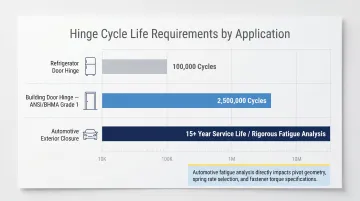
- Refrigerator door hinges pass approval at 100,000 opening cycles
- Building door hinges certified to ANSI/BHMA Grade 1 require 2,500,000 cycles
- Automotive closure durability testing applies rigorous cycle-based fatigue analysis per SAE methodology
The higher cycle life demands of automotive applications affect fatigue design of pivot points, fastening hardware, and spring elements. Automotive engineers must analyze stress concentration at pivot interfaces and specify thread locking methods for fasteners subjected to continuous vibration. Material selection for springs also becomes critical — components must retain tension over hundreds of thousands of cycles.
Motion Path Geometry and Multi-Link Hinge Architectures
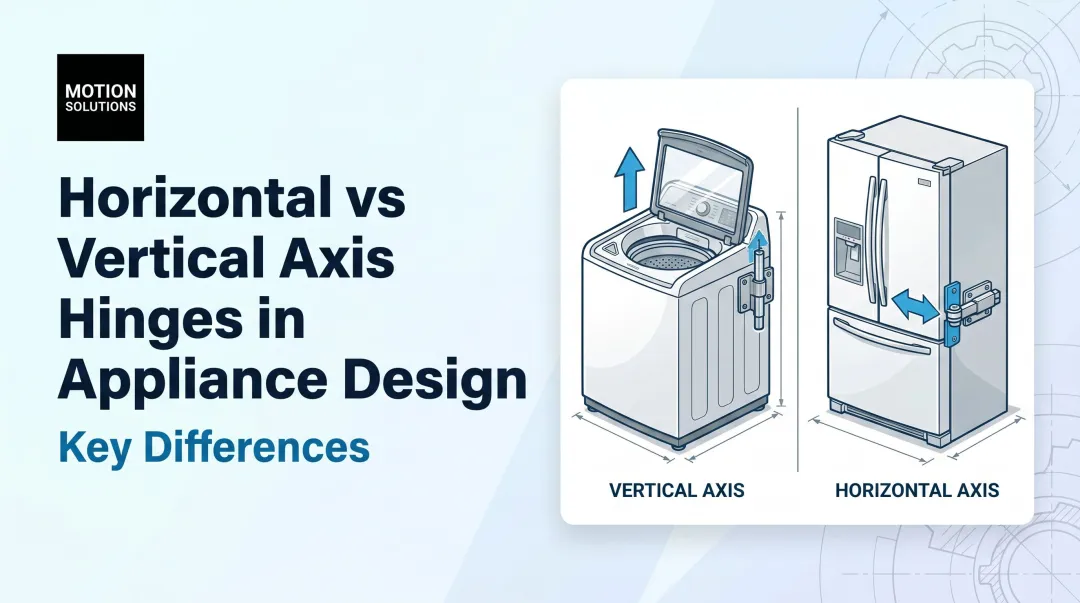
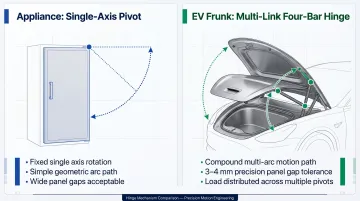
Most appliance hinges use a simple pivot point: the door rotates around a fixed axis, and the geometry is chosen primarily for access and fit within the appliance cabinet. A refrigerator door, for example, swings open on vertical pivot pins with no adjacent bodywork to clear.
EV frunk and deck lid hinges must route the panel through a specific geometric path that clears adjacent body panels, preserves the intended crumple zone structure, and allows the frunk or trunk opening to be fully accessible without interference. This often requires multi-link hinge systems.
Four-bar and multi-bar linkage hinges allow the lid to move through a compound arc — rising, clearing the bodywork, and pivoting — rather than simply rotating around a fixed point. This complexity is unnecessary in appliance design but mandatory in automotive exterior closure engineering. A tonneau cover for a pickup truck bed, for example, must lift vertically to clear the truck cab before rotating open — a motion path achievable only with a four-bar linkage.
The geometric constraints are severe. Modern passenger vehicles target panel gaps of approximately 3–4 mm, with luxury vehicles holding even tighter. Hinge geometry must maintain consistent panel positioning throughout the full arc of motion — not just at the closed or open position.
That tolerance regime is more demanding than typical appliance requirements, where gaps of several millimeters are acceptable and cosmetic panels often cover hinges entirely.
That geometric precision has a secondary benefit: multi-link systems distribute load more effectively across heavy panels. By introducing intermediate pivot points, engineers can tune the instantaneous torque required at each point in the motion arc — improving tactile feel and reducing actuation effort:
- Spreads structural load across multiple pivot joints rather than a single fulcrum
- Allows torque profiling across the full arc, not just at the open or closed position
- Reduces peak actuation force, which matters for both manual and power-assisted lids
The Lincoln Star Concept introduced in 2022 shows how far EV frunk design has moved beyond simple pivot mechanisms. The concept features a vertical-lift hood that rises parallel to the ground, combined with a motorized slide-out drawer at the grille — a split-opening system that eliminates lifting items over a high bumper.
For engineers specifying these systems, the implication is clear: EV closure hinge geometry is a bespoke engineering problem, not an adaptation of existing appliance or ICE vehicle architectures.
Materials Selection and Weight Optimization
Appliance hinge material selection is driven primarily by cost, corrosion resistance for indoor use, and manufacturability. Steel and zinc-plated steel dominate. EV hinge design adds a significant new driver: mass reduction.
Every kilogram added to a body structure closure affects both range (in EVs) and vehicle dynamics. Automotive OEMs often push for aluminum, high-strength steel, or composite materials in hinge components even when they add cost. Reducing vehicle mass improves energy efficiency and extends driving range — two competitive differentiators that matter enormously in the EV market.
The trade-offs are complex:
- Aluminum cuts weight 32–36% versus steel in hood assemblies, but demands different forming processes, specialized fastening (no standard welding), and corrosion protection at bimetallic interfaces
- High-strength steel allows thinner sections with comparable structural performance, though it changes tooling requirements and may require heat treatment
- Aluminum materials run two to three times higher per kilogram than steel — a cost premium OEMs must weigh against range benefits
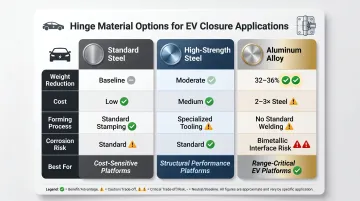
Switching from steel to aluminum yields approximately 32–36% mass reduction according to WorldAutoSteel benchmarking of 20 aluminum versus 7 steel hoods.
That savings isn't fully linear, though. Aluminum outer panels require thicker gauges (1.20 mm) compared to steel (0.72 mm) to achieve comparable stiffness, which partially offsets the density advantage.
Surface Finish Requirements
Automotive hinges may be partially visible or paint-in-place. That changes the finish requirements entirely — Class A surface standards, paint adhesion specs, and UV resistance for exposed finishes are all in play, none of which apply to hidden appliance hinge applications.
OEM lightweighting targets for exterior closures often impose specific material or mass budgets that hinge suppliers must hit. Engineers must balance structural performance, corrosion resistance, mass targets, and cost constraints simultaneously — and the right answer for a frunk hinge looks very different from the right answer for a refrigerator door.
OEM Safety Standards and Certification Requirements
The automotive OEM qualification process imposes requirements with no direct equivalent in appliance component manufacturing. Hinge components for EV frunks and deck lids must pass the full suite of AIAG Quality Core Tools:
- APQP (Advanced Product Quality Planning)
- PPAP (Production Part Approval Process)
- FMEA (Failure Mode and Effects Analysis)
- MSA (Measurement Systems Analysis)
- SPC (Statistical Process Control)
PPAP requires suppliers to certify that validation results meet all design specifications on a per-cavity, per-production-line basis. Required documentation includes dimensional inspection reports, material certifications, process flow diagrams, and process FMEA. Appliance hinge qualification involves none of this structured development overhead.
Crash safety implications are critical: EV frunk lids sit in the primary frontal crash zone. Hinge design must account for controlled deformation or detachment behavior in a frontal impact to protect pedestrians and to manage the structural interaction with the crumple zone.
EC Regulation 631/2009 requires hood/frunk areas to meet Head Protection Criterion (HPC) thresholds of 1,000 or 1,700 under headform impacts at 9.7 m/s. Test zones include hinge mounting locations, meaning hinge geometry directly influences pedestrian safety scores — a design constraint that simply doesn't exist for a refrigerator or oven door.
Latching and secondary retention requirements add system-level design dimensions beyond simple stay-open or stay-closed requirements. FMVSS 113 (49 CFR 571.113) mandates that any front-opening hood that could obstruct the driver's forward view must have a secondary latch system — preventing accidental opening at speed. EV frunks inherit this requirement, demanding redundant latching that adds layers of system complexity appliance closures never encounter.
Because of this, automotive hinge and latch systems are typically co-designed as integrated assemblies. The hinge must work in concert with the primary latch, secondary catch, and release mechanism. Each interface is a potential failure point, so the design team carries responsibility across the full retention system — not just the hinge in isolation.
Because the hinge and latch are co-designed, they are also sourced together in volume. EV programs buying frunk and deck lid hinges in bulk should confirm volume pricing tiers, minimum order quantities per part number, and release schedules for the full retention system rather than for the hinge in isolation.
Frequently Asked Questions
Do electric cars have frunks?
Many—but not all—EVs have frunks (front storage spaces) made possible by the compact size of electric motors relative to ICE powertrains. Frunk size and design varies widely: the smallest measure just 7 liters (Volvo EX30), while the largest reach 400 liters (Ford F-150 Lightning, Tesla Cybertruck). At least 59 distinct EV models currently offer frunks.
What is the main engineering difference between an EV frunk hinge and an appliance door hinge?
Three fundamental differences: (1) Load and counterbalance demands—EV panels weigh 8-13+ kg and require non-linear torque curves versus appliance doors at 7-11 kg with simple spring balancing; (2) Environmental exposure—automotive hinges face salt spray, freeze-thaw cycles, and UV radiation versus controlled indoor conditions; (3) Motion path complexity—multi-link architectures to clear bodywork versus simple single-axis pivots.
Why do EV frunk lids require counterbalance or lift-assist mechanisms?
EV frunk lids are large exterior body panels with significant mass (8-13+ kg). Without a counterbalance system, the lid would require heavy force to open and could slam shut, creating safety and usability problems. The counterbalance must deliver non-linear torque that varies with opening angle and remain reliable across wide temperature extremes.
How do cycle life requirements compare between automotive and appliance hinges?
Automotive exterior closure hinges must meet higher cycle life targets than appliance hinges. Refrigerator door hinges pass approval at 100,000 cycles, while building door hinges achieve 1.5-2.5 million cycles. Automotive OEMs apply rigorous cycle-based fatigue analysis that drives design choices in pivot geometry, spring selection, and fastening hardware to ensure performance over a vehicle's 15+ year service life.
Can appliance hinge designs be adapted for EV frunk and deck lid applications?
Engineering knowledge from appliance hinge design transfers well—particularly in counterbalance systems and pivot mechanisms—but automotive applications require custom-engineered solutions, not direct adaptation. AIAG quality requirements, crash safety regulations, and environmental validation protocols create a qualification gap that incremental modification cannot bridge.
What materials are typically used in EV frunk and deck lid hinges?
Automotive hinges use steel, high-strength steel, and aluminum alloys. Aluminum reduces weight 32-36% versus steel but requires thicker gauge stock for equivalent stiffness and introduces bimetallic corrosion risks at steel attachment points. Material selection is driven by OEM mass targets, corrosion requirements, and structural performance criteria.
Mansfield Engineered Components designs and manufactures custom motion control components for appliance OEMs, automotive aftermarket, and industrial equipment manufacturers. With over 80 years of manufacturing experience and 200+ design and engineering professionals, the company delivers custom counterbalance systems, four-bar hinges, and lift-assist mechanisms engineered to customer specifications. For engineering consultation on automotive closure applications, contact Jim Collene, VP of Engineering, at jim.collene@mansfieldec.com or call +1.419.524.1300.