Introduction
Picture this: a commercial appliance OEM ships thousands of units, and within 18 months, warranty claims start rolling in. The door sags. The seal gaps. Technicians are dispatched. The root cause? A hinge specification that worked fine in the lab but couldn't survive real-world use frequency and door weight.
It happens more often than product designers expect. The hinge is frequently the last variable scrutinized — and the first one to fail.
This article breaks down exactly how continuous hinges differ from regular hinges, where each type performs, and what criteria should drive the specification decision. Whether you're specifying a commercial appliance door, an industrial enclosure, or a heavy-duty access panel, the breakdown below gives you the criteria to make the right call.
Key Takeaways
- Continuous hinges span the full door or panel length, distributing load evenly; regular butt hinges concentrate stress at two to four discrete points
- Continuous hinges hold alignment better, resist warping, and outlast regular hinges in high-frequency or heavy-load applications
- Regular hinges cost less upfront and suit standard residential or light-duty commercial uses with moderate cycle demands
- The right choice comes down to load, cycle frequency, alignment requirements, and total cost of ownership, not purchase price alone
Continuous Hinges vs. Regular Hinges: Quick Comparison
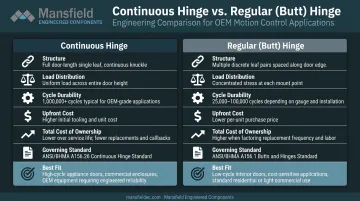
| Factor | Continuous Hinge | Regular (Butt) Hinge |
|---|---|---|
| Structure | Single piece, full door/panel length | 2–4 individual hinges at fixed intervals |
| Load distribution | Spread across entire hinge length | Concentrated at each hinge knuckle |
| Governing standard | ANSI/BHMA A156.26 | ANSI/BHMA A156.1 |
| Typical lengths | 6 ft to 10 ft (stock); custom lengths available | 3–5 inches per hinge |
| Cycle durability | Engineered for high-frequency use | Suited for moderate-use applications |
| Upfront cost | Higher | Lower |
| Total cost of ownership | Lower in high-use environments | Increases with maintenance frequency |
| Best fit | Commercial appliance doors, industrial enclosures, heavy-duty lids, transportation access panels, medical casegoods | Residential doors, light cabinetry, low-frequency access panels |
What Are Continuous Hinges?
A continuous hinge is a single-piece hinge designed to run the full height of a door, lid, access panel, or enclosure. By spanning the entire edge rather than mounting at isolated points, it provides uninterrupted support across the full pivot line.
The common alias "piano hinge" comes from the original application on piano lids — but the modern continuous hinge has moved well beyond that. Today, they're engineered components specified by industrial OEMs, medical equipment manufacturers, and commercial appliance brands where performance under demanding conditions is a hard requirement.
The Structural Advantage
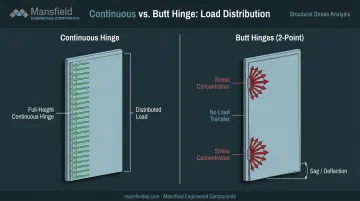
The fundamental difference is load path. With a continuous hinge, the pivot load is distributed across the entire hinge body — there are no gaps between knuckles, and no single point bears disproportionate stress. With a regular butt hinge setup, stress concentrates at each individual hinge's knuckle and pin.
According to ANSI/BHMA A156.26, continuous hinges undergo cycle, abuse, overload, vertical wear, and strength testing — a test regime built around exactly the kind of demanding use these components are specified for.
Material Options
| Material | Best For |
|---|---|
| Stainless steel (304/316) | Corrosive environments, food contact, medical casegoods, outdoor access panels |
| Aluminum (6063-T6) | Weight-sensitive applications requiring corrosion resistance |
| Carbon/cold-rolled steel | Cost-effective strength in controlled indoor environments |
| Brass | Aesthetic or decorative applications with moderate load |
Primary Subtypes
Two subtypes are well-documented for OEM applications:
- Pin-and-barrel: Knuckles formed around a central pin; available in 14-gauge 304 stainless steel with stainless pin. Strong choice for secure, heavy-duty, or corrosion-exposed applications.
- Geared continuous: Interlocking splines in an extruded aluminum cap, rotating on self-lubricating polymer bearings. Preferred where alignment precision and smooth operation under high door-edge load are priorities.
Customization for OEM Programs
Continuous hinges can be cut to precise lengths, configured with specific hole patterns, and engineered to meet application-specific load and cycle-life targets. Mansfield Engineered Components designs custom continuous hinges — and all motion control components — from scratch for each OEM program. Every specification is built to the customer's exact design requirements, tolerances, and production volumes — with no catalog part numbers standing in the way.
Use Cases of Continuous Hinges
Continuous hinges appear wherever a hinge failure means more than an inconvenience — it means product downtime, warranty exposure, or a compromised safety seal.
Common OEM applications include:
- Commercial foodservice equipment doors (ovens, warming cabinets, pass-throughs)
- Industrial enclosures requiring environmental sealing and restricted access
- Medical casegood panels that require corrosion-resistant hardware compatible with disinfectant cleaning
- Transportation access hatches and equipment lids
- Heavy toolboxes and industrial equipment with high-cycle lid mechanisms
FWE, a commercial foodservice equipment manufacturer, offers a full-length piano door hinge as a durability option on select equipment lines — a practical example of an OEM specifying continuous hinges where door performance under frequent use is a design requirement. nVent Hoffman's Type 4 industrial enclosures are another documented case: they use continuous hinges paired with 3-point latching and foam-in-place gaskets to achieve environmental sealing and restricted access compliance.
The cycle-life demands in these environments are substantial — a commercial kitchen door may cycle hundreds of times daily. ANSI/BHMA A156.26, the governing standard for architectural continuous hinges, sets testing requirements that directly account for this kind of accumulated stress across the same applications outlined above.
What Are Regular Hinges?
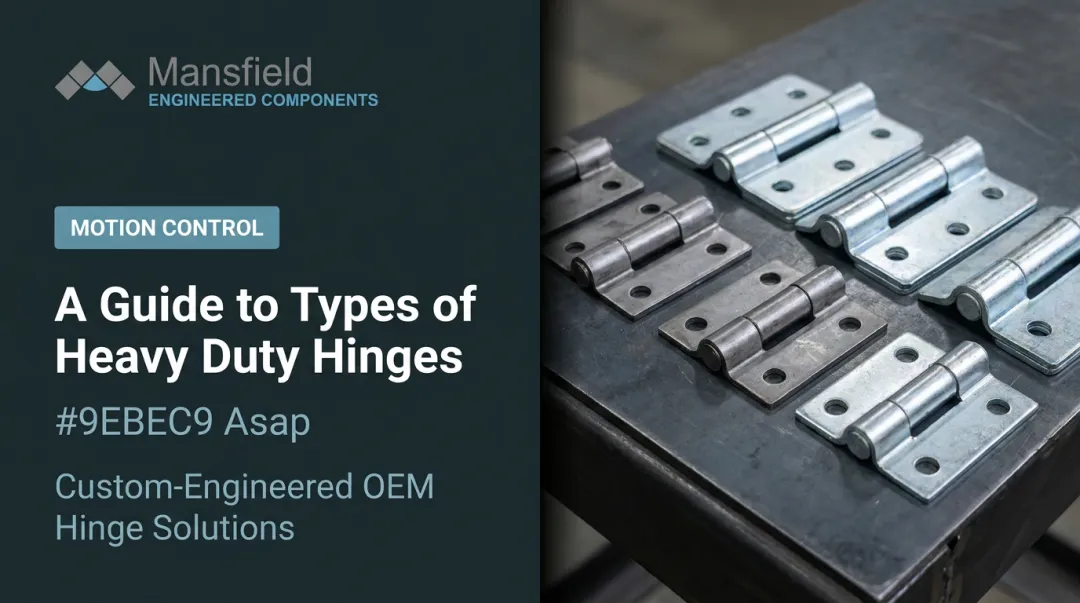
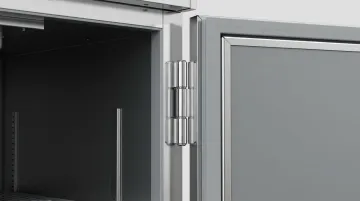
Regular hinges — most commonly butt hinges or mortise hinges — mount at two to four discrete points along the door edge. They're the hinge most people have seen on every residential interior door, light cabinet, or standard-duty enclosure.
ANSI/BHMA A156.1 governs this category, covering cycle, lateral and vertical wear, friction, strength, finish, and material testing. A standard full-mortise butt hinge is typically specified by two dimensions — for example, 4-1/2 in × 4-1/2 in, with the first dimension representing height.
Structural Limitation
Stress concentrates at each hinge knuckle rather than distributing across the door edge. Under heavy loads or high cycle counts, this localized stress accelerates wear and creates the conditions for door sag. The Steel Door Institute defines door sag as uneven lock-edge clearance — typically narrow at the top lock edge and wide at the bottom — a failure symptom directly linked to hinge performance.
ASSA ABLOY's hinge technical documentation also notes that hinge failure often begins when doors are opened beyond their stop-device limits, a misuse pattern that worsens localized wear at each knuckle.
Common Subtypes
- Butt/mortise: Most common; mortised into the door and frame
- Surface-mounted: Simpler installation; no mortise required; lower load capacity
- Spring hinges: Self-closing function for doors that need passive closure
- Strap hinges: Extended leaf for heavier doors or barn-style applications
Where Regular Hinges Work Well
Regular hinges are the right call for:
- Standard residential interior and exterior doors
- Light-duty furniture and cabinetry
- Low-frequency access panels where replacement is a manageable maintenance task
- Decorative applications where aesthetics and upfront cost take priority over cycle longevity
Continuous vs. Regular Hinges: What Actually Matters
Stress Distribution and Alignment
The difference that affects product life most directly is how each hinge handles load over time. A continuous hinge maintains door alignment across its full service life because stress never accumulates at a single point. A multi-point butt hinge setup gradually allows the door to sag, shift, or bind — especially under heavy loads or repeated cycling.
For product designers, this isn't just a mechanical issue. It translates to:
- Enclosure seal gaps that compromise environmental protection ratings
- Misaligned appliance doors that increase thermal loss or require user adjustment
- Accelerated wear on adjacent components like gaskets, latches, and door frames
Warp and Sag Prevention
Continuous hinges resist the bending stress that causes panel warping — particularly relevant for thinner metal appliance doors and access panels. When load is concentrated at two or three points, the panel between those points is essentially unsupported. Spanning the full door length removes that unsupported span entirely.
Security and Tamper Resistance
Continuous hinges create a tight edge seal with minimal clearance gap and no exposed pins or fasteners when closed. For industrial enclosures and restricted-access equipment panels, this matters. In Type 4-rated industrial enclosure designs, for example, a continuous hinge paired with a multi-point latch system lets the hinge itself contribute to the overall access control strategy, not just provide swing function.
Total Cost of Ownership
Butt hinges on high-abuse, high-traffic doors tend to require maintenance, repair, or replacement more frequently in demanding environments. The cost calculation isn't just the hinge price — it's technician time, replacement parts, and product downtime accumulated over the installation's service life.
When to Choose Each
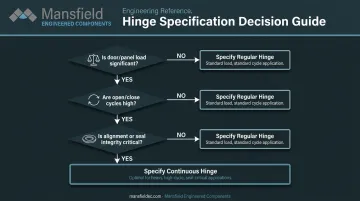
Choose a continuous hinge when:
- Door or panel weight is significant
- Open/close cycles are high (commercial, industrial, or high-traffic environments)
- Alignment precision affects product function or safety
- Seal integrity is a design requirement
- Long service life with minimal maintenance is the expectation
Choose a regular hinge when:
- Application is standard residential or light-duty commercial
- Cycle frequency is low to moderate
- Upfront cost is the primary constraint
- Periodic maintenance or replacement fits within normal operational workflow
Real-World Applications: Putting the Comparison into Practice
The scenario that drives most specification changes follows a familiar pattern: a manufacturer ships a product with standard butt hinges, field performance holds for the first year, and then door sag complaints emerge at the 12–18 month mark.
Root cause analysis typically traces the problem to stress concentration at the hinge points under high-cycle use, a failure mode that doesn't appear under lab testing conditions but surfaces with real-world usage.
Re-specifying to a continuous hinge engineered to the actual load and cycle requirements resolves the alignment problem and reduces warranty exposure. Two real-world examples show how this plays out across different product categories:
- Commercial foodservice equipment: FWE's full-length piano door hinges on commercial food holding equipment reflect this logic applied at the product design stage — distributing door load across the full height rather than concentrating stress at two or three hinge points.
- Industrial enclosures: nVent Hoffman's continuous-hinge Type 4 enclosures demonstrate that hinge selection is integral to achieving environmental sealing and access control specifications, not secondary to them.
For product designers and procurement engineers facing similar decisions, both examples point to the same conclusion: selecting from a catalog is the wrong starting point when load distribution and cycle life are part of the spec. Mansfield Engineered Components designs and tests custom motion control components, including continuous hinges, to exact OEM specifications, with in-house prototyping and cycle-life validation before tooling is cut. If your application sits in that gray zone between "a standard hinge will do" and "we need something built to this load profile," a direct engineering conversation saves time and tooling cost. Contact the team at mansfieldec.com to start the conversation.
Conclusion
Continuous hinges aren't universally better — they're purpose-built for high-load, high-cycle, alignment-critical applications where long-term performance and reduced maintenance justify the higher upfront cost. Regular hinges remain the right answer for standard-duty, low-frequency applications where simplicity and unit cost are the priorities.
For product designers and procurement engineers, the hinge specification directly affects product durability, warranty exposure, and end-user experience. Locking in the right specification at the design stage — based on actual load data and cycle requirements — costs far less than a field retrofit or warranty-driven redesign later.
The cost comparison also shifts with quantity. Continuous hinges carry a higher unit price than regular hinges, but buying them in bulk against an annual build plan moves the per-unit number considerably, so procurement engineers should price both options at the volume they actually intend to order rather than at list.
Frequently Asked Questions
What is the benefit of a continuous hinge?
Continuous hinges distribute load across the full door or panel length, eliminating the stress concentration points that cause regular hinges to wear or sag. The result is better alignment stability, longer service life, and a tighter edge seal — qualities that matter most in heavy-duty or high-frequency applications.
Does a continuous hinge prevent warping?
Yes, significantly. By supporting the full door or panel edge rather than at two or three discrete points, continuous hinges eliminate the unsupported spans that allow bending stress to accumulate. This is particularly valuable for thinner metal panels and appliance doors where panel integrity affects sealing and appearance.
What is the difference between a piano hinge and a continuous hinge?
The terms are interchangeable. "Piano hinge" is the original name, derived from early use on piano lids. Modern continuous hinges use the same full-length, single-piece design but are now engineered to far more demanding load, material, and cycle-life specifications for commercial and industrial applications.
When should I choose a continuous hinge over a regular hinge?
Choose a continuous hinge when the application involves significant door weight, high open/close cycle frequency, precision alignment requirements, or environmental sealing needs. If door sag or maintenance downtime is operationally unacceptable, a continuous hinge is the correct specification.
How long do continuous hinges last compared to regular hinges?
ANSI/BHMA A156.26 establishes testing requirements for architectural continuous hinges — covering cycle, abuse, overload, and strength. In demanding commercial and industrial applications, continuous hinges are engineered to higher cycle targets than standard butt hinges specified under A156.1, though actual service life varies with material, load, and use frequency.
Can continuous hinges be customized for specific load or size requirements?
Yes. Continuous hinges can be cut to custom lengths, configured with specific hole patterns, and engineered to precise load, material, and cycle-life specifications. For OEM programs where standard options fall short, custom-engineered solutions built to exact application requirements are the norm.