Introduction
Picture this: An appliance design team is six weeks from launch. Industrial design is finalized. Electronics are validated. Tooling is nearly complete. Then someone asks, "What about the hinge?"
The question triggers a scramble. Engineers pull distributor catalogs. Procurement searches for the cheapest compatible part number. Someone checks whether the mounting holes align. If the bracket fits and the price is low, it ships.
This pattern is industry-wide. Hinges are load-bearing components that engage on every single use cycle, yet they're routinely sourced as afterthoughts rather than engineered from the start.
U.S. appliance manufacturers paid $1.18 billion in warranty claims in 2025, and a significant share of those claims trace back to door hardware that was never properly specified.
The fix isn't complicated — but it starts earlier than most teams think.
TLDR
- Hinges rarely receive dedicated engineering ownership early in development, making them vulnerable to under-specification
- Failures manifest as warranty claims, door misalignment, seal degradation, and costly field fixes—all preventable with proper specification
- Appliance hinges face thermal cycles, high-duty loads, and seal demands that off-the-shelf parts aren't built to handle
- Bringing hinge engineering into the concept stage reduces redesign risk and total ownership cost
Why Hinges End Up Last in the Design Process
Appliance development follows a familiar workflow. Major systems—compressor assemblies, heating elements, control boards, cosmetic panels—receive dedicated engineering resources and budget allocation from day one. Hardware like hinges gets categorized under "fasteners and miscellaneous components" and handed to procurement late in the schedule.
Organizational silos reinforce the problem:
- Industrial designers focus on door aesthetics and panel geometry
- Mechanical engineers focus on structural load paths and chassis integrity
- Procurement focuses on unit cost and supplier availability
No single owner is accountable for hinge performance across the full use life. The hinge exists in the gap between disciplines, and gaps don't get engineering time.
The Commoditization Trap
Standard hinges are available from distributors. Catalog pages list generic load ratings, standard mounting geometries, and familiar part numbers. Teams assume a compatible part can always be found.
That assumption breaks down when appliance-specific requirements never appear in standard catalog specifications. Consider what a catalog hinge doesn't account for:
- Thermal exposure during 500°F self-cleaning cycles
- Torque profiles that hold a door at intermediate positions
- Seal loading that maintains gasket compression through thousands of cycles
A residential-grade hinge that works fine on a cabinet door fails under the demands of a commercial kitchen — hundreds of open/close cycles per day, sustained heat, and no tolerance for sag.
Compressed development timelines make this worse. When schedules tighten, hinges get deferred as "lower risk," and specification complexity gets resolved by defaulting to the cheapest catalog option rather than an application-specific design.
The Widening Performance Gap
This pattern isn't new. But as appliances grow more complex — integrated panels, French door configurations, commercial-grade residential units — the gap between a commodity hinge and an engineered one widens. And the downstream cost of a late-stage hinge failure, whether that's a tooling redesign, a field recall, or a lost production quarter, is rarely small.
What That Oversight Costs: The Real Consequences
Warranty and Field Service Costs
A door that sags, misaligns, or loses closing force after 12–18 months triggers service calls, replacement parts, and labor. The appliance industry's warranty claims rate averages 1.6% of product sales revenue, with U.S. appliance and HVAC manufacturers setting aside $1.33 billion in warranty accruals in 2025. Door and hinge failures represent a measurable category: Consumer Reports explicitly tracks "door part broke (handle, hinge, seal)" as a distinct failure mode in its appliance reliability surveys.
Seal and Energy Efficiency Impact
In refrigeration, a hinge that allows even 2–3mm of door sag breaks the gasket seal. Research shows that 35% of total refrigerator heat leakage is caused by ambient air seeping through door gaskets. When hinge misalignment compromises that seal, the compressor runs continuously, energy consumption climbs, and moisture infiltration accelerates evaporator frosting.
The same study found that improving gasket contact reduced total refrigerator energy consumption by up to 3.19%—a gain that's impossible to realize when hinge deflection prevents proper seal engagement.
Redesign and Tooling Costs
Energy losses are costly. Tooling failures cost more. Discovering hinge under-specification during validation—or after launch—requires redesigning brackets, modifying door geometry, or retooling mounting points. Those corrective costs far exceed what a properly engineered hinge would have added to the bill of materials from the start.
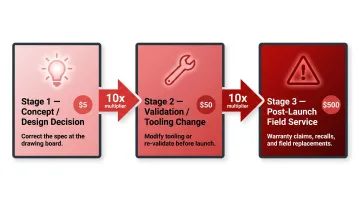
The 1-10-100 rule in quality engineering establishes that defects cost 10 times more at each subsequent stage of production. In practice: a $5 design decision deferred at concept becomes a $50 tooling change at validation and a $500 field service event post-launch.
| Stage | Relative Cost |
|---|---|
| Concept (design decision) | $5 |
| Validation (tooling change) | $50 |
| Post-launch (field service) | $500 |
Brand and Perceived Quality Impact
For premium appliance brands, a door that doesn't feel solid or close with authority is a direct sensory signal of quality failure. Perceived door action—closing resistance, damping behavior, and positional hold—shapes how consumers judge overall build quality. A refrigerator door that sags visibly or an oven door that drops at broil position shows up directly in one-star reviews and return rates, regardless of what the product delivers elsewhere.
Compliance and Certification Risk
Commercial appliance categories must meet certifications (NSF, UL, CE) that include door integrity requirements. A hinge that fails under operational conditions can jeopardize certification status and create liability exposure. Recalls are not hypothetical: Hisense recalled 55,200 French door refrigerators in 2022 specifically because door hinges could break and cause doors to detach, posing an impact injury hazard.
Where Hinge Failures Show Up in Finished Appliances
Oven and Range Doors
Oven door hinges must handle extreme repeated thermal cycling—from ambient to 500°F+—plus the mechanical stress of broil-position holds. Self-cleaning cycles subject hinges to sustained temperatures between 800 and 900 degrees Fahrenheit, accelerating metal fatigue and lubricant breakdown in hinges not designed for that thermal range.
Under-specified hinges lose their counterbalance tension. Doors drop rather than hold at intermediate positions, creating both a usability failure and a safety issue.
UL 197 standards for commercial electric cooking appliances require hinges to pass 30,000-cycle endurance tests for cooking operations, with each cycle subjecting the hinge to operational thermal exposure. Standard catalog hinges rarely meet this requirement. That gap between specification and reality has consequences. ZLINE recalled 5,000 wall ovens in 2024 when door hinges dislodged, releasing springs that damaged or broke through door trim—a direct result of hinge mechanisms not engineered to handle operational stress.
Refrigerator and Freezer Doors
Refrigerator door hinges bear compound loads: door weight plus stored-item weight. A fully loaded French door can exceed 50 pounds per panel. A hinge that allows even 2-3mm of lateral deflection breaks the magnetic gasket seal, causing energy loss and moisture infiltration.
In side-by-side and French door configurations, hinge tolerances must be tight enough to maintain door panel alignment. Visible misalignment between panels is one of the top consumer complaints in premium refrigerator categories. Consumer Reports data shows that 49% of refrigerators purchased since 2015 have experienced a problem, with door hardware accounting for a measurable share of those failures.
Commercial Appliances
Commercial appliances face dramatically higher duty cycles than residential units. A commercial oven door might open and close hundreds of times per shift. Commercial kitchen equipment replacement costs rose 24% for refrigeration units and 21% for cooking equipment between January 2022 and October 2024, amplifying the cost impact of component failures.
Residential-grade or catalog hinges fail prematurely under that load. The downstream costs compound quickly:
- Unplanned downtime during peak service hours
- Repair timelines stretched by parts availability gaps
- Breakdown claim costs that doubled between 2024 and 2025, driven in part by supply chain delays
What a Well-Engineered Hinge Actually Does
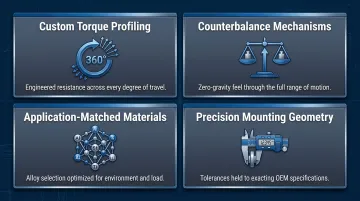
An engineered appliance hinge is a custom motion control system—designed around a specific application, not pulled from a catalog with a generic load rating.
Key differentiators include:
- Custom torque profiling so the door opens smoothly and holds at any position without operator effort
- Counterbalance mechanisms calibrated to actual door weight and center of gravity for consistent, repeatable performance
- Material selection matched to thermal and humidity environments—specialty alloys for high-temperature applications, corrosion-resistant finishes for moisture exposure
- Mounting geometry designed around the specific appliance chassis for precise fit and long-term reliability
Beyond the Hinge: Integrated Motion Control
Counterbalances, dampers, and position-control mechanisms work together to create the smooth, controlled door action that consumers associate with quality. This requires integrated design, not piecemeal component sourcing.
Mansfield Engineered Components ships over 250,000 motion control components weekly to brands including Sub-Zero, Bosch, GE, and Whirlpool. Each component is custom-engineered to specific torque curves, motion arcs, and duty-cycle requirements for the target application.
Validation Through Testing
Proper validation means cycling a hinge through thousands of open/close repetitions under simulated thermal and load conditions before production begins. Performance is confirmed, not assumed. In-house prototyping and testing allow design changes to be implemented and re-evaluated without external lab handoffs, keeping development timelines tight.
How to Bring Hinge Design Into the Process Earlier
Establish Hinge Ownership
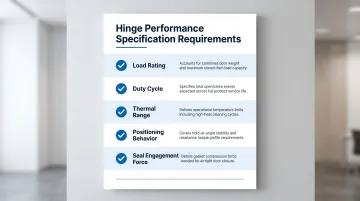
Someone on the engineering team—or a dedicated external partner—should be assigned to define hinge performance requirements at the concept stage alongside door geometry decisions. Performance specifications should include:
- Load rating (door weight plus stored-item weight)
- Duty cycle (expected open/close events over product life)
- Thermal range (operational and cleaning cycle temperatures)
- Positioning behavior (hold-at-angle requirements, counterbalance torque profile)
- Seal engagement force (gasket compression requirements)
Early Engagement with a Hinge Engineering Partner
Effective early engagement means sharing door weight estimates, CAD geometry, use-case scenarios, and target price points early enough for the partner to develop and test custom solutions during the design phase—not scrambling to find a workable part during tooling.
Mansfield Engineered Components works with OEM design teams from concept through prototyping to production validation. That early involvement means custom hinge solutions are designed, tested, and refined before tooling commitments are made—compressing development timelines and eliminating late-stage surprises.
The Total Cost Argument
The incremental cost of a properly engineered hinge versus a catalog substitute is almost always less than the cost of a single warranty campaign, field service visit, or design revision cycle. The earlier that cost comparison is made, the easier the decision becomes.
Research on Early Supplier Involvement found that bringing suppliers into the design process can reduce engineering change orders by 55-95%. For appliance development teams, the implication is direct: earlier hinge supplier involvement reduces the downstream corrections that drive cost overruns and launch delays.
The $2–$5 difference in unit cost between an engineered hinge and a catalog part disappears against the $1.18 billion annual warranty claims burden the appliance industry carries. On a per-unit basis, reliability engineering pays for itself many times over.
That economics argument only strengthens at volume. Because appliance hinges are bought in bulk against annual build plans, a few cents of per-unit difference is settled by the volume tier and the release schedule — which is why teams negotiating bulk hinge pricing should bring the engineered option into the comparison from the start, not after the catalog part has already been designed in.
Frequently Asked Questions
What are the most common hinge specification mistakes in appliance design?
The most common mistakes are under-specifying load ratings, ignoring thermal exposure at the hinge location, and treating hinge selection as a late-stage procurement decision. Each creates usability failures that proper specification at the concept stage would prevent.
Why do appliance hinges fail before other components?
Hinges engage on every single use cycle, making them among the most mechanically stressed components in any appliance. Yet they're routinely specified last and underengineered for the actual thermal, load, and duty-cycle conditions they'll face—so performance gaps don't surface until there are field failures.
What is the difference between a standard hinge and a custom engineered hinge for appliances?
Standard catalog hinges offer generic load ratings and standard mounting geometry. Custom engineered hinges are torque-profiled, thermally rated, load-matched to door weight and center of gravity, and validated through cycle testing under simulated operational conditions. The difference shows up in reliability, door feel, and service life.
Can a hinge problem be fixed after an appliance is already in production?
Post-production fixes are possible but expensive, typically requiring new tooling, modified mounting brackets, or field service kits. Correction costs post-launch far exceed what proper up-front specification would have required, and recalls add direct warranty costs plus reputational damage on top.
How many open/close cycles should an appliance hinge be designed to handle?
Requirements vary by appliance type and segment. UL 197 sets 30,000 cycles for commercial cooking equipment, while residential and heavy-commercial targets differ. A qualified hinge engineering partner should define and validate a cycle life target based on real-world use patterns for the specific application.
Moving hinge engineering earlier in the design process directly affects reliability, field performance, and warranty costs. When the specification is right from concept, manufacturers avoid the retrofits, recalls, and brand exposure that under-engineered hinges create.
For appliance OEMs ready to move hinge specification earlier in the design process, Mansfield Engineered Components provides custom-engineered motion control solutions from concept through production. Reach the engineering team at +1.419.524.1300 or jim.collene@mansfieldec.com.