Introduction
Appliance manufacturers building a single product platform for both US and global markets face a persistent engineering tension: every component—including hinges—must satisfy different regional requirements, yet teams are under constant pressure to reduce SKU proliferation.
A hinge specified solely for the US market may fail CE certification in Europe. A design optimized for compact European appliances may buckle under the heavier doors and taller clearances common in American kitchens—with direct consequences for product liability, time-to-market, and total cost.
The scale of the problem is significant. According to Mordor Intelligence, the global home appliances market will reach $710.21 billion by 2031, with OEMs under constant pressure to rationalize platforms across divergent regional standards.
Late-stage design changes—including hinge re-specification after door geometry is locked—drive steep cost increases through retooling, redesign, and validation rework, as documented by Quality Magazine's analysis of manufacturing change costs.
Getting hinge design right early—before door geometry locks—is where the real platform decision happens. This article breaks down the specific requirements separating US and international markets, and gives engineers a framework for deciding when a unified global hinge works versus when regional variants are the more defensible choice.
Key Takeaways
- US hinge designs are governed by UL certifications, heavier door weights (up to 42 lbs for oven doors), and AHAM-driven durability expectations
- European markets require IEC/EN compliance, CE marking, compact footprints (typically 60 cm width), and concealed hinge aesthetics
- Critical design variables: torque/counterbalance specs, reversibility, climate-specific corrosion resistance, and door-seal performance under energy mandates
- A single global platform hinge is possible, but regional variants are often more cost-effective — trade-offs must be resolved early in design
- Custom-engineered solutions are typically required to meet the full range of regional certification and performance standards
US vs. International Markets: At-a-Glance Comparison
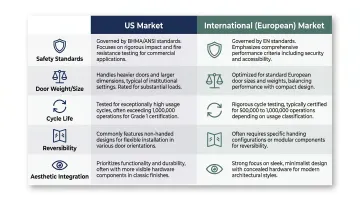
Five key dimensions separate US and international (primarily European) appliance hinge requirements:
| Dimension | US Market | International (European) Market |
|---|---|---|
| Governing safety standards | UL 858 (ranges), UL 749 (dishwashers), CPSC stability tests | IEC/EN 60335 series, CE marking under Low Voltage Directive 2014/35/EU |
| Typical door weight/size | 30–36 in width ranges; oven doors up to 42 lbs (19 kg); refrigerators 24–40 in | 60 cm (23.6 in) built-in ovens/dishwashers; lighter door panels (typically 30–40% less mass) |
| Cycle life requirements | Industry targets 20,000–50,000 open/close cycles (manufacturer-driven, not mandated) | IEC test equipment validated to 100,000 cycles (capability, not mandated minimum) |
| Reversibility/swing requirements | Less critical in freestanding products; left/right symmetry less common | Reversible door hinges standard in built-in refrigerators and some dishwashers for cabinetry flexibility |
| Aesthetic integration | Historically accepts visible/semi-exposed hinge hardware; premium segment shifting | Strong preference for concealed, flush-mount hinges preserving clean cabinet lines |
Important caveat: "International" is not a single, uniform market. Regional priorities diverge significantly:
- Asia (Japan, Southeast Asia): Ultra-compact footprints and anti-corrosion finishes for high-humidity environments
- Middle East: Extreme-heat material specifications driven by climate conditions
- Latin America: Blend of US-style freestanding products and European-style built-ins
Hinge Design Requirements for the US Market
Safety Certification Landscape
UL 858 (Household Electric Ranges) is the primary compliance framework for cooking appliances in the US. The CPSC range stability report documents specific door-load tests:
- Normal use stability: A 75 lb static weight placed at the geometric center of a fully open oven door (50 lb if door height exceeds 36 in) for 5 minutes; the unsecured range must not tip
- Abnormal use test: A 250 lb weight on the open door must not cause the range to tip or a 4.6 lb pan on the cooktop to slide
These tests directly influence hinge design: counterbalance springs must support door weight across the full motion arc, and pivot assemblies must handle peak static loads without permanent deformation.
For dishwashers, UL 749 governs safety, though publicly available hinge-specific performance clauses are limited. During self-clean cycles, oven doors lock automatically; hinges must maintain structural integrity under sustained elevated temperatures (typically 500°F+).
Door Weight and Size Demands
US appliances are characteristically larger. Maytag's refrigerator sizing guide lists standard widths from 24 to 40 in, with 36 in being the most common footprint. Freestanding ranges typically measure 30 in wide.
Door mass follows suit. Miele's installation manual for the H6780BP2/H6880BP2 oven lists door weight at approximately 42 lbs (19 kg), with a maximum safe load on the open door of 33 lbs (15 kg). Those load requirements translate directly into:
- Higher counterbalance spring force requirements to offset panel weight and reduce user opening effort
- Robust pivot designs with larger-diameter pins and reinforced mounting brackets
- Stronger materials (high-strength steel alloys) to handle cumulative fatigue over thousands of cycles
Cycle Life and Durability Expectations
Oven door hinges are typically engineered for 20,000 to 50,000 open/close cycles — no AHAM standard mandates a specific count, but HRB Industries' SC1 soft-close hinge is validated to 50,000 closure cycles, reflecting commercial durability benchmarks.
Materials and spring calibration approaches to meet these targets include:
- Cold-rolled steel stampings with zinc or nickel plating for corrosion resistance
- Music wire or stainless steel torsion springs calibrated to maintain torque within ±10% over the target cycle life
- Bushings or bearing surfaces at pivot points to reduce friction and wear
ADA and Ergonomic Considerations
The ADA Standards for Accessible Design, Section 404 specify a maximum opening force of 5 lbf for interior hinged doors — but these apply to building doors, not appliance doors. No ADA provision specifically governs appliance oven or refrigerator door opening force.
Even so, commercial and accessible residential product lines increasingly specify maximum opening forces — often 8–12 lbf — to improve usability for elderly or mobility-impaired users. The practical hinge implications are:
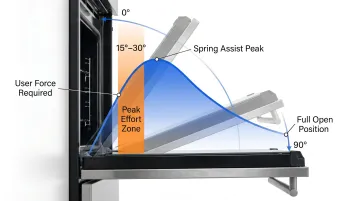
- Asymmetric torque profiles that provide more assist during the initial 15–30° of opening, where gravitational moment peaks
- Counterbalance mechanisms tuned to reduce peak effort rather than maintain constant torque across the full arc
Aesthetic Versus Functional Balance
US appliance buyers and OEMs have traditionally accepted visible or semi-exposed hinge hardware, favoring robust, serviceable designs. The premium and built-in segment is shifting toward European-influenced concealed hinges, but that preference hasn't displaced the mainstream.
That history shaped North American hinge architectures: external pivot points, accessible mounting screws, and modular assemblies that prioritize field serviceability over visual integration.
Hinge Design Requirements for International Markets
European Certification Framework
CE marking under the Low Voltage Directive 2014/35/EU is mandatory for electrical appliances sold in Europe. Compliance requires technical documentation retention for 10 years and conformity with harmonized standards—primarily the IEC/EN 60335 series for household appliances.
IEC 60335-1:2020 (Edition 6.0) includes requirements for:
- Stability and mechanical hazards (Clause 20)
- Mechanical strength (Clause 21)
- Construction (Clause 22)
- Tropical climate guidance (Annex P) specifying test ambient temperatures for Japan (25°C ± 10°C) and India (27°C ± 5°C)
IEC 60335-2-6 governs stationary cooking ranges. While the full test protocol is paywalled, endurance test equipment suppliers reference validation capability to 100,000 opening/closing cycles—indicating mechanical endurance is part of the certification scope, though specific mandated counts are not publicly confirmed.
Unlike UL 858, IEC test methodologies do not specify the same static-load stability tests (75 lb/250 lb door weights) documented in the CPSC's analysis. European testing focuses instead on thermal cycling, endurance cycles, and energy efficiency impact.
Compact Form Factor and Lighter Door Weights
Standard European built-in oven and dishwasher widths are 60 cm (23.6 in), as confirmed by Siemens and Samsung product specifications. These shorter door spans and lower overall appliance mass result in:
- Door panels typically run 30–40% lighter than comparable US full-size models
- Lighter doors need less counterbalance spring energy and lower holding torque
- Full counterbalance assemblies are often unnecessary; damped or friction-only hinges can suffice
- Spring and damper sizing can be optimized downward, reducing component cost
Concealed and Integrated Hinge Preferences
European and premium Asian OEMs strongly prefer flush, concealed hinges that preserve clean cabinet lines. This drives:
- Pivot points recessed into the door or cabinet frame — no externally visible hardware
- Gap consistency between door and cabinet held within 1–2 mm across the full opening arc
- Soft-close dampers integrated within the concealed hinge envelope on premium models
The engineering implications include:
- Multi-cavity progressive dies required for compound-curve stampings
- Tighter tolerances on pivot bores and bushing fits than exposed-hinge designs
- Damping module integration adds assembly steps without increasing the space envelope
- Surface finish requirements on concealed faces often rival those on visible surfaces
Regional Sub-Market Variations
Asian markets (Southeast Asia and Japan):
- Ultra-compact appliances (under-counter models as narrow as 45 cm)
- Anti-corrosion requirements: humid environments demand stainless steel components or enhanced coatings (JIS Z 2371 salt spray testing is widely referenced, though appliance-specific standards are not publicly accessible)
- High-gloss finishes and premium tactile feel expectations
Middle Eastern and Gulf markets present a different challenge: sustained outdoor temperatures above 50°C push standard lubricants past their rated viscosity ranges. High-temperature greases are required at pivot points and spring assemblies, and material expansion coefficients must be factored into clearance tolerances to prevent binding after prolonged heat exposure.
Latin American markets:
- Mixed platform environment: US-influenced freestanding ranges coexist with European-style built-ins
- Lower cost targets drive simpler hinge mechanisms (friction-only or basic detent hinges)
- Varied voltage/frequency standards complicate electrical interlock designs (for self-clean door locks)
Energy Efficiency Directives and Door-Seal Performance
The EU Ecodesign Regulation 66/2014 and Energy Labelling Regulation 65/2014 set energy efficiency requirements for domestic ovens. These regulations do not prescribe hinge torque or cycle counts, but they indirectly affect hinge design: door sag over the hinge's lifecycle can compromise gasket sealing, causing the appliance to fail energy efficiency ratings during end-of-life testing.
This means:
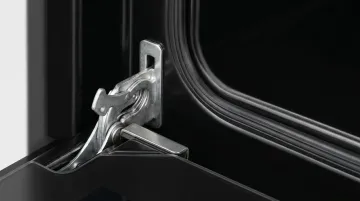
- Hinge assemblies must maintain door alignment within ±1 mm over 10+ years of use
- Spring rate degradation must be minimized (stainless steel or chrome-silicon alloy springs preferred over music wire)
- Pivot wear must be controlled through bushings, bearings, or hardened contact surfaces
What Actually Drives the Differences: Key Engineering Decision Factors
Torque and Counterbalance Specification
The single most consequential design variable when moving between markets is the required holding torque and counterbalance spring energy. Torque required to support a door depends on:
- Door weight (mass)
- Distance from the pivot to the door's center of gravity
- Opening angle (gravitational moment varies with door position)
As Sugatsune's torque calculation guide explains, the moment M = distance to center of gravity × mass × 9.80665 (SI units). Weber Knapp's engineering article confirms that hinge load capacity depends on both door mass and lever arm to the center of gravity, not just weight alone.
Practical impact: A hinge calibrated for a 42 lb US oven door will not perform correctly on a 25 lb European door without re-specification. The US hinge will over-assist, causing the door to spring open too quickly. Conversely, a European hinge undersized for a US door will require excessive user force and risk pivot failure.
Reversibility and Swing Configuration
Left-hand/right-hand hinge reversibility is more critical in European and Asian built-in segments than in typical US freestanding products. Vestel's built-in refrigerator catalog and Bosch refrigerator specifications confirm that reversible door hinges are standard features to accommodate varied cabinet configurations.
A reversible hinge design impacts:
- Pivot assembly symmetry: The hinge must function identically whether mounted left or right
- Spring orientation: Torsion springs must be hand-neutral or easily reconfigured
- Mounting hole patterns: Symmetrical or universal mounting points reduce installation errors
Each of these requirements adds design complexity. Single-component reversibility is achievable, but at high volumes, regional variants — separate left-hand and right-hand SKUs — are often more economical.
Material Selection for Climate and Corrosion Performance
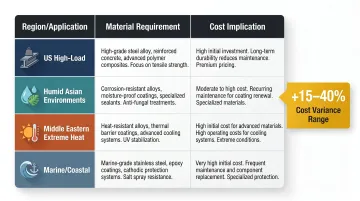
Material requirements vary significantly across regions:
| Region/Application | Material Requirement | Cost Implication |
|---|---|---|
| US high-load applications | High-strength steel alloys (1050–1095 carbon steel) | Baseline cost |
| Humid Asian environments | Stainless steel (304/316) or zinc-nickel plating | +15–30% per component |
| Middle Eastern extreme heat | High-temperature lubricants (synthetic greases rated to 200°C+); dimensionally stable alloys | +10–20% per component |
| Marine/coastal installations | Marine-grade stainless (316L) or proprietary corrosion-resistant coatings | +25–40% per component |
IEC 60335-1 Annex P addresses tropical climate applications, specifying ambient test conditions for Japan and India, but dedicated corrosion standards for appliance hinges vary by region and are not consolidated in a single public standard.
Early-Stage Design Integration as the Decisive Factor
The most avoidable cost and delay in global platform hinge development comes from treating hinge selection as a late-stage decision. Hinges specified after door geometry and cabinet clearances are locked in often force suboptimal compromises:
- Insufficient space envelope for required counterbalance spring energy
- Pivot locations that create unfavorable lever arms
- Mounting points that conflict with door seal routing or wiring harnesses
Starting hinge specification concurrently with door panel design is what separates efficient global platforms from costly late-stage redesigns. Early integration enables:
- Optimized pivot placement for torque efficiency
- Door thickness and material selection coordinated with hinge load capacity
- Cabinet clearance budgets that accommodate hinge motion arcs across all configurations
Mansfield Engineered Components engages at this early stage with OEMs including Bosch, Electrolux, GE/Haier, and Arçelik — co-developing hinge specifications alongside door panel design so that platform variants don't require expensive mechanical compromises later.
Building One Global Platform vs. Regional Hinge Variants: Which Approach Wins?
The Core Trade-Off
A universal hinge designed to the most demanding requirement in each dimension—highest torque, fullest reversibility, best corrosion resistance, longest cycle life—is technically feasible but carries a cost and weight premium that may be unnecessary in markets with lighter requirements.
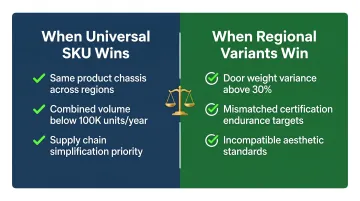
When a single SKU strategy makes economic sense:
- The OEM sells the same physical product chassis in multiple regions (e.g., premium built-in ovens with minimal regional variation)
- Annual volumes per region do not justify separate tooling amortization (typically below 50,000–100,000 units/year combined)
- Supply chain complexity reduction is a strategic priority (single BOM, simplified logistics)
When regional variants are more cost-effective:
- Door weights diverge sharply (e.g., 42 lb US oven door vs. 25 lb European door)
- Certification testing differs enough that a universal design would require significant over-engineering for one market (e.g., IEC 100,000-cycle validation when US targets are 20,000–50,000)
- Aesthetic expectations are incompatible (concealed European hinge vs. semi-exposed US hinge)
Situational Decision Framework
Ask these questions in order:
1. What is the door weight variance across regions?
- If variance exceeds 30%, separate counterbalance specs are likely justified
2. Are reversibility requirements symmetric?
- If all markets require reversible hinges, design universal; if only one market requires it, consider a regional variant
3. What is the combined annual volume?
- Above 100,000 units/year: regional variants may be more economical through optimized material specs
- Below 50,000 units/year: universal platform hinge likely wins
4. What are the certification test requirements?
- If both UL 858 and IEC 60335-2-6 testing are required regardless, a universal design adds no testing cost
- If regional variants would allow skipping one certification regime, that may offset tooling duplication
The Role of a Custom Hinge Design Partner
Working through this framework often surfaces tradeoffs that are difficult to resolve without hinge-specific engineering input—which is where Mansfield Engineered Components adds direct value.
MEC works with global appliance OEMs to prototype, test, and validate hinge solutions built around specific platform and market requirements. Every component is custom-engineered to specification, not adapted from a standard catalog.
MEC's capabilities include:
- Progressive die stamping for high-volume shared components with single-stage tooling for regional-specific variants
- Flexible assembly lines accommodating both high-volume global platforms and lower-volume regional SKUs
- In-house cycle-life testing, force/torque measurement, and environmental validation (temperature, humidity, corrosion)
- Value engineering to optimize unit economics across different volume scenarios
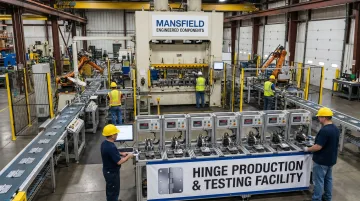
Engaging MEC's engineering team at the concept stage—before platform architecture is locked—gives OEMs the clearest picture of which hinge strategy (universal or regional) delivers the best cost-performance outcome across their full market footprint.
Conclusion
The US versus international hinge design question rarely has a single "right" answer—it depends on the specific appliance platform, target market mix, door characteristics, and the OEM's tolerance for SKU complexity versus design optimization. The goal is making that tradeoff deliberately, with real cost data behind it.
Three principles guide cost-effective global hinge platform development:
- Specify hinges concurrently with door geometry, not after cabinet clearances are locked
- Quantify the cost of over-engineering (universal platform) versus the cost of tooling duplication (regional variants) based on real volume forecasts and material cost differentials
- Partner early with a hinge engineering specialist who understands both regional certification requirements and custom motion control design
Engineers designing appliance platforms for global distribution should treat hinge specification as a first-order design constraint — not a downstream detail. Mansfield Engineered Components has spent over 80 years developing custom motion control solutions for OEMs like Whirlpool, GE/Haier, Bosch, and Electrolux, across both US and international platforms. If your team is working through a global hinge specification decision, that's exactly the kind of problem MEC is built to help solve.
Global platforms are also bulk-buying platforms. Consolidating a hinge specification across regions raises the order quantity behind a single part number, which improves the volume price break and simplifies release scheduling — one of the more direct financial arguments for platform standardization.
Frequently Asked Questions
What are the 4 types of hinges used in appliance design?
The four main functional categories are constant torque positioning hinges (friction-based, hold any angle), detent/bistable hinges (snap to one or two stable positions), counterbalance hinges (spring-assisted to offset door weight), and damping/soft-close hinges (control closing speed). Counterbalance hinges are most common in ovens and washing machines; soft-close hinges appear in premium dishwashers and refrigerators.
What is the strongest hinge design for heavy appliance doors?
Counterbalance spring hinges with high-strength steel components (1050+ carbon steel or stainless alloy) are typically specified for the heaviest appliance doors, such as large US oven doors. The right choice depends on the load case: static door weight, dynamic opening force, and cumulative cycle fatigue each drive different specification requirements.
What is a French hinge, and is it used in appliances?
A "French hinge" typically refers to a piano hinge (continuous hinge). While it appears in some cabinetry applications, it is less common in modern appliance designs than engineered pivot or counterbalance hinges because it lacks the torque control and counterbalancing that heavy drop-down or side-swinging doors require.
Do appliance hinges need to meet different certifications in the US versus Europe?
Yes. US appliance hinges are governed by UL standards such as UL 858 for ranges, while European products require compliance with IEC/EN 60335 standards and must carry CE marking. These standards specify different test parameters, so hinge designs validated for one market cannot automatically be assumed compliant in the other.
What is the standard cycle life requirement for an oven door hinge?
Industry-standard cycle life targets for oven door hinges typically range between 20,000 and 50,000 open/close cycles, depending on the OEM's tier and durability expectations. HRB Industries' soft-close oven hinge is validated to 50,000 cycles. Verify the applicable protocol (UL or IEC) for your specific product category early in the design process.
How do appliance door sizes and weights differ between US and European markets?
US full-size ovens and refrigerators are generally wider and heavier than their European counterparts. Standard European built-in oven cavities are typically 60 cm (23.6 in) wide, while US freestanding ranges vary from 24 to 36 in with correspondingly heavier door panels—often 42 lbs (19 kg) for premium US oven doors. This makes direct hinge interchangeability uncommon without re-specification.