Introduction
Most engineers don't think twice about a hinge — until it fails. A concealed hinge is far more than a pivot point. It's an engineered component that directly determines how a product opens, closes, holds position, survives years of daily use, and looks when the door is shut. Get it wrong, and you're looking at warranty claims, compliance failures, or a redesign mid-production.
The challenge for OEM engineers and procurement teams is real: the global concealed hinge market spans hundreds of manufacturers, but very few combine genuine custom engineering capability, consistent quality, and reliable delivery at production scale. Picking the wrong partner — especially one whose core competency is furniture cabinetry when you're building commercial appliances — is an expensive mistake.
That mistake is avoidable. This article profiles 10 manufacturers selected for engineering depth, industry specialization, and verified global supply capability. Whether you're sourcing for appliances, architectural doors, medical casework, or industrial enclosures, the right partner is listed here — and which one fits depends entirely on your application.
Key Takeaways
- Concealed hinges are hidden pivot mechanisms used in appliances, architectural doors, medical casework, furniture, and industrial enclosures.
- Top manufacturers span the USA, Germany, Japan, Austria, and Italy, each specializing in distinct verticals.
- Key selection criteria: custom engineering capability, certifications (UL, CE, EN 1935, ANSI/BHMA), load capacity, material, cycle durability, and after-sales support.
- Mansfield Engineered Components leads in custom appliance and industrial concealed hinge solutions; Simonswerk/TECTUS and SOSS lead in architectural and invisible door hinges.
- Match the manufacturer's core competency to your application — a furniture specialist won't cut it for heavy-duty OEM programs.
Overview of Concealed Hinges in the Global Hardware Market
Concealed hinges are pivot or motion-control mechanisms engineered to be invisible when a panel, door, or access point is closed. They appear across oven doors, refrigerator casework, medical enclosures, luxury interior doors, and industrial cabinets — wherever aesthetics, security, or reliable access requires hardware to stay out of sight.
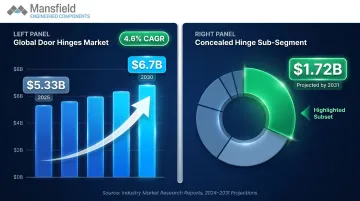
The market behind these components is substantial. According to a 2026 Research and Markets report, the global door hinges market is projected to grow from $5.33 billion in 2025 to $6.7 billion by 2030 at a 4.6% CAGR. Within that, the concealed door hinge sub-segment alone is projected to reach $1.72 billion by 2031, reflecting growing demand from construction, furniture OEMs, and smart building adoption.
Key demand drivers include:
- Residential and commercial construction activity
- Appliance manufacturing at scale
- Healthcare facility upgrades and medical casegood procurement
- Preference for flush, minimalist aesthetics across consumer and industrial products
The 10 manufacturers profiled below were selected for engineering depth, product range, certifications, industry-specific expertise, and global supply capability — covering both industrial/appliance applications and architectural use cases.
Top 10 Concealed Hinge Manufacturers Worldwide
Selection criteria include engineering depth, application specialization, certifications, global supply capability, and verified customer base — not brand size alone. Each entry below reflects a manufacturer with a distinct market position; the right choice depends on your application, volume, and compliance requirements.
1. Mansfield Engineered Components (USA)
Founded in 1939 and headquartered in Mansfield, Ohio, MEC is a specialized custom manufacturer for appliance hinges, counterbalances, and motion control components — shipping over 250,000 components weekly to OEM customers across the home appliance, commercial appliance, medical casework, transportation, and industrial sectors.
MEC maintains no product catalog. Every concealed hinge is custom-engineered for the specific application — oven drop-down doors, refrigerator side-swing doors, washing machine lids, dishwasher doors — with in-house prototyping and cycle-life testing completed before tooling begins.
Now part of the Sabaf Group, MEC combines over 80 years of family-owned engineering expertise with expanded global sourcing and resources.
| Category | Details |
|---|---|
| Key Industries | Home appliances, commercial appliances, medical casework, transportation, automotive aftermarket, general industrial |
| Core Capabilities | Custom concealed hinge design, counterbalances, motion control; 200+ engineering and manufacturing professionals; global offshore sourcing partnerships |
| Quality Approach | Custom-engineered to customer specifications; same-day customer response; on-time delivery commitment; in-house prototype testing and cycle-life validation |
2. Simonswerk / TECTUS (Germany)
Founded in 1889 in Rheda-Wiedenbrück, Germany, Simonswerk introduced the fully concealed TECTUS hinge system in 2002. It has since become the architectural benchmark for flush-to-wall door installations in commercial and luxury residential projects worldwide.
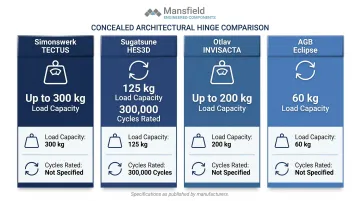
The TECTUS TE 640 3D supports up to 200 kg per pair, with the broader TECTUS range rated up to 300 kg. Full 3D adjustability (side ±3mm, height ±3mm, depth ±1mm), maintenance-free slide-bearing technology, and fire/smoke resistance options make it a go-to specification for architects demanding precision and invisibility.
| Category | Details |
|---|---|
| Key Industries | Luxury residential, commercial architecture, hospitality, institutional buildings |
| Core Capabilities | Fully concealed 3D-adjustable hinge systems; TECTUS TE 340/540/640 Series; fire-rated options |
| Certifications | EN 1935, CE, UL (20-minute fire rating on TE 640 3D) |
3. SOSS Door Hardware (USA)
Joseph Soss invented the original invisible hinge in 1903, and the brand — now owned by Allegion plc following a 2024 acquisition — remains iconic in U.S. trim carpentry, cabinetry, and institutional building markets for wood and metal door applications.
SOSS hinges provide a fully flush appearance with no visible hardware and comply with BHMA/ANSI Grade 3 testing criteria. Fire-rated models span 20, 90, and 180-minute ratings (UL-listed), making SOSS a strong choice for secure facilities, healthcare environments, and commercial interiors where aesthetics and fire compliance are both required.
| Category | Details |
|---|---|
| Key Industries | Residential, institutional, commercial interiors, secure facilities |
| Core Capabilities | Invisible hinges for wood and metal; UL fire-rated models (20/90/180 min); compact form; 180° opening |
| Certifications | ANSI/BHMA Grade 3, UL fire-rated |
4. Sugatsune (Japan)
Founded in 1930 in Tokyo, Sugatsune manufactures the HES3D series of 3-way adjustable concealed hinges used in luxury interiors, hospitals, smart buildings, and industrial equipment. The HES3D-E190 series (UL-rated for up to 3-hour fire resistance) supports up to 100 kg with 2 hinges and 125 kg with 3 hinges, with post-installation adjustment across vertical, horizontal, and depth axes.
The HES3D line has passed 300,000 open/close cycle tests (manufacturer private testing) — a durability benchmark that directly addresses fatigue performance in high-use environments. A lift-off feature simplifies installation and door removal.
| Category | Details |
|---|---|
| Key Industries | Luxury residential, healthcare, smart buildings, industrial equipment |
| Core Capabilities | HES3D Series concealed hinges; 3-way post-installation adjustability; wide range of finishes |
| Certifications | UL (3-hour fire rating on HES3D-E190WT-UL), RoHS 3 compliant; 300,000-cycle private testing |
5. Blum (Austria)
Based in Vorarlberg, Austria, with production sites in Poland, the USA, and Brazil, Blum is a globally recognized manufacturer of furniture and cabinet hardware. Its Clip Top BLUMOTION series — a fully concealed soft-close hinge — is widely used in residential kitchens, office furniture, and light commercial cabinetry.
The built-in BLUMOTION soft-close mechanism adapts to door dynamics automatically. The product range covers standard 110° hinges, thick-door/profile applications, wide-angle models, inset and overlay configurations, and aluminum frame applications. Blum holds ISO 9001, ISO 14001, and ISO 50001 certifications — quality, environmental, and energy management combined.
| Category | Details |
|---|---|
| Key Industries | Residential furniture, kitchen cabinetry, office furniture, light commercial |
| Core Capabilities | Clip Top BLUMOTION soft-close hinges; full overlay, half overlay, and inset options; snap-on/snap-off CLIP technology |
| Certifications | ISO 9001, ISO 14001, ISO 50001, AEO status |
6. Häfele (Germany)
Founded in 1923 in Nagold, Germany, Häfele operates across more than 150 countries and offers its Startec H series concealed hinges for wooden interior doors — the H2 model being a 3D-adjustable, 95mm satin-chrome hinge available in left or right-hand configuration. The broader Startec range includes integrated self-close options.
Häfele's global distribution network and Service+ program — which provides planning, customization, and certified expert support — make it a practical choice for commercial project specifiers who need consistent supply across multiple geographies.
| Category | Details |
|---|---|
| Key Industries | Hospitality, residential, office, healthcare, education |
| Core Capabilities | Startec H2/H7/H12 concealed hinge range; 3D adjustable; soft-close integration; global distribution |
| Certifications | EN 1935, CE (European-market range) |
7. Southco (USA)
Southco has been in the engineered access hardware business since 1945, operating across 30+ countries. Its concealed hinge portfolio includes the E6 Adjustable Torque Position Control Hinge — which provides infinite control over door positioning without additional hardware — and concealed/removable styles suited to enclosure, medical, transportation, and industrial applications.
The key differentiator is adjustable torque and position-control functionality: engineers can specify exactly how a panel opens, how far it travels, and whether it holds position mid-arc. This degree of control is especially relevant for OEM environments where access performance must be consistent and repeatable across thousands of units.
| Category | Details |
|---|---|
| Key Industries | Transportation, medical, industrial enclosures, architectural |
| Core Capabilities | E6 Position Control Hinges; adjustable torque concealed hinges; stainless steel and zinc alloy options |
| Certifications | ISO; corrosion-resistant material standards; application-specific compliance |
8. Otlav (Italy)
Founded in 1952 in Santa Lucia di Piave, near Venice, Otlav produces its INVISACTA concealed hinge line — 9 distinct models ranging from 40 kg to 200 kg capacity — for interior doors and windows. The range is distributed in over 80 countries and backed by a portfolio of nearly 100 patents.
A seven-fulcrum pivot axis design minimizes friction and maximizes load performance. The IN343 model supports 200 kg with 3D adjustability. Fire-rated options carry a 90-minute rating, and burglar-resistant models add another certification layer for security-focused architectural projects.
| Category | Details |
|---|---|
| Key Industries | Residential, commercial architecture, security-rated installations |
| Core Capabilities | INVISACTA series (9 variants); 40–200 kg capacity range; 3-way adjustment; fire and burglar-resistant options |
| Certifications | CE, UL, fire-rated 90-minute, anti-burglary certified |
9. Hettich (Germany)
Hettich is a global German furniture fittings manufacturer with over 130 years of history, headquartered in Kirchlengern, Germany. Its concealed cabinet hinges — including soft-close and push-to-open variants — are widely used by furniture OEMs and kitchen manufacturers across Europe, Asia, and the Americas.
The catalog covers frameless and face-frame cabinetry configurations with broad overlay options, making Hettich a practical fit for furniture manufacturers who need standardized concealed hinge solutions at high volume with strong technical documentation and consistent supply.
| Category | Details |
|---|---|
| Key Industries | Furniture manufacturing, kitchen cabinetry, office furniture, retail fixtures |
| Core Capabilities | Concealed cabinet hinge systems; soft-close and push-to-open variants; broad OEM supply capability |
| Certifications | ISO, EN; tested to high open/close cycle standards |
10. AGB (Italy)
Founded in 1947 in Romano d'Ezzelino, Italy, AGB manufactures concealed hinges for interior doors under its Eclipse 3.X series — including a self-closing variant (Eclipse 3.2 HD Self) with a built-in door closer mechanism. The Eclipse 3.0 offers tool-assisted 3-way adjustability per EN 1935 and compatibility with both aluminum and wood frames.
Load capacity reaches 40 kg with 2 hinges and 60 kg with 3 hinges — appropriate for residential and light commercial interior doors. The built-in closer mechanism distinguishes the Eclipse 3.2 HD Self from most concealed hinge competitors that require a separate door closer installation.
| Category | Details |
|---|---|
| Key Industries | Residential interiors, commercial architecture, hospitality |
| Core Capabilities | Eclipse 3.X series; built-in door closer option; aluminum and wood frame compatibility |
| Certifications | EN 1935, CE-compliant; 40 kg/2 hinges, 60 kg/3 hinges |
How We Chose the Best Concealed Hinge Manufacturers
We built this list around a multi-factor evaluation — not brand recognition or price. The most common mistake buyers make is selecting a manufacturer that's well-known without validating that their core competency matches the application. A best-in-class furniture hinge manufacturer may be entirely wrong for a commercial appliance program.
The Evaluation Criteria
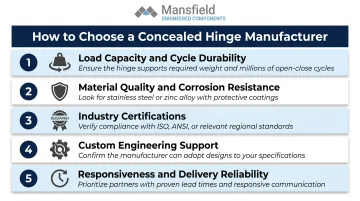
Each manufacturer was assessed across five dimensions:
- Load capacity and cycle durability — critical for high-use environments; inadequate specs here lead to premature field failures
- Material quality and corrosion resistance — particularly relevant for medical, food service, and marine applications
- Industry-specific certifications — EN 1935 and CE for European architectural work, UL for fire-rated applications, ANSI/BHMA for North American standards
- Custom engineering support — can they co-develop a solution, or only sell from a catalog?
- Responsiveness and delivery reliability — production programs don't wait
Why Custom Engineering Matters Most for OEM Buyers
For OEM and industrial buyers specifically, the ability to co-develop a concealed hinge rather than adapt an off-the-shelf product is often the single biggest differentiator. Catalog hardware works when you can design your product around available components. It fails when you have specific torque-curve requirements, unusual geometric constraints, premium tactile feel targets, or material requirements that standard hardware doesn't accommodate.
This is where Mansfield Engineered Components adds the most value. Their engineering team collaborates with OEM product designers from concept through prototype validation to production release, with in-house cycle-life testing, force and torque measurement, and environmental testing built into every program.
The volume crossover where custom engineering becomes more cost-effective than catalog pricing typically sits between 10,000 and 100,000 annual units, after which custom tooling amortization beats catalog component pricing.
Conclusion
The concealed hinge market is broad, deep, and genuinely specialized. The right manufacturer depends entirely on what you're building. A custom appliance hinge requiring 200,000+ cycle validation and precise torque-curve performance calls for a different partner than an architectural flush door demanding 3D adjustability and fire certification.
Evaluate manufacturers on engineering responsiveness, prototyping capability, delivery reliability, and their ability to scale with your production program — not just on catalog depth or global brand recognition. At high volumes, those operational criteria separate reliable long-term partners from vendors who look good on paper.
If your application demands fully custom-engineered components — no catalog defaults, no off-the-shelf compromises — Mansfield Engineered Components is a strong fit for appliance, medical casework, transportation, and industrial OEM programs. Contact the team at sales@mansfieldec.com or call +1.419.524.1300 to discuss your custom concealed hinge or motion control requirements.
Volume matters to the commercial terms as much as to the engineering. Buyers sourcing concealed hinges in bulk should ask every shortlisted manufacturer for volume pricing tiers at their real annual quantity, the minimum order quantity per part number, and whether blanket orders can be released against a build schedule. Those answers usually separate a shortlist faster than catalog depth does.
Frequently Asked Questions
What are the three types of concealed hinges?
The three main types are fully concealed (mortised into both door and frame, invisible when closed), semi-concealed (one leaf hidden, one visible), and European/cup hinges (mortised into the door panel, with the mounting plate visible on the cabinet interior). Each suits different applications based on how much visibility is acceptable.
What is the difference between a concealed hinge and a standard butt hinge?
A standard butt hinge sits on the surface with exposed knuckles and pins visible when the door is closed. A concealed hinge recesses into the door and/or frame, producing a flush profile, no exposed pins, and a cleaner look suited to modern architectural and appliance applications.
How do I choose the right concealed hinge manufacturer for an OEM or industrial application?
Start with vertical-specific experience — appliances, medical, transportation, or industrial enclosures each have distinct requirements. From there, confirm certifications, prototype capability, and whether the manufacturer can scale to your production volumes before committing.
Are concealed hinges suitable for heavy-duty or high-cycle applications?
Yes. Many industrial and appliance-grade concealed hinges are specifically engineered for high-cycle durability, with leading manufacturers testing to 200,000–300,000+ open/close cycles. Load capacities range from 40 kg for light interior doors up to 200+ kg for heavy architectural applications.
What certifications should I look for in a concealed hinge manufacturer?
It depends on the application. EN 1935 and CE mark for European architectural door hinges, UL listing for fire-rated applications, ANSI/BHMA for North American standards, and ISO-aligned quality systems for general industrial and OEM manufacturing programs.
What industries use concealed hinges beyond doors and furniture?
Concealed hinges are common in home and commercial appliances (oven doors, refrigerators, dishwashers), medical casework, transportation enclosures, automotive aftermarket storage, and industrial equipment — wherever aesthetics, access reliability, and cycle durability all matter in the same design.