Introduction
Picture the procurement manager's dilemma: your new commercial oven line needs a custom drop-down door hinge that can withstand 240°C operating temperatures, deliver smooth controlled motion across a 90-degree arc, pass 2.5 million cycle testing, and fit within a 15mm mounting envelope.
The natural instinct is to divide and conquer—send the stamping to a metal fabricator, assembly to a contract manufacturer, surface finishing to a plating shop, and testing to a third-party lab. It feels like control, using specialists at each stage.
Then the coordination problems emerge. The stamped bracket arrives 0.3mm out of tolerance. The assembly vendor blames the stamping house. The plating shop's lead times slip because they prioritized a larger customer. Your launch date is eight weeks away, and no single vendor will take ownership of the program outcome.
When accountability fragments across multiple suppliers, quality disputes, schedule slippage, cost overruns, and finger-pointing become predictable outcomes. Every handoff introduces risk. Every vendor boundary is a place where ownership disappears.
This article defines the single-source responsibility model, explains why it matters for hinge and motion control component sourcing, and identifies what to look for in a partner capable of owning the entire process from concept through delivery.
Key Takeaways
- One partner owns the entire program—design, engineering, production, testing, delivery
- Eliminates finger-pointing and handoff errors inherent in fragmented supply chains
- Hinge programs require tight coordination across design, tooling, testing, and production—single-source delivers that
- Reduces hidden costs, compresses time-to-market, delivers consistent quality
- The right partner brings engineering, prototyping, manufacturing, and service in-house
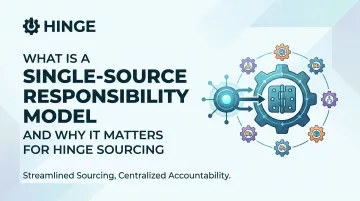
What Is a Single-Source Responsibility Model?
A single-source responsibility model means one supplier takes complete, contractual ownership of a component program—from initial design and engineering through production, testing, and on-time delivery—without sub-delegating accountability to other vendors.
One Entity Owns the Entire Outcome
This goes well beyond consolidating purchase orders. One entity is operationally and contractually on the hook for the entire outcome, including failures at the intersections between processes. When a torque specification drifts out of range or a surface finish fails inspection, there's one responsible party. One team owns the problem from root cause to corrective action.
How It Differs from Fragmented Multi-Vendor Sourcing
In a fragmented model, each vendor is responsible only for their defined scope. The stamping house delivers stampings. The assembly shop assembles what it receives. The finishing vendor applies the specified coating. Disputes at the handoff points — dimensional variation, surface damage, specification drift — become the buyer's problem to investigate and resolve.
In a single-source model, the partner owns every handoff. There are no vendor boundaries where accountability ends.
Single Sourcing vs. Sole Sourcing
Sole sourcing occurs when only one supplier exists for a requirement—a monopoly position where the buyer has no alternative. Single-source responsibility is a deliberate choice to consolidate program ownership with one capable partner, even when alternatives exist. The key difference is where the power to choose sits: buyers control single sourcing; the market dictates sole sourcing.
Beyond OEM, ODM, and CM Models
- OEM (Original Equipment Manufacturer): Produces to the buyer's design; the buyer retains IP and design authority
- ODM (Original Design Manufacturer): Designs and builds standardized products the buyer can brand; faster to market but limited customization
- CM (Contract Manufacturer): Manufactures only what the buyer specifies; no design responsibility
A single-source responsibility partner combines design authority, engineering support, prototype validation, and production under a unified accountability structure. For hinge programs specifically, that means a single point of contact carries the program from concept geometry through validated, production-ready components — with no gaps in ownership between steps.
Why Hinge Sourcing Demands More Than a Standard Supplier
Deceptive Complexity of Motion Control Components
Unlike commodity fasteners or raw materials, hinges require coordination of mechanical design, material selection, surface treatment, torque calibration, and cycle-life testing—all aligned precisely for the component to perform correctly in its end application.
According to ANSI/BHMA A156.1-2025 standards, Grade 1 hinges must pass 2.5 million cycles under 300 lb loads with wear under 0.010 inches, withstand 600 lb static overload, and meet specific corrosion resistance thresholds. These aren't suggestions—they're minimum performance requirements for OEM-grade components.
Application-Specific Requirements
Every hinge program is different:
- Oven door hinges must sustain controlled descent torque at 240°C (per IEC 60335-2-6) and hold smooth feel through hundreds of thermal cycles
- Commercial refrigerator hinges require food-zone materials per NSF/ANSI 2, Ra 32 micro-inch surface finish, and crevice-free cleanability
- Medical casegood hinges demand disinfectant-resistant finishes, quiet operation, and high cycle-life for clinical use
- Truck toolbox counterbalances need torque curves calibrated to hold heavy lids at angle against both gravity and road vibration
A commodity approach cannot satisfy these requirements reliably.
Compounding Errors Across Vendor Handoffs
When one vendor stamps the bracket, another assembles the mechanism, and a third applies the finish, small dimensional discrepancies at each stage compound. A 0.2mm stamping variance plus a 0.1mm assembly misalignment plus plating buildup creates cumulative fit issues, unwanted noise, premature wear, and warranty claims—with no single party accountable for the result.
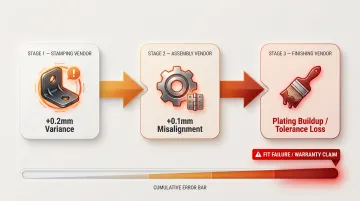
These failures typically surface at final inspection or in the field, long after any corrective window has closed.
The Hidden Costs of Managing Multiple Hinge Vendors
Administrative and Coordination Overhead
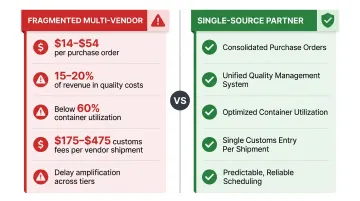
Managing multiple vendors for a single hinge program means multiple purchase orders, multiple lead times, multiple quality audits, and multiple points of contact. APQC benchmarking data shows organizations spend $14 to $54+ per purchase order. For companies issuing thousands of POs annually, this performance gap translates to millions in operating costs.
Add supplier quality management overhead: a Fortune 500 manufacturer incurred a $2.3 million audit response when 18% of Tier 1 suppliers had expired certifications, delaying three production programs.
Compounding Quality Risk
Every vendor handoff introduces new opportunity for dimensional variation, surface damage, or specification drift. Research shows quality-related costs typically consume 15% to 20% of sales revenue, reaching up to 40% of total operations in some organizations. Fragmented supplier oversight directly increases these Cost of Poor Quality (COPQ) metrics.
Organizations implementing standardized supplier quality processes see supplier defect rates 46% lower than those without such processes—but implementing standardized processes across multiple independent vendors is far harder than holding a single manufacturing partner accountable end-to-end.
Delay Amplification and the Domino Effect
MIT research demonstrates order variability (sigma) amplifies from 1.26 at the retailer tier to 7.30 at the factory tier across a four-tier supply chain. Each vendor handoff compounds scheduling volatility.
A short delay at one vendor in a sequential supply chain cascades through the entire program, multiplying the original delay by the number of interdependent steps. This dynamic is most damaging during new product launches when hinge validation is on the critical path.
Ambiguous Accountability in Quality Disputes
When a hinge fails in the field, root cause determination across multiple vendors is slow and contentious. Did the problem originate in stamping, assembly, finishing, or material selection? Each vendor points upstream or downstream.
The result: delayed corrective action, extended warranty exposure, and buyer engineering teams spending weeks acting as referee instead of developing the next product.
Hidden Logistics and Landed-Cost Implications
Multiple vendors in different locations mean multiple shipments, potentially multiple customs entries, and additional duty exposure. C.H. Robinson research shows fragmented shipments average below 60% container utilization versus 75-85% for mature consolidation programs.
Customs broker fees alone run $175 to $475 per shipment for standard ocean imports. Three vendors shipping monthly instead of one means those fees hit three times over — a straightforward cost that rarely appears in sourcing models until it's already eroding margin.
Key Benefits of Single-Source Responsibility for Hinge Programs
Unified Design-to-Delivery Ownership
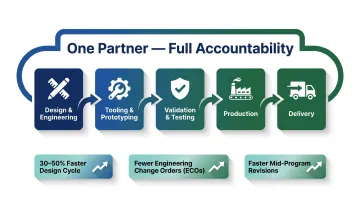
When one partner controls design, tooling, and production, design decisions are made with manufacturing constraints already in mind. This is design for manufacturability in practice.
Data-driven DFM approaches achieve 30-50% design cycle reduction and 20-40% quality improvement by integrating design and manufacturing knowledge from the start. The result:
- Fewer engineering change orders
- Faster prototype-to-production transitions
- Components that perform as intended from the first production run
Single Accountability Means Faster Problem Resolution
When a torque spec deviation, surface finish inconsistency, or delivery shortfall occurs, one team owns the problem from identification to corrective action — no escalation matrix required.
This compresses resolution time compared to multi-vendor dispute cycles, where blame-shifting is the default response. Instead of coordinating root cause analysis across three vendors, the single-source partner investigates internally and implements corrective action without waiting on external handoffs.
Consistent Quality Throughout the Component Lifecycle
No inter-vendor handoffs means consistent quality standards, tooling, and process controls across every unit in every production run. The spec that shipped in year one is the spec that ships in year five.
This consistency is especially important for programs with long product cycles. Full supplier qualification typically requires 12 to 24 weeks, with PPAP documentation spanning 18 required elements. Mid-program supplier changes introduce fresh requalification risk and potential specification drift. A single-source partner eliminates this exposure.
Faster Time-to-Market and Greater Program Agility
An integrated design, engineering, and production team can iterate prototypes quickly, compress the validation cycle, and absorb design changes without restarting a multi-vendor qualification process.
When market feedback demands a design revision mid-program, a single-source partner absorbs it internally. There's no re-qualifying a new tooling vendor or reconciling conflicting tolerances across suppliers — just an updated drawing and a revised production schedule.
Accumulated Institutional Knowledge Drives Long-Term Value
A single-source partner who works with a customer across multiple programs builds deep knowledge of that customer's product architecture, consumer preferences, and performance standards.
This accumulated context accelerates future programs and reduces specification errors. By the third or fourth program together, the partner already knows your torque envelope, your finish standards, and the tolerance thresholds that have caused field issues before — which means less time spent re-explaining requirements and more time spent solving new ones.
What to Look for in a True Single-Source Hinge Partner
In-House Design, Engineering, and Prototype Validation Capability
The partner must accept a performance brief and translate it into a tested, validated prototype without outsourcing design work or tooling engineering.
Ask: Do they design and test their own prototypes before production? This is the dividing line between a true single-source partner and a broker who coordinates on your behalf.
Look for engineering validation capabilities including:
- Cycle-life testing to industry standards
- Force and torque measurement across the full motion arc
- Environmental testing (temperature, humidity, corrosion exposure)
- Hold-at-angle testing for counterbalance components
Breadth of Manufacturing Capability and a Unified Quality System
Look for a partner who controls the full production process—metal stamping, forming, assembly, surface finishing—under one quality system with consistent process controls and full traceability.
A partner whose manufacturing scope requires external sub-suppliers for key steps reintroduces the exact handoff risks that single-source responsibility eliminates. Verify:
- In-house stamping (progressive die and single-stage)
- Sheet metal fabrication (bending, forming, welding)
- Assembly operations (riveting, fastening, sub-assembly)
- Quality inspection (in-process and final)
How to Verify Delivery Performance and Long-Term Reliability
Single-source responsibility is only meaningful if the partner consistently delivers on time and responds immediately when questions or issues arise.
Look for evidence of long-term relationships with demanding OEM customers across multiple industries. Brands like Whirlpool, GE/Haier, Sub-Zero, and Bosch choosing the same partner across decades is a strong signal of sustained delivery performance.
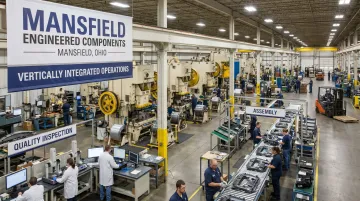
Mansfield Engineered Components has operated on this model since 1939—same-day response to customer questions, strategic inventory levels to protect on-time delivery, and 250,000+ components shipped weekly from its Mansfield, Ohio facility.
The vertically integrated operation handles mechanical design, prototyping, tooling, metal stamping, assembly, inspection, and delivery without external handoffs. When an oven manufacturer needs a controlled-descent hinge rated for 240°C, or a commercial refrigerator OEM requires NSF-compliant food-zone hinges, Mansfield owns the entire program from concept through production.
Single-source responsibility also simplifies bulk buying. One supplier owning design through delivery means one part number, one volume price break, and one release schedule to manage, instead of coordinating bulk orders, minimum quantities, and lead times across several vendors.
Frequently Asked Questions
What is a single-source manufacturer?
A single-source manufacturer takes full ownership of a component program—covering design, engineering, production, and delivery—rather than acting as one step in a multi-vendor chain. The defining feature is unified accountability for the entire outcome, not just one process step.
What is the difference between single sourcing and sole sourcing?
Sole sourcing occurs when only one supplier exists in the market for a requirement (a de facto monopoly). Single sourcing is a deliberate strategic choice to consolidate a program with one capable partner even when alternatives exist. The buyer holds the power of choice in single sourcing.
What is OEM vs ODM vs CM?
OEM: Produces components to the buyer's design. ODM: Designs and builds a standardized product the buyer can brand. CM: Manufactures only, following buyer specifications. A single-source responsibility partner combines all three functions—design authority, engineering support, prototype validation, and production—under one accountable entity.
What are the risks of splitting hinge sourcing across multiple vendors?
Splitting hinge sourcing across vendors creates compounding risks that are especially damaging in application-specific programs:
- Quality variation compounds at each handoff
- Accountability becomes ambiguous when problems occur
- Cascading delays across vendor handoffs extend lead times
- Administrative overhead increases without clear program ownership
When does single-source responsibility make the most sense for a component program?
Single-source responsibility is most valuable when the component is application-specific (not a commodity), when design and manufacturing processes are interdependent, when the engineering team lacks bandwidth to coordinate multiple vendors, and when the cost of field failures or delays is high.
How do I evaluate whether a hinge supplier can truly serve as a single-source partner?
Focus on three criteria when vetting a potential single-source partner:
- Do they control design, tooling, and production in-house without critical sub-suppliers?
- Do they have a track record of on-time delivery and quality consistency across long-term OEM programs?
- Do they commit to responsive communication and take clear ownership when problems arise?