Introduction
Picture this: An OEM engineer approves a gas strut for a commercial oven lid to save $15 per unit on initial component cost. Six months into production, warranty claims flood in—seal failures from heat exposure, dangerous over-pressure incidents, and frustrated end users struggling with lids that won't stay open in cold kitchens. The "savings" evaporate into field service costs that dwarf the original component budget.
That scenario plays out across appliances, medical equipment, and commercial food service more often than most design teams expect. In high-volume OEM environments, the choice between spring hinges, gas struts, and counterbalance mechanisms is rarely just about initial price.
The wrong mechanism affects cycle life, warranty exposure, temperature stability, contamination risk, and total cost of ownership across a product's lifespan. Getting this decision right at concept phase is far less costly than correcting it after tooling is cut.
This guide breaks down each mechanism across the engineering factors that matter most — so you can make the right specification call while it's still inexpensive to change.
Key Takeaways
- Spring hinges self-close or self-open light panels via torsion springs; best for low-load, high-frequency vertical applications
- Gas struts actively lift heavy lids using pressurized nitrogen, but force varies 3.3–3.5% per 10°C and performance degrades over time
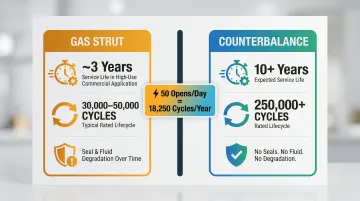
- Counterbalances neutralize lid weight across the full range of motion using mechanical springs; rated for 250,000+ cycles compared to 30,000–50,000 for gas struts
- No single solution fits all OEM applications: load, cycle count, environment, and envelope constraints all factor into the right choice
- Hybrid designs pairing gas strut lift assist with a mechanical counterbalance backup can resolve the most demanding requirements
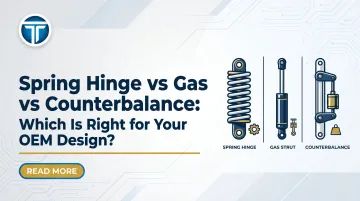
Understanding the Three Mechanisms: Spring Hinge, Gas Strut, and Counterbalance
Spring Hinge
A spring hinge replaces one or more knuckles of a standard hinge with a torsion spring. When the door or lid moves, the spring stores energy and releases it to return the panel to its default position—either open or closed depending on mounting orientation.
Typical OEM applications:
- Light-to-medium weight vertical doors and access panels
- Enclosure covers requiring self-closing or self-opening without operator effort
- Instrument panels and equipment covers
- Control cabinet doors
Spring tension is fixed during manufacture and can only be adjusted by changing spring count or strength. This simplicity offers reliability but limits adaptability.
Key limitations for OEM context:
- Work best on lighter panels (typically under 50-100 lbs depending on configuration)
- May require latches to hold intermediate positions
- Push toward a set position rather than holding at any angle
- Don't provide active lifting assistance—they return force, not lift assist
Spring hinges rated for 100,000+ cycles make them suitable for high-frequency applications where the load remains within their capacity range.
Gas Strut (Gas Spring)
Gas strut, gas spring, gas piston, and gas shock all refer to the same component: a sealed steel or stainless steel cylinder filled with pressurized nitrogen gas (10-230 bar) plus a small amount of lubricating oil. An internal piston on a rod extends under gas pressure.
In OEM applications, gas struts mount alongside a standard hinge to provide active outward force that assists in lifting or holding heavy lids, covers, and doors open. Standard industrial gas springs deliver extension forces from 10 to 250 lbs per strut, with specialty units reaching 1,124 lbs.
Common applications:
- Appliance lids (washing machines, chest-style equipment)
- Equipment hoods and access covers
- Horizontal trunk-style lids requiring ergonomic lift assistance
- Display mounts and adjustable panels
The key trade-off: Gas struts offer genuine ergonomic lift assistance for heavy loads, but their sealed gas system introduces inherent limitations. Rubber seals that contain nitrogen pressure degrade with thermal cycling, mechanical cycles, and age. Industry data from major manufacturers (Stabilus, Bansbach, Suspa) rate standard gas springs at 10,000 to 100,000 double strokes depending on type. Expect less than 10% force loss after 50,000 cycles and less than 8% force loss in the first two years from natural gas permeation.
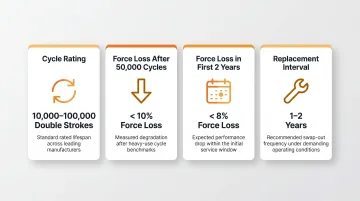
In demanding industrial conditions, gas springs typically require replacement after 1-2 years, whereas mechanical alternatives last 3-5+ years.
Counterbalance Mechanism
A counterbalance mechanism uses internal mechanical springs—typically torsion or coil—engineered to generate rotational force that precisely offsets the weight of a lid, door, or cover throughout its range of motion. The user feels near-zero effort to open or hold the panel at any angle.
Unlike spring hinges, which push toward a preset position (open or closed), a counterbalance neutralizes gravity across the full arc of travel. That difference translates to smooth, controlled motion without the slam or snap-back of spring-return mechanisms.
Counterbalances are purely mechanical—no gas, no fluid. For OEM designers specifying long-lifecycle products, that distinction matters:
- Immune to temperature extremes (no pressure variation)
- Capable of very high cycle counts (250,000+ cycles)
- Free from seal degradation or gas permeation
- Suitable for food-contact and medical environments without contamination risk
- Maintenance-free over 10+ year product lifecycles
Commercial ovens, medical storage cabinets, and heavy outdoor cooking equipment are common fits—anywhere temperature swings or high cycle counts would shorten a gas strut's service life. The sections below use these distinctions to walk through how to match each mechanism to your specific design constraints.
Head-to-Head: 6 Engineering Factors Every OEM Designer Should Evaluate
Load Capacity and Weight Range
Spring hinges are generally limited to light-to-medium panels, typically 50-100+ lbs depending on configuration and hinge count. Multiple spring hinges can distribute load, but beyond approximately 100 lbs, spring hinges become impractical.
Gas struts scale across a wide force range depending on cylinder pressure specification. Standard stock sizes deliver 10-250 lbs per strut; industrial gas springs extend this to 1,124 lbs per unit. Multiple struts can be paralleled for heavier loads.
Counterbalances can be precisely engineered for very heavy lids by adjusting spring geometry, material, and preload. Custom torque-curve counterbalances match panel weight and motion arc without the incremental steps of catalog gas strut ratings.
OEM implication: Over-specifying or under-specifying load capacity at volume leads to premature failure or unnecessary cost. The mechanism must match actual door or lid weight, including dynamic loads from vibration, impact, or off-angle use.
Cycle Life and Durability at OEM Scale
Gas struts have finite service life. Rubber seals degrade through thermal cycling, mechanical cycles, and age. Major manufacturers document:
- 10,000-100,000 double strokes depending on type
- Less than 10% force loss after 50,000 cycles
- Less than 8% force loss in first two years from gas permeation
- Replacement intervals of 1-2 years in demanding conditions
Mechanical alternatives last substantially longer. Well-designed spring hinges and counterbalance mechanisms are engineered for 100,000+ to 250,000+ cycles with no fluid or seal replacement. For OEM products with 10+ year design lives, this difference has direct implications for warranty exposure and total cost of ownership.
A commercial food service lid opened 50 times per day reaches 18,250 cycles per year—exhausting a gas strut's rated life in under 3 years but representing less than 8% of a counterbalance's rated capacity.
Temperature Sensitivity
Physics governs gas strut performance: Gas pressure is temperature-dependent (Gay-Lussac's Law: P₁/T₁ = P₂/T₂). Manufacturers quantify this as approximately 3.3-3.5% force change per 10°C.
Across the full rated temperature span (-30°C to +80°C), this produces approximately 36% total force variation. In cold environments, gas struts lose significant lifting force; near heat sources like ovens or grills, pressure builds and can cause overpressure or seal failure.
Key manufacturer temperature thresholds to know:
- Standard gas springs: 80°C continuous maximum
- Short-duration exposure: 110°C for up to 1 hour
- Stabilus extended-range dampers: rated to 130°C
- Below -30°C: sealing materials lose elasticity; above 80°C, they soften and wear accelerates
DADCO explicitly warns: "Maximum internal gas spring pressure may be exceeded by means of over charge, fluid ingestion, high temperature, or a combination of these factors."
Spring hinges and counterbalances contain no pressurized gas, making them immune to temperature-driven force variation. For OEM applications near heat sources—commercial ovens, smokers, autoclaves—or in cold storage environments, mechanical solutions are the default choice.
Space and Packaging Constraints
Gas struts require significant interior clearance for the cylinder body and rod travel, plus precise mounting point geometry to achieve correct leverage. A gas strut typically needs mounting points offset from the hinge pivot, consuming interior volume and complicating enclosure design.
Spring hinges occupy minimal space—they replace standard hinge knuckles without requiring additional mounting points or interior clearance beyond the hinge itself.
Counterbalances occupy more space than spring hinges due to internal spring housings, but can often be designed to conform to available space. Custom counterbalance geometry can nestle into corners or follow enclosure contours that fixed-dimension gas struts cannot.
Packaging decisions made late in development are expensive to reverse. Locking in motion control geometry during concept phase—not after enclosure dimensions are finalized—keeps all three options on the table.
Cleanliness and Contamination Risk
Gas struts present contamination risk in food preparation, pharmaceutical, and medical equipment applications. A failed seal can release oil or gas into the product environment. Food-grade gas springs exist—ACE Controls V4A stainless steel gas springs ship with food-grade oil conforming to FDA 21 CFR 178.3570—but add cost.
However, NSF/ANSI 169 prohibits continuous (piano) hinges in food zones and requires lift-off hinges with removable pins, creating additional design constraints beyond fluid selection.
Mechanical spring mechanisms (spring hinges and counterbalances) require lubrication but have no sealed fluid reservoir at risk of pressurized leakage. For OEM applications in regulated food or medical environments, this distinction often drives the decision entirely. Under ISO 14971 for medical devices, any fluid-containing component triggers formal risk analysis for contamination hazard.
Total Cost of Ownership Across Production Volume
Gas struts may have lower per-unit purchase price (approximately $12 base), but when factoring in separate hinge hardware, mounting bracket fabrication, precise installation geometry, and eventual field replacement, total cost is often higher than a purpose-engineered mechanical solution.
Counterbalance mechanisms cost more upfront ($50-$1,000 per unit) but deliver 5-8x the cycle life (250,000+ cycles vs. 30,000-50,000). Weber Knapp analysis documents a 5-year ROI payback period for mechanical counterbalances in high-cycle industrial applications.
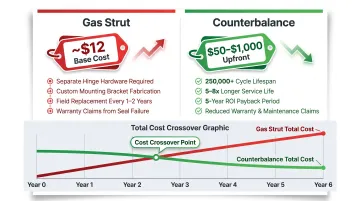
OEM designers should model cost across expected product life, including warranty claims and service calls driven by gas seal failure, before selecting gas struts based on initial part price alone. Research shows that design changes made during concept phase cost 5x less than changes made later—making component selection a high-leverage cost control point.
OEM Decision Framework: Matching the Mechanism to Your Application
Before specifying any motion control component, define four parameters:
- Panel weight (including dynamic loads)
- Required cycle life (realistic field use, not just lab testing)
- Operating environment (especially temperature range and contamination risk)
- Space envelope (mounting points, interior clearance, installation geometry)
Map these to the mechanism that satisfies all four without over-engineering.
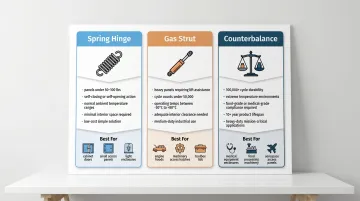
When to Specify a Spring Hinge
Use spring hinges when:
- Panel is light-to-medium weight (under 50-100 lbs)
- Primary requirement is self-closing or self-opening, not active lift assist
- Operating environment is normal temperature range (-30°C to 80°C)
- Space is limited (no room for gas strut cylinder and rod clearance)
Typical applications: Access panels, light enclosure doors, instrument covers, control cabinet doors.
When to Specify a Gas Strut
Use gas struts when:
- Panel is heavy and user needs active lift assistance to open it
- Product has relatively low cycle life requirement (under 50,000 cycles)
- Operating temperature stays within safe range for gas specification (-30°C to 80°C)
- Interior space permits proper strut mounting geometry
Appropriate applications: Trunk-style lids, equipment hoods requiring ergonomic lift, display mounts, horizontal access covers in temperature-controlled environments.
When to Specify a Counterbalance
Use a counterbalance when:
- Application involves high cycle counts (100,000+ cycles)
- Elevated temperatures (near ovens, grills, outdoor equipment)
- Food or medical environments where contamination from gas seal failure is a risk
- Need for smooth, controllable motion across full range of travel
- Product has 10+ year design life with minimal maintenance
Preferred specifications: Commercial appliances, high-end refrigerators, outdoor cooking equipment, medical storage cabinets, industrial access covers, heavy washing machine lids.
Hybrid Solutions
In complex OEM designs, combining a gas strut for initial lift assist with a mechanical counterbalance for position control and safety backup can address requirements that neither mechanism alone satisfies. This requires custom engineering collaboration with a motion control specialist to ensure forces are balanced and don't conflict.
When an application pushes into hybrid territory—or when any of the four parameters above conflict with standard mechanism limits—that's the point to bring in a custom engineering partner. Mansfield Engineered Components works directly with OEM engineering teams from concept through production validation, designing and prototyping spring hinge, gas strut, and counterbalance solutions (including combinations) to the specific weight, cycle, environmental, and space constraints of each application.
Common OEM Design Mistakes When Specifying Motion Control
Three specification errors show up repeatedly across appliance, commercial, and industrial OEM programs:
Skipping temperature evaluation for gas struts. For ovens, grills, and outdoor commercial equipment, gas pressure shifts with ambient temperature. A strut rated -30°C to +80°C experiences roughly 36% force variation across that range — making a lid dangerously hard to lift in cold conditions or prone to slamming when hot. Mechanical springs sidestep this problem entirely.
Underestimating cycle life at the design stage. A component that survives 10,000 cycles in testing may fail at 50,000 cycles in normal use. Warranty exposure from premature gas strut seal failure routinely exceeds whatever was saved by specifying a lower-grade mechanism. In high-use commercial applications, mechanical counterbalances rated for 250,000+ cycles remove that risk from the equation.
Treating motion control as a late-stage decision. Hinge geometry, mounting point placement, and travel arc must be built into the product envelope from the start. Retrofitting a mechanism into a finalized enclosure forces compromises in performance, aesthetics, or cost — and costs 5x more to change than decisions made during concept phase.
Conclusion
Choosing the wrong motion control mechanism doesn't just affect performance — it drives up warranty costs, complicates assembly, and shortens product life. The right choice depends on clear-eyed evaluation of load, cycle life, environment, and integration constraints, not on what's most familiar or cheapest upfront.
Each mechanism has a distinct role:
- Spring hinges provide simple, reliable return force for lighter panels with minimal complexity
- Gas struts offer genuine lift assistance but introduce temperature sensitivity, finite seal life, and contamination risk
- Counterbalances deliver smooth, controlled motion for heavy lids across extreme environments and high cycle counts
Ready to specify the right mechanism for your application? Contact Mansfield Engineered Components' engineering team to discuss your specific load, cycle, and environmental requirements. MEC designs and ships over 250,000 custom motion control components per week for leading OEM brands across appliances, medical, transportation, and commercial equipment.
Contact MEC:
📧 sales@mansfieldec.com
📞 419.524.1300
📍 1776 Harrington Memorial Rd, Mansfield, OH 44903
Whichever mechanism fits, it is bought in volume. Ask for bulk pricing tiers at your annual quantity, the minimum order quantity per part number, and the release schedule — the comparison between spring hinge, gas strut, and counterbalance should be made at real bulk order volumes, not at sample prices.
Frequently Asked Questions
Is a gas strut the same as a gas spring?
Yes, gas strut and gas spring are interchangeable terms for the same component—a sealed nitrogen-filled cylinder with a piston rod that extends under pressure. The terms gas shock and gas piston also describe the same device.
What are the benefits of using spring hinges?
Spring hinges offer several practical advantages for OEM designs:
- Self-actuating with no external force or power required
- Compact and purely mechanical — no gas, fluid, or seals
- Cost-effective for light-to-medium load applications
- Configurable to close or open automatically based on mounting orientation
- Rated for 100,000+ cycles with minimal maintenance
What are the three types of hinges?
The three most common categories in OEM motion control are butt/standard hinges (passive pivot), spring hinges (spring-assisted return), and specialty hinges such as continuous, lift-off, or counterbalance designs. Classification can shift depending on application requirements.
When should you use a counterbalance instead of a gas strut?
Counterbalances are the better choice when:
- Cycle counts are high (100,000+) and longevity is a design priority
- Operating temperatures are extreme — near ovens, grills, or in cold storage
- Contamination risk from gas seal failure is unacceptable (food or medical environments)
- Consistent force output over the full product lifespan is required
Can spring hinges and gas struts be used together in an OEM design?
Yes, hybrid configurations are used in practice. For example, a gas strut can provide initial lift assist for a heavy lid while a spring hinge or counterbalance element handles return force or position holding. Both mechanisms must be engineered together to keep forces balanced and avoid interference.
How do temperature extremes affect gas strut performance in appliance applications?
Gas pressure rises and falls with temperature. In cold environments, gas struts lose lifting force; near ovens or grills, pressure builds and can cause overpressure or seal failure. Mechanical counterbalances avoid this entirely, delivering consistent performance across wide temperature ranges.